
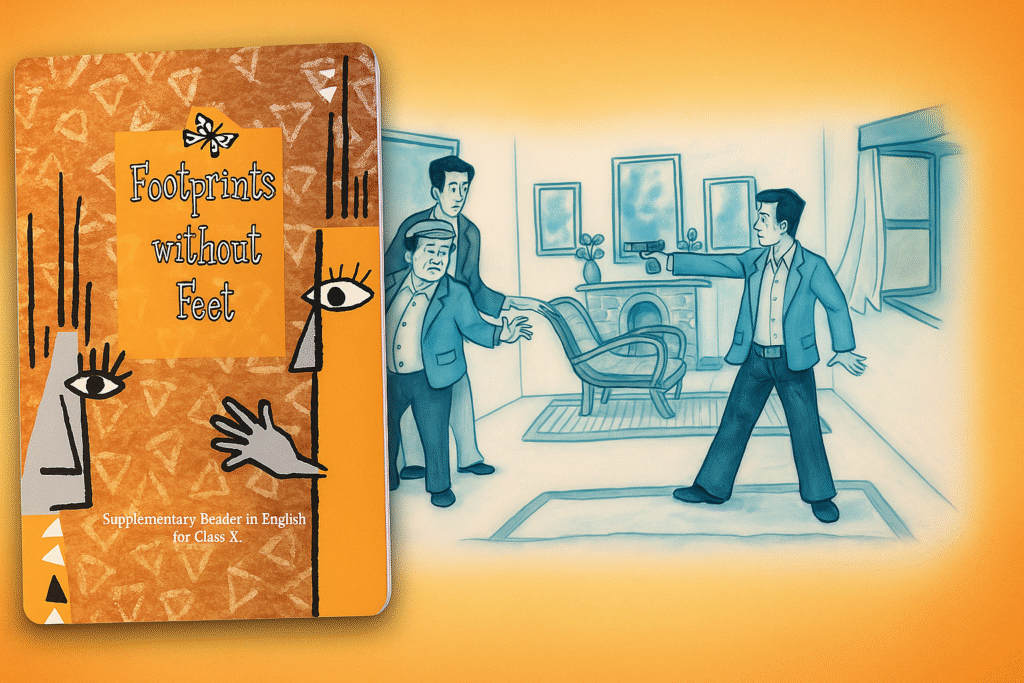
This page provides complete study material for The Midnight Visitor Class 10 NCERT solutions, including a detailed summary, character sketches of Ausable, Fowler, and Max, and NCERT-style answers to all important questions. You’ll find explanations of key themes and moral lessons, including the presence of mind concept, plus an analysis of the clever balcony trick that forms the story’s turning point. Whether you need last-minute exam questions, character analysis for essays, or a thorough understanding of plot and meaning, this comprehensive guide covers everything from Footprints Without Feet to help you prepare confidently for your board exams.
Table of Contents
midnight visitor summary
English Summary
Have you ever imagined a spy as bold, slim, and dangerous—and then met someone who looks nothing like that? You’re about to step into a quiet hotel room where danger arrives silently at midnight. One wrong move here can mean life or death.
This chapter shows how an ordinary-looking secret agent faces a sudden threat in his hotel room. A dangerous rival comes to steal an important report, but the agent escapes using quick thinking instead of force.
The story begins in a gloomy French hotel in Paris, where Ausable, a secret agent, walks down a musty corridor with Fowler, a young writer. Fowler feels deeply disappointed. Ausable is very fat, slow-moving, and wheezes when he speaks. His room is small and dull, not at all the exciting place Fowler expected for a spy. Fowler had imagined “mysterious figures in the night” and danger, but instead he spent a boring evening with a man who only received an ordinary phone call. Ausable clearly understands Fowler’s disappointment and gently teases him about it. Still, he hints that something important is about to happen because he is expecting a very secret and valuable report that could even “affect the course of history.”
As Ausable switches on the light in his room, the night suddenly turns dangerous. Fowler gets his first real thrill when he sees a man standing in the room with a pistol. The man is Max, another secret agent. He looks calm and clever, more like a fox than a criminal. Max calmly demands the secret report about new missiles that is supposed to arrive that night. He says it will be safer with him. Ausable does not panic. Instead, he complains angrily that someone has entered his room again through the balcony. This surprises Max. He says he used a passkey and did not know about any balcony. Ausable then explains in detail that the balcony belongs to the next room and runs under his window. He says someone used it once before and the hotel management promised to block it off but never did.
Max forces Fowler to sit down and says they will wait for half an hour. Just then, there is a loud knock on the door. Fowler jumps in fear. Ausable stays calm and smiles. He says the police are at the door because he arranged for extra protection for the important report. He adds that if he does not open the door, the police will break in and shoot. Max becomes nervous and angry. Trapped between the door and the gunshots he imagines, he chooses to escape. He climbs out of the window, planning to hide on the balcony. As the door opens, Max drops down—and suddenly screams as he falls.
The door opens, but it is not the police. It is Henry, a waiter, carrying drinks that Ausable had ordered earlier. Fowler is shocked and confused. Ausable calmly explains that there were no police at all. When Fowler worries about Max returning from the balcony, Ausable reveals the truth. There was never any balcony. The whole story was a clever trick. Max believed it, jumped out, and fell to his end. Fowler finally understands how Ausable survives in the dangerous world of spies—not with strength, but with sharp intelligence and perfect timing.
Ausable – calm and intelligent – a secret agent who defeats danger using presence of mind
Fowler – curious and romantic – a writer who witnesses real espionage for the first time
Max – clever but overconfident – a rival spy who is tricked into defeat
The central message is that you do not need muscles or weapons to defeat danger. Presence of mind and calm thinking can save you even in the most dangerous situations.
midnight visitor Hindi summary
क्या तुमने कभी किसी जासूस की कल्पना बहादुर, पतला और खतरनाक रूप में की है—और फिर ऐसे व्यक्ति से मिले हो जो बिल्कुल वैसा न दिखता हो? तुम एक शांत होटल के कमरे में कदम रखने वाले हो, जहाँ आधी रात को चुपचाप खतरा आ जाता है। यहाँ एक भी गलत कदम जीवन और मृत्यु का फर्क बन सकता है।
यह अध्याय दिखाता है कि साधारण-सा दिखने वाला एक गुप्त एजेंट अपने होटल के कमरे में अचानक आए खतरे का सामना कैसे करता है। एक खतरनाक दुश्मन एक महत्वपूर्ण रिपोर्ट चुराने आता है, लेकिन एजेंट ताकत नहीं, बल्कि तेज़ दिमाग से बच निकलता है।
कहानी पेरिस के एक उदास फ्रांसीसी होटल से शुरू होती है, जहाँ ऑसाबल, एक गुप्त एजेंट, फाउलर, एक युवा लेखक, के साथ एक बासी और अँधेरे गलियारे से गुजरता है। फाउलर बहुत निराश महसूस करता है। ऑसाबल बहुत मोटा है, धीरे चलता है, और बोलते समय उसकी साँस फूलती है। उसका कमरा छोटा और नीरस है, बिल्कुल वैसा नहीं जैसा फाउलर ने किसी जासूस के लिए सोचा था। फाउलर ने “रात में रहस्यमयी परछाइयाँ” और खतरे की कल्पना की थी, लेकिन इसके बजाय उसने एक उबाऊ शाम ऐसे आदमी के साथ बिताई जिसे सिर्फ़ एक साधारण फोन कॉल मिला। ऑसाबल फाउलर की निराशा को साफ़ समझता है और हल्के-फुल्के अंदाज़ में उसे चिढ़ाता है। फिर भी, वह इशारा करता है कि कुछ खास होने वाला है, क्योंकि वह एक बहुत ही गुप्त और कीमती रिपोर्ट का इंतज़ार कर रहा है, जो “इतिहास की दिशा को प्रभावित कर सकती है।”
जैसे ही ऑसाबल अपने कमरे की बत्ती जलाता है, रात अचानक खतरनाक हो जाती है। फाउलर को दिन का पहला असली रोमांच तब मिलता है जब वह कमरे में एक आदमी को पिस्तौल पकड़े खड़ा देखता है। वह आदमी मैक्स है, एक और गुप्त एजेंट। वह शांत और चालाक दिखता है, किसी अपराधी से ज़्यादा लोमड़ी जैसा। मैक्स शांति से नई मिसाइलों से जुड़ी उस गुप्त रिपोर्ट की माँग करता है, जो उसी रात आने वाली है। वह कहता है कि रिपोर्ट उसके पास ज़्यादा सुरक्षित रहेगी। ऑसाबल घबराता नहीं। इसके बजाय, वह गुस्से में शिकायत करता है कि कोई फिर से बालकनी के रास्ते उसके कमरे में घुस आया है। यह सुनकर मैक्स चौंक जाता है। वह कहता है कि उसने पास-की से प्रवेश किया और उसे किसी बालकनी के बारे में पता नहीं था। तब ऑसाबल विस्तार से बताता है कि बालकनी बगल के कमरे की है और उसकी खिड़की के नीचे से गुजरती है। वह कहता है कि पहले भी कोई वहाँ से आया था और होटल प्रबंधन ने उसे बंद करने का वादा किया था, लेकिन कभी किया नहीं।
मैक्स फाउलर को बैठने के लिए मजबूर करता है और कहता है कि वे आधा घंटा इंतज़ार करेंगे। तभी दरवाज़े पर ज़ोर से दस्तक होती है। फाउलर डर के मारे उछल पड़ता है। ऑसाबल शांत रहता है और मुस्कराता है। वह कहता है कि दरवाज़े पर पुलिस है, क्योंकि उसने उस महत्वपूर्ण रिपोर्ट के लिए अतिरिक्त सुरक्षा का इंतज़ाम किया है। वह जोड़ता है कि अगर वह दरवाज़ा नहीं खोलेगा, तो पुलिस अंदर घुस आएगी और गोली चला देगी। मैक्स घबरा जाता है और गुस्से से भर जाता है। दरवाज़े और अपनी कल्पना में चलती गोलियों के बीच फँसा हुआ, वह भागने का फैसला करता है। वह खिड़की से बाहर चढ़ता है, बालकनी में छिपने की योजना बनाता है। जैसे ही दरवाज़ा खुलता है, मैक्स नीचे कूदता है—और गिरते ही अचानक चीख पड़ता है।
दरवाज़ा खुलता है, लेकिन वहाँ पुलिस नहीं होती। वहाँ हेनरी होता है, एक वेटर, जो वे पेय लाया है जिन्हें ऑसाबल ने पहले मँगवाया था। फाउलर हैरान और उलझन में पड़ जाता है। ऑसाबल शांति से बताता है कि पुलिस कभी थी ही नहीं। जब फाउलर मैक्स के बालकनी से लौट आने की चिंता करता है, तो ऑसाबल सच्चाई बता देता है। वहाँ कोई बालकनी थी ही नहीं। पूरी कहानी एक चाल थी। मैक्स ने उस पर भरोसा किया, बाहर कूदा, और अपने अंत तक जा पहुँचा। तब फाउलर समझ जाता है कि ऑसाबल जासूसों की खतरनाक दुनिया में कैसे ज़िंदा रहता है—ताकत से नहीं, बल्कि तेज़ बुद्धि और सही समय से।
ऑसाबल – शांत और बुद्धिमान – ऐसा गुप्त एजेंट जो सूझ-बूझ से खतरे को हराता है
फाउलर – जिज्ञासु और रोमांटिक – एक लेखक जो पहली बार असली जासूसी देखता है
मैक्स – चालाक लेकिन आत्मविश्वास से भरा – एक प्रतिद्वंद्वी जासूस जो चाल में फँस जाता है
कहानी का मुख्य संदेश यह है कि खतरे को हराने के लिए ताकत या हथियार ज़रूरी नहीं होते। अगर तुम शांत रहो और सही समय पर सही सोच सको, तो सबसे खतरनाक हालात से भी बच सकते हो।
midnight visitor Keywords and meanings:
- Ausable – clever secret agent who stays calm
- Fowler – young writer seeking real thrill
- Max – rival spy with a pistol
- Hotel – gloomy French building setting
- Sixth floor – top-floor room location
- Corridor – musty hallway to the room
- Window – place Max tries to escape
- Balcony – fake ledge Ausable invents
- Passkey – master key used to enter
- Report – secret paper on missiles
- Missiles – new weapons in the report
- Police – bluff to scare Max
- Waiter – Henry brings ordered drink
- Twelve-thirty – time of the appointment
- Thirty-one minutes – countdown to delivery
- Scream – Max’s cry as he falls
- Bluff – smart lie to trap Max
- Presence of mind – quick, calm thinking in danger
- Espionage – spying work between agents
- American accent – Ausable’s Boston speech hint
- Music hall – earlier dull evening place
- Management – hotel staff Ausable blames
- Living room – old suite room with balcony
- Empty room – access point “two doors down”
- Automatic pistol – weapon in Max’s hand
midnight visitor Important Phrases
- “Ausable did not fit any description of a secret agent”
- “musty corridor of the gloomy French hotel”
- “small room, on the sixth and top floor”
- “You are disappointed”
- “espionage and danger”
- “the crack of pistols, drugs in the wine”
- “a quite important paper”
- “affect the course of history”
- “a small automatic pistol in his hand”
- “Max, you gave me quite a start”
- “The report that is being brought to you tonight concerning some new missiles”
- “raise the devil with the management”
- “that nuisance of a balcony”
- “It’s not my balcony… It belongs to the next apartment.”
- “You can get onto it from the empty room two doors down”
- “Please sit down”
- “We have a wait of half an hour, I think.”
- “Thirty-one minutes”
- “That will be the police”
- “a little extra protection”
- “they will not hesitate to shoot”
- “Send them away! I’ll wait on the balcony.”
- “Mr Ausable! Mr Ausable!”
- “he screamed once, shrilly”
- “Here is the drink you ordered for when you returned”
- “There were no police.”
- “there is no balcony.”
the midnight visitor question answer
Text based questions and answers
Q1. How is Ausable different from other secret agents?
Answer: Ausable is different because he does not look like a typical secret agent. He is very fat and has an American accent despite living in Paris for twenty years. Unlike the usual image of secret agents as fit and mysterious, Ausable appears ordinary and unthreatening. This helps him stay unnoticed, showing that appearance can be deceptive. This teaches that true skill is more important than looks.
Q2. Who is Fowler and what is his first authentic thrill of the day?
Answer: Fowler is a man who reads about secret agents but is disappointed when he meets Ausable because Ausable looks ordinary. Fowler’s first authentic thrill of the day happens when he follows Ausable, expecting excitement but finding none at first. This shows how expectations can differ from reality. It also prepares readers for the story’s surprising events.
Q3. How has Max got in?
Answer: Max has sneaked into the hotel room by surprising Ausable. He is a dangerous secret agent who threatens Ausable with a pistol, demanding a report. Max’s unexpected entry creates tension and danger in the story. It reminds us that threats can arrive suddenly, requiring quick thinking.
Q4. How does Ausable say he got in?
Answer: Ausable says he got into the room like any respectable guest, by registering at the hotel desk and taking the stairs up to his room. This calm and ordinary explanation contrasts with Max’s aggressive behavior. It shows Ausable’s cleverness in masking the danger with normality, making Max underestimate him.
Text based questions and answers
Q1. “Ausable did not fit any description of a secret agent Fowler had ever read.” What do secret agents in books and films look like, in your opinion? Discuss in groups or in class some stories or movies featuring spies, detectives and secret agents, and compare their appearance with that of Ausable in this story.
Answer: Secret agents in books and films usually look smart, fit, and mysterious, wearing stylish clothes and acting bravely, like James Bond or Sherlock Holmes. Ausable is different because he looks ordinary and fat, which surprises Fowler. This contrast shows that appearances can be misleading and cleverness matters more than looks. It teaches that real courage and skill are not always obvious.
Q2. How does Ausable manage to make Max believe that there is a balcony attached to his room? Look back at his detailed description of it. What makes it a convincing story?
Answer: Ausable describes the imaginary balcony with great detail, mentioning flowers and a decent view, which makes it feel real to Max. He speaks confidently and calmly, painting a vivid picture. This convinces Max because we tend to believe someone who seems sure about what they say. It shows how confidence and detail can trick people, helping Ausable save himself.
Q3. Looking back at the story, when do you think Ausable thought up his plan for getting rid of Max? Do you think he had worked out his plan in detail right from the beginning? Or did he make up a plan taking advantage of events as they happened?
Answer: Ausable likely did not have a full plan from the start but created it quickly as events unfolded. His calm thinking and quick wit helped him adapt to danger. When Max entered, Ausable used his smart ideas right away, such as inventing the balcony and alerting the police. This shows how staying calm and thinking on your feet can help in emergencies.
Q4. In this story, Ausable shows great ‘presence of mind,’ or the ability to think quickly, and act calmly and wisely, in a situation of danger and surprise. Give examples from your own experience, or narrate a story, which shows someone’s presence of mind.
Answer: Presence of mind means staying calm and acting wisely in sudden danger. For example, if a small fire starts in the kitchen, turning off the gas and using a fire extinguisher quickly can stop it from spreading. Ausable’s quick thinking saved him from Max. Being prepared mentally helps us respond better to emergencies, boosting our confidence and safety.
Q5. Discuss what you would do in the situations described below. Remember that presence of mind comes out of a state of mental preparedness. If you have thought about possible problems or dangers, and about how to act in such situations, you have a better chance of dealing with such situations if they do arise.
1.A small fire starts in your kitchen.
Answer: Quickly turn off the gas or electricity and use a fire extinguisher or water if safe. Call for help if needed.
2.A child starts to choke on a piece of food.
Answer: Encourage the child to cough, and if it doesn’t help, perform the Heimlich maneuver or call for medical help.
3.An electrical appliance starts to hiss and gives out sparks.
Answer: Unplug the appliance immediately and switch off the power supply if possible. Avoid touching it directly.
4.A bicycle knocks down a pedestrian.
Answer: Check if the person is hurt and call for medical assistance. Help keep them calm and safe until help arrives.
5.It rains continuously for more than twenty-four hours.
Answer: Stay indoors, avoid flooded areas, and keep emergency supplies ready like food and water.
6.A member of your family does not return home at the usual or expected time.
Answer: Try contacting them by phone and inform neighbors or friends. If no response, notify the police.
Midnight visitor Grammar
Do as directed:
- Ausable did not fit any description of a secret agent Fowler had ever read. (Change the verb form to simple present to state a general fact) Do as directed.
- Fowler felt let _____ as he followed Ausable down the musty corridor of the gloomy French hotel. (Fill in with a suitable preposition) Do as directed.
- “You are disappointed,” Ausable said wheezily over his shoulder. (Change into indirect speech) Do as directed.
- It was a small room, on the sixth and top floor. (Change to a yes/no question beginning with “Was…?”) Do as directed.
- Though he spoke French and German passably, he had never altogether lost the American accent. (Rewrite using the modal “still” to show continued state) Do as directed.
- Instead of having messages slipped into his hand by dark-eyed beauties, he got a prosaic telephone call making an appointment in his room. (Change to passive voice for the underlined clause: “dark-eyed beauties slipped messages into his hand.”) Do as directed.
- “Max,” he wheezed, “you gave me quite a start. I thought you were in Berlin.” (Convert to indirect speech in one sentence) Do as directed.
- Max was slender, a little less than tall, with features that suggested the crafty, pointed countenance of a fox. (Rewrite using a comparative degree for “crafty” between Max’s features and those of a fox) Do as directed.
- “The report that is being brought to you tonight concerning some new missiles.” (Begin with: He murmured that…) Do as directed.
- Somebody has got into my room through that nuisance of a balcony. (Change to passive voice) Do as directed.
- It’s not my balcony; it belongs to the next apartment. (Combine the sentences using a relative pronoun) Do as directed.
- “We have a wait of half an hour, I think,” Max said. (Replace the underlined idea with a modal to express future expectation/necessity) Do as directed.
- “That will be the police,” he said. (Rewrite to express possibility using “might”) Do as directed.
- If I do not answer the door, they will enter anyway. (Rewrite using “unless” without changing the meaning) Do as directed.
Editing (Error spotting): Underline and correct one error in each line. Do as directed.
a) The waiter set the tray on table and uncorked the bottle.
b) White-faced, Fowler stare after him.
c) There were no police; only Henry was expect.
16. Omission (Missing words): One word is missing in each line; write the word before/after/inserted. Do as directed.
Ausable said that such an important paper _____ a little extra protection.
He said he _____ them to check on him to make sure everything was all right.
Max bit his lip _____ the knocking was repeated.
17. Gap Filling (Cloze): Fill each blank with one suitable word. Do as directed.
Ausable moved to an armchair and sat _____ heavily. He said he was going to raise the devil _____ the management because somebody had got _____ his room through that nuisance of a balcony. He explained that it was not his balcony; it _____ to the next apartment.
18. Transformation (Negative to affirmative without changing meaning): “Send them away or I’ll shoot and take my chances!” (Rewrite as a negative imperative) Do as directed.
Here are the answers to the grammar questions
1. does not fit
2.down
3.Ausable said wheezily that he was disappointed.
4.Was it a small room on the sixth and top floor?
5.He still had not altogether lost the American accent.
6.Messages were slipped into his hand by dark-eyed beauties.
7.He wheezed that Max had given him quite a start and that he had thought Max was in Berlin.
8.Max’s features were craftier than those of a fox.
9.He murmured that the report was being brought to him that night concerning some new missiles.
10.My room has been got into through that nuisance of a balcony.
11. It is not my balcony which/that belongs to the next apartment.
12.We will have to wait about half an hour. / We should wait about half an hour.
13.He said that might be the police.
14.They will enter anyway unless I answer the door.
15.a) on table → on the table; b) stare → stared; c) expect →expected
16.needed; had told; as
17.down; with; into; belonged
18.Do not keep them here, or I’ll shoot and take my chances. / Do not refuse to send them away.
Midnight visitor Short answer (30–40 words)
Q1. Who was Fowler, and why was he disappointed at first?
Answer : Fowler was a young writer who came to see the exciting life of a spy, but he found Ausable fat, sloppy, and ordinary, and spent a dull evening in a music hall, so he felt let down.
Q2.How was Ausable different from the usual image of secret agents?
Answers :Ausable was very fat, spoke with an American accent, and lived in a small, gloomy hotel room; he did not match the glamorous, dangerous spy image Fowler expected from books and films.
Q3.What gave Fowler his first “authentic thrill” of the day?
Answer :When the lights came on in Ausable’s room, Fowler saw a man, Max, standing with a small automatic pistol in his hand, which shocked and thrilled him.
Q4.Why had Max come to Ausable’s room?
Answer :Max came to take the report about new missiles that was being brought to Ausable that night, saying it would be safer in his own hands.
Q5.What story did Ausable tell about the balcony?
Answer :Ausable said the room once belonged to a larger suite and the balcony now ran under his window from the next apartment; someone had even used it last month, and the management had not yet blocked it off.
Q.6 Why did Max decide to wait on the “balcony”?
Answer :Hearing the knocking and believing Ausable’s claim, “That will be the police,” Max panicked and backed to the window to hide on the balcony till they went away.
Q.7 Who actually came to the door and why?
Answe :It was Henry, the waiter, bringing the drink Ausable had ordered for his return; Ausable had been expecting him, not the police.
Q8.How did Ausable finally outwit Max?
Answer:By calmly inventing the balcony and the police, Ausable tricked Max into jumping out of the window to the non-existent balcony, leading to his fall.
Midnight visitor Long answer (100–120 words)
9. How does Ausable show presence of mind in the story?
- Ausable remains calm when Max appears with a gun.
- He invents a convincing story about a balcony.
- He gives clear details to make it believable.
- He pretends the police are at the door.
- He uses Max’s fear to force him to escape.
- His plan requires no weapons or force.
- The trick works perfectly and saves lives.
- His intelligence defeats a dangerous enemy.
10. Give a character sketch of Ausable.
- Ausable looks ordinary and unfit.
- He is fat and wheezes while speaking.
- He does not panic in danger.
- He thinks quickly and speaks confidently.
- He uses words as his weapon.
- He plans cleverly under pressure.
- His calm nature hides sharp intelligence.
- He is a true secret agent by mind, not appearance.
11. How is Fowler different from Ausable?
- Fowler is young, romantic, and imaginative.
- He expects thrill and action.
- He is nervous and easily frightened.
- Ausable is calm and experienced.
- Fowler reacts emotionally to danger.
- Ausable controls the situation wisely.
- Fowler learns what real espionage is.
12. Explain how Ausable trapped Max without violence.
- He invented the balcony story.
- He complained about hotel management.
- He pretended to call the police.
- He frightened Max with gunfire threats.
- Max believed everything.
- He jumped out of the window.
- Ausable never used physical force.
Midnight visitor Extract-based questions
Extract 1:
“And as the light came on, Fowler had his first authentic thrill of the day. For halfway across the room, a small automatic pistol in his hand, stood a man.”
Q1.Who is the man, and what does he want?
Ans.The man is Max, another secret agent, who wants to take the missile report being brought to Ausable that night.
Q2.How does Ausable react to seeing him?
Ans.Ausable stays calm, addresses him by name, and begins guiding the conversation with questions and a firm tone.
Extract 2:
“This is the second time in a month that somebody has got into my room through that nuisance of a balcony!”
Q1.Why does this line sound convincing to Max?
Ans. It adds history and detail—“second time in a month”—and ties to a specific feature, making the balcony feel like a real security problem.
Q2. What truth about the room does Ausable mention to support this?
Ans.He says the room used to be part of a larger unit, the next room had the balcony, and it now extends under his window.
Extract 3:
“‘That will be the police,’ he said. ‘I thought that such an important paper … should have a little extra protection.’”
Q1. What effect does this have on Max?
Ans.Max panics, bites his lip, and backs to the window, deciding to hide on the balcony.
Q2.Who actually arrives at the door?
Ans.Henry, the waiter, with a tray, a bottle, and two glasses for the drink Ausable ordered.
Midnight visitor Additional short answers (30–40 words)
Q1. What time was the appointment for the report, and how does Ausable use this detail?
Ans. The appointment was for twelve-thirty; Ausable says “Thirty-one minutes,” adding precision that makes his story about police protection more believable.
Q2. Describe Max’s appearance and how it contrasts with his actions.
Ans. Max is slender, slightly less than tall, with fox-like features; though armed, he appears less menacing and is easily unsettled by Ausable’s calm lies.
Q3.What is the twist ending of the story?
Ans. After Max jumps to the “balcony,” Ausable reveals to Fowler that there is no balcony, proving his entire story was a clever trap.

FAQs
Q1: Who are Ausable and Fowler, and how do they differ from typical spy characters?
A: Ausable is a calm, clever secret agent who looks ordinary and speaks with an American accent; Fowler is a young writer who expects glamour. The chapter shows that real espionage depends on presence of mind and wit, not on flashy looks or action.
Q2: Why did Max come to Ausable’s room at midnight, and what was he after?
A: Max, an enemy agent with a pistol, broke in to steal an important missile report due at twelve-thirty. He believed taking the report would give his side a strategic advantage.
Q3: How did Ausable trick Max into believing there was a balcony?
A: Ausable told a detailed story about a leftover balcony and the room’s former suite to make the idea believable. His calm confidence and precise timing (saying “thirty-one minutes,” hinting at police arrival) made Max accept the bluff.
Q4: Who knocked at the door, and how did that moment help Ausable?
A: It was Henry, the waiter, bringing Ausable’s drink — not the police. The knocking, timed by Ausable, created the illusion of backup and pressured Max into a panicked decision.
Q5: Why did Max jump out of the window, and what was the outcome?
A: Believing Ausable’s bluff about the balcony and fearing the “police,” Max tried to get onto the imagined ledge and fell. The twist reveals that there was no balcony, so Max’s panic caused his own downfall.
Q6: What does the story teach about “presence of mind”?
A: Presence of mind means staying calm and thinking quickly under pressure. Ausable’s composed lies and precise language turned a violent threat into a non-violent victory, highlighting mental skill over force.
Q7: Was Ausable’s trick ethical? How should students view it?
A: The story presents Ausable’s bluff as a clever, non-violent way to stop danger. For exam answers, focus on the theme: intelligence and calm judgment can neutralize threats, and appearances can be misleading.
Q8: How does the gloomy hotel setting add to the suspense of the chapter?
A: The musty corridor, top-floor room and the midnight timing create a tense atmosphere that amplifies fear and surprise — making Ausable’s quiet, logical strategy even more dramatic and effective.