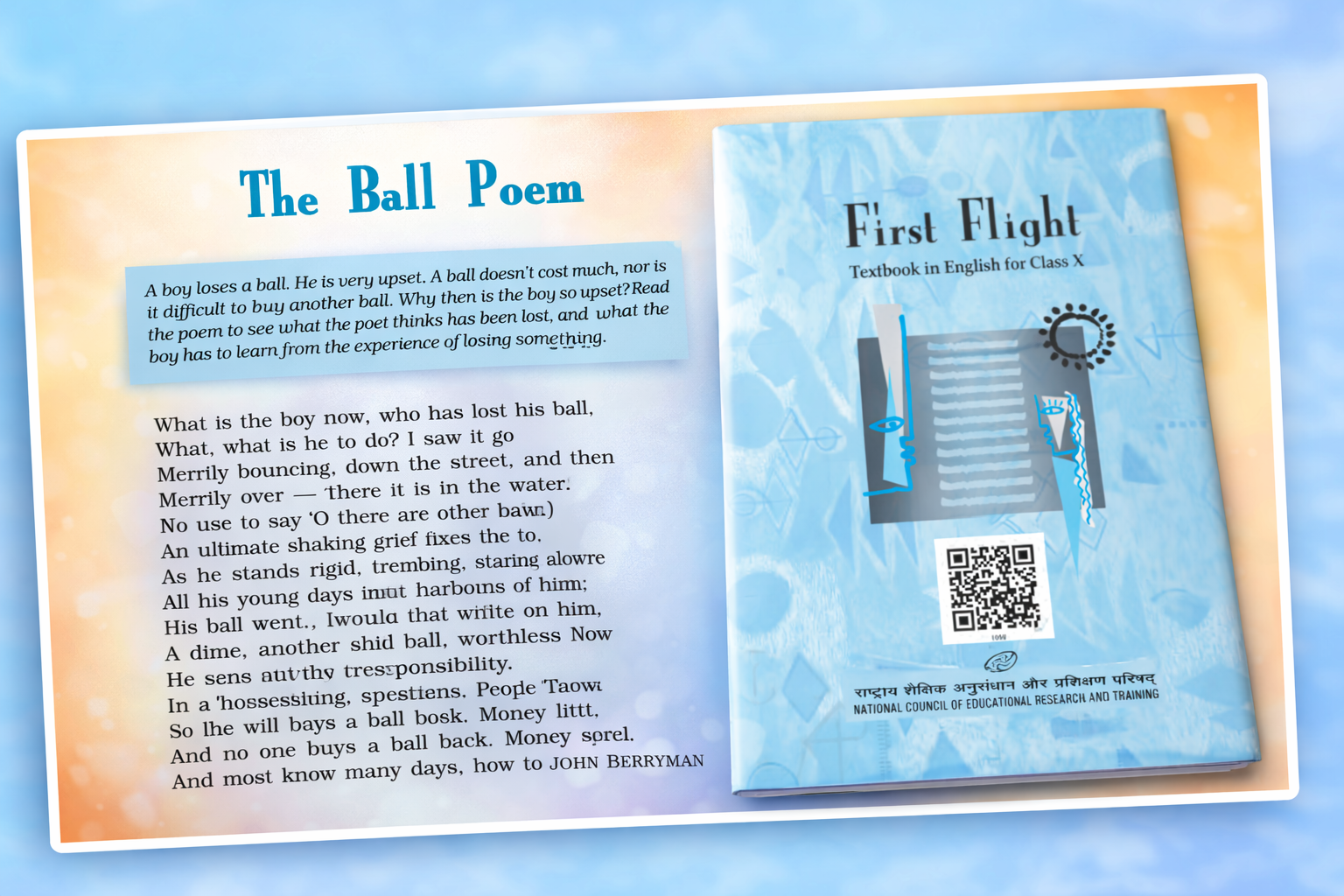

This page helps students understand the poem clearly and prepare confidently for exams. The ball poem summary is explained in simple language within the first section, followed by detailed question answers based on the NCERT pattern. Students will also find the ball poem questions and answers, important notes on theme and message, and the ball poem extra questions and answers for better practice. Written for Class 10 CBSE learners, the content also explains the poem by John Berryman, key ideas, and exam-focused points to support quick revision and accurate answers.
Table of Contents
the ball poem summary
English summary
Have you ever watched something you love disappear right in front of your eyes, knowing you cannot get it back? Imagine standing still, helpless, as it slips away forever. That is exactly where this poem begins—with one small loss that suddenly feels very big.
The poem shows a young boy who loses his ball in the harbour and feels deep, shaking grief. Though the ball can be replaced, the loss teaches him something more important. By the end, the boy begins to understand responsibility, loss, and how the world of possessions truly works.
The poem opens with a simple but painful moment. A boy loses his ball while playing. The poet asks, “What is the boy now, who has lost his ball, / What, what is he to do?” The ball is seen “merrily bouncing, down the street” and then suddenly it goes “over—there it is in the water!” The moment is quick and final. The boy watches as his ball disappears into the harbour, and there is nothing he can do to stop it. The cheerful movement of the ball makes the loss feel sharper, because happiness turns into sadness in seconds.
At first, it may seem like a small problem. Someone could easily say, “O there are other balls.” But the poet clearly says this will not help. The boy feels an “ultimate shaking grief” that freezes him where he stands. He is “rigid, trembling, staring down” into the harbour. He is not just looking at the water; he is looking at “all his young days” connected to that ball. The ball is linked to his memories of play, joy, and childhood. That is why the loss hurts so deeply. The poet chooses not to disturb the boy and says, “I would not intrude on him.” Offering “a dime” or money for another ball would be “worthless” at this moment.
As the boy stands silently, something important changes inside him. This is the first time he truly feels responsibility “in a world of possessions.” He begins to understand that things people own can be lost forever. The poet explains gently that “People will take / Balls, balls will be lost always.” Loss is not rare—it is part of life. No one can buy back the exact same thing once it is gone. The line “Money is external” shows that money cannot replace feelings, memories, or learning.
By the end of the poem, the boy is learning a hard but necessary lesson. Behind his “desperate eyes,” he is learning “the epistemology of loss.” This means he is learning what it truly means to lose something and how to face that pain. The poet says this is something “every man must one day know.” The boy is learning how to stand up again after loss. Though the poem ends quietly, the moment marks the boy’s step out of innocence and into emotional maturity.
Boy – sensitive and young – experiences loss and emotional growth
Poet (speaker) – observant and understanding – explains the boy’s inner learning
This poem teaches you that loss is a part of life and cannot always be fixed with money. It shows that growing up means learning to accept loss and stand strong again. You learn that some experiences, though painful, help you understand life better and make you mature.
the ball poem Hindi Summary
क्या तुमने कभी अपनी आँखों के सामने अपनी किसी प्यारी चीज़ को गायब होते देखा है, यह जानते हुए कि वह वापस नहीं आ सकती? ज़रा सोचो, तुम बिल्कुल स्थिर खड़े हो, बेबस, और वह हमेशा के लिए फिसल कर दूर चली जाती है। यही वह जगह है जहाँ यह कविता शुरू होती है—एक छोटे से नुकसान से, जो अचानक बहुत बड़ा लगने लगता है।
यह कविता एक छोटे लड़के को दिखाती है, जो बंदरगाह (harbour) में अपनी गेंद (ball) खो देता है और गहरे, झकझोर देने वाले दुःख में डूब जाता है। हालाँकि गेंद को बदला जा सकता है, लेकिन यह नुकसान उसे कुछ और ज़्यादा महत्वपूर्ण सिखाता है। अंत तक पहुँचते-पहुँचते, लड़का ज़िम्मेदारी, नुकसान और चीज़ों की दुनिया (world of possessions) को सच में समझना शुरू कर देता है।
कविता की शुरुआत एक साधारण लेकिन दर्दनाक पल से होती है। खेलते समय एक लड़का अपनी गेंद खो देता है। कवि पूछता है, “अब वह लड़का क्या है, जिसने अपनी गेंद खो दी है, / वह क्या करे?” गेंद को “खुशी-खुशी सड़क पर उछलते हुए” देखा जाता है और फिर अचानक वह “ऊपर से—लो, वह पानी में है!” यह पल बहुत तेज़ और अंतिम है। लड़का देखता रहता है कि उसकी गेंद बंदरगाह में गायब हो जाती है, और उसे रोकने के लिए वह कुछ भी नहीं कर सकता। गेंद की खुशी भरी चाल इस नुकसान को और तीखा बना देती है, क्योंकि कुछ ही सेकंड में खुशी दुःख में बदल जाती है।
पहली नज़र में यह एक छोटी सी समस्या लग सकती है। कोई भी आसानी से कह सकता है, “अरे, और भी गेंदें हैं।” लेकिन कवि साफ़ कहता है कि इससे कोई फ़ायदा नहीं होगा। लड़का “अंतिम झकझोर देने वाले दुःख” को महसूस करता है, जो उसे वहीं जमा देता है। वह “जकड़ा हुआ, काँपता हुआ, नीचे देखता हुआ” बंदरगाह की ओर खड़ा है। वह सिर्फ पानी को नहीं देख रहा; वह उस गेंद से जुड़े “अपने सारे बचपन के दिन” देख रहा है। गेंद उसकी खेल, खुशी और बचपन की यादों से जुड़ी है। इसी वजह से यह नुकसान उसे इतना गहरा दर्द देता है। कवि लड़के को परेशान नहीं करना चाहता और कहता है, “मैं उसमें दख़ल नहीं दूँगा।” उस समय “एक डाइम” या दूसरी गेंद के लिए पैसा देना पूरी तरह “बेकार” होता।
जब लड़का चुपचाप खड़ा रहता है, तो उसके भीतर कुछ बहुत महत्वपूर्ण बदलता है। यह पहली बार है जब वह सच में “चीज़ों की दुनिया में ज़िम्मेदारी” महसूस करता है। वह समझने लगता है कि जिन चीज़ों के मालिक लोग होते हैं, वे हमेशा के लिए खो भी सकती हैं। कवि नरमी से समझाता है, “लोग गेंदें ले लेंगे, / गेंदें हमेशा खोती रहेंगी।” नुकसान कोई अनोखी बात नहीं है—यह ज़िंदगी का हिस्सा है। एक बार जो चीज़ चली जाए, बिल्कुल वही चीज़ दोबारा कोई नहीं खरीद सकता। पंक्ति “पैसा बाहरी चीज़ है” यह दिखाती है कि पैसा भावनाओं, यादों या सीख की जगह नहीं ले सकता।
कविता के अंत तक, लड़का एक कठिन लेकिन ज़रूरी सीख ले रहा होता है। उसकी “बेबस आँखों” के पीछे, वह “नुकसान की समझ (epistemology of loss)” सीख रहा है। इसका मतलब है कि वह यह जान रहा है कि कुछ खोने का असली अर्थ क्या होता है और उस दर्द का सामना कैसे किया जाए। कवि कहता है कि यह वह बात है जिसे “हर आदमी को एक दिन जानना ही पड़ता है।” लड़का नुकसान के बाद फिर से खड़े होना सीख रहा है। हालाँकि कविता शांत तरीके से खत्म होती है, लेकिन यह पल उसके मासूमपन से बाहर निकलकर भावनात्मक समझ की ओर बढ़ने का संकेत देता है।
लड़का – संवेदनशील और छोटा – नुकसान झेलता है और भावनात्मक रूप से बढ़ता है
कवि (वक्ता) – ध्यान से देखने वाला और समझदार – लड़के की अंदरूनी सीख को समझाता है
यह कविता तुम्हें सिखाती है कि नुकसान ज़िंदगी का हिस्सा है और हर बार उसे पैसे से ठीक नहीं किया जा सकता। यह दिखाती है कि बड़ा होना मतलब नुकसान को स्वीकार करना और फिर से मज़बूती से खड़ा होना सीखना है। तुम यह भी सीखते हो कि कुछ अनुभव, भले ही दर्दनाक हों, तुम्हें ज़िंदगी को बेहतर समझने और परिपक्व बनने में मदद करते हैं।
the ball poem Keywords with meanings:
boy – young child who loses his ball
ball – toy that bounces away and symbolizes lost childhood
harbour – water where the ball falls, representing irreversible loss
grief – deep sadness that shakes the boy
rigid – stiff and frozen in shock
trembling – shaking from emotion
responsibility – duty to handle loss in life
possessions – things people own that can be taken or lost
epistemology – understanding of loss and knowledge
dime – small amount of money, worthless for true replacement
the ball poem Important Phrases:
What is the boy now, who has lost his ball
Merrily bouncing, down the street
there it is in the water!
O there are other balls
ultimate shaking grief fixes the boy
stands rigid, trembling, staring down
All his young days into the harbour
I would not intrude on him
A dime, another ball, is worthless
world of possessions
balls will be lost always, little boy
Money is external
behind his desperate eyes
epistemology of loss
how to stand up
the ball poem questions and answers
Text based questions and answers
Q1. Why does the poet say, I would not intrude on him? Why doesnt he offer him money to buy another ball?
Answer:The poet says “I would not intrude on him” because the boy’s grief is deep and personal; he respects his space during this emotional moment.
Money or “a dime, another ball, is worthless” since it can’t replace the ball’s emotional value or the life lesson.
This shows true loss needs inner strength, not quick fixes, helping the boy grow on his own.
Q2. … staring down All his young days into the harbour where His ball went Do you think the boy has had the ball for a long time? Is it linked to the memories of days when he played with it?
Answer:Yes, the boy has likely had the ball for a long time, as he stares “all his young days into the harbour” where it went.
The phrase links the ball to his happy play memories, now lost forever in the water.
This gaze shows how one small loss floods back a lifetime of joy, making grief feel endless yet teaching resilience.
Q3. What does in the world of possessions mean?
Answer:” In the world of possessions” means a reality where people own things like balls that can always be lost, taken, or broken.
The poet notes “People will take / Balls, balls will be lost always, little boy,” highlighting life’s unpredictability with belongings.
Understanding this prepares us to face losses without breaking down completely.
Q4. Do you think the boy has lost anything earlier? Pick out the words that suggest the answer.
Answer: No, the boy has not lost anything important earlier, as this is his “first responsibility” moment.
Key words like “senses first responsibility” and “ultimate shaking grief fixes the boy” show this fresh, overwhelming pain.
Such newness makes the lesson stick, turning shock into quiet wisdom for future challenges.
Q5. What does the poet say the boy is learning from the loss of the ball? Try to explain this in your own words.
Answer:The poet says the boy learns “the epistemology of loss, how to stand up,” behind his “desperate eyes.”
In simple words, he’s grasping how to handle irreplaceable losses, knowing “what every man must one day know” about standing strong after grief.
This growth from a toy’s loss builds lifelong courage, like rising after every fall in life.
Q6. Have you ever lost something you liked very much? Write a paragraph describing how you felt then, your loss. and saying whether and how 47 you got over
Answer:Once, I lost my favorite bicycle, a red one I’d ridden everywhere with friends for years. It vanished from outside school, leaving me empty and angry, staring at the empty spot like the boy at his ball in the harbor.
Tears came hard because it held memories of races, adventures, and freedom—gone forever, no money could bring back those rides.
But over time, I got over it by saving for a new one and making fresh memories; the ache faded as I learned, like the boy, to stand up stronger, ready for what life takes next.
the ball poem Grammar (Do as Directed)
Do as directed. (Fill in the blank with the correct past tense form of the verb.)
The boy _____ (lose) his ball.
Do as directed. (Change into passive voice.)
I saw the ball go merrily bouncing down the street.
Do as directed. (Change into indirect speech.)
The poet said, “I would not intrude on him.”
Do as directed. (Fill in the blank with the correct article.)
_____ ultimate shaking grief fixes the boy.
Do as directed. (Fill in the blank with the correct preposition.)
The boy stands rigid _____ the harbour.
Do as directed. (Rewrite using the modal ‘may’ to show possibility.)
People will take balls.
Do as directed. (Change the sentence into a question.)
No one buys a ball back.
Do as directed. (Rewrite in negative form without changing the meaning.)
Money is external.
Do as directed. (Change into superlative degree by adding ‘most’ appropriately.)
The boy is learning the epistemology of loss.
Do as directed. (Combine the two sentences using ‘where’.)
The ball went into the water. The boy stared down.
Do as directed. (Error spotting: subject-verb agreement.)
Find the error in the sentence and correct it:
The boy have lost his ball always.
Do as directed. (Omission: Insert the correct word to complete the meaning.)
Balls _____ lost always in a world of possessions.
Do as directed. (Add a question tag.)
He senses responsibility.
Do as directed. (Join into a complex sentence using ‘who’.)
The poet watched the boy. The boy trembled.
Do as directed. (Change into exclamatory sentence.)
A dime is worthless.
Do as directed. Cloze Test (Gap Filling): Complete the passage with the correct form of verbs/modals/articles from the poem’s context.
The boy _____ (stand) rigid, trembling, as his ball _____ (go) into the harbour. He _____ (learn) that in _____ world of possessions, loss _____ (be) inevitable. _____ poet _____ (not intrude) because money _____ (can/not) replace true grief.
Here are grammar questions answers:
lost
The ball was seen going merrily bouncing down the street by me.
The poet said that he would not intrude on him.
An
by / near
People may take balls.
Does anyone buy a ball back?
Money is not internal.
The boy is learning the most important epistemology of loss.
The boy stared down where the ball went into the water.
have → has
will be
doesn’t he?
The poet watched the boy who trembled.
How worthless a dime is!
Cloze Test: stood / went / is learning / a / is / The / does not / cannot
the ball poem Extra questions and answers
Short Answer Questions
Q1. Who is the speaker in the poem and what does he witness?
Answer:The speaker is the poet who watches the boy lose his ball.
He sees it “merrily bouncing, down the street, and then / Merrily over—there it is in the water!”
This moment starts the boy’s deep grief by the harbour.
Q2. Why is the loss of the ball more than just a toy?
The ball represents the boy’s happy childhood memories and carefree days.
He stares “all his young days into the harbour” where it went, showing emotional attachment.
Replacing it with money can’t bring back those feelings.
Q3. What does the poet mean by “Money is external”?
Answer: Money is outside help that can’t fix inner pain from loss.
“A dime, another ball, is worthless” because it doesn’t heal the heart.
True recovery comes from within, not from buying something new.
Long Answer Questions
Q1. Describe the boy’s reaction to losing the ball and what it teaches him. (100-120 words)
The boy stands “rigid, trembling, staring down” into the harbour after his ball bounces away.
An “ultimate shaking grief fixes the boy” as he pours “all his young days” into the spot where it vanished, linking it to his play memories.
He learns his “first responsibility” in a “world of possessions” where “balls will be lost always” and no one buys them back.
Behind “desperate eyes,” he grasps “the epistemology of loss, how to stand up,” a lesson every person faces.
This turns his shock into strength, preparing him for life’s unavoidable losses.
Q2. Explain the central theme of the poem with examples from the text. (100-120 words)
Answer: The theme is learning to cope with loss and irreplaceable things in life.
The poet refuses to intrude because “a dime, another ball, is worthless,” showing money can’t replace emotional bonds.
In the “world of possessions,” losses happen often—”People will take / Balls, balls will be lost always, little boy.”
The boy senses responsibility and studies “the epistemology of loss,” knowing “what every man must one day know… how to stand up.”
It teaches resilience, turning grief into the power to move forward despite pain.
Extract Based Questions and answers
Extract: “What is the boy now, who has lost his ball, / What, what is he to do? I saw it go”
Q1. What does this extract reveal about the boy’s state of mind?
Answer: The repeated “What” shows confusion and helplessness after the loss.
The poet’s observation highlights the sudden shift from play to despair.
It sets up the boy’s rigid grief by the water.
Extract: “No use to say O there are other balls”
Q1. Why is this advice useless according to the poet?
Other balls can’t replace the memories tied to this one.
The grief is “ultimate shaking,” deeper than a simple purchase.
It stresses the personal pain of true loss.
FAQs
Q1. What is the central theme of The Ball Poem by John Berryman?
The central theme of The Ball Poem is learning to accept loss as a part of life.
Through the boy’s experience, the poet shows how loss leads to emotional maturity and responsibility.
Q2. Why does the boy feel deep grief after losing the ball?
The boy’s grief is intense because the ball is linked to his childhood memories and joy.
It represents more than a toy, so losing it feels like losing a part of his young days.
Q3. What does the ball symbolize in The Ball Poem?
The ball symbolizes the boy’s childhood, innocence, and personal memories.
Its loss represents the first emotional loss that teaches him an important life lesson.
Q4. How does the poet describe the boy’s reaction to the loss?
The poet describes the boy as “rigid” and “trembling,” staring silently into the harbour.
This shows shock, helplessness, and deep emotional pain rather than loud crying.
Q5. What is meant by “first responsibility” in The Ball Poem?
“First responsibility” means the boy’s first real experience of handling loss on his own.
It marks the beginning of understanding life in a world of possessions.
Q6. Why does the poet say money is “external” in the poem?
Money is called external because it cannot heal emotional pain or replace memories.
The poet shows that true loss cannot be solved by buying another object.
Q7. Why does the poet not offer the boy another ball or money?
The poet does not intrude because the boy needs to face the loss himself.
Offering money would weaken the lesson of coping with loss and growing stronger.
Q8. What life lesson does the boy learn from losing the ball?
The boy learns that loss is unavoidable and must be accepted calmly.
This lesson helps him grow emotionally and prepares him for future challenges.
Q9. What is the significance of the harbour in The Ball Poem?
The harbour represents irreversible loss, as the ball can never be recovered.
It highlights how some things, once lost, are gone forever.
Q10. Why is The Ball Poem important from an exam perspective?
The poem is important for exams due to its clear theme, symbolism, and poetic devices.
It frequently appears in Class 10 questions, extracts, and value-based answers.
