
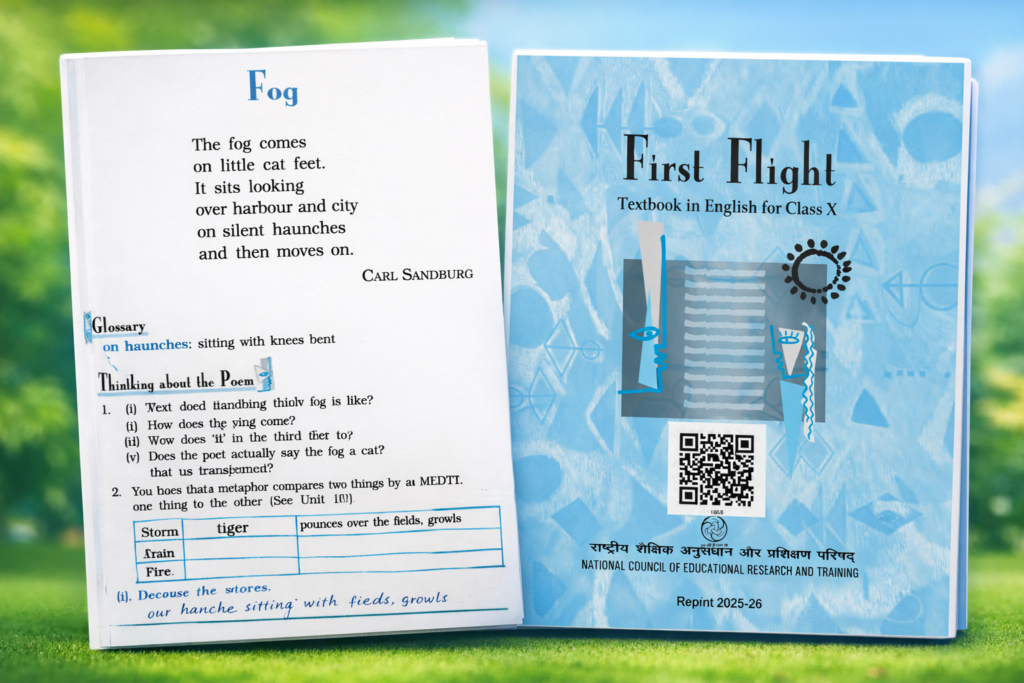
This page helps you revise Fog poem summary Class 10 with clear, exam-focused content in one place. You will find a simple fog class 10 summary, detailed fog class 10 explanation, and fog class 10 questions and answers based on NCERT. It also includes extra questions and answers, word meaning of fog class 10, poetic devices of fog class 10, and the message of fog class 10 for better understanding. Hindi summary support and practice questions make this page useful for quick revision, homework, and board exam preparation.
Table of Contents
fog poem summary
Have you ever seen fog arrive so quietly that you don’t even notice when it comes? You look up, and suddenly the world feels softer, slower, and strangely still. That quiet moment is where this poem begins.
The poem shows how fog enters a city gently and silently, stays for a short time, and then leaves without noise or force. Its arrival and departure are calm and natural, creating a peaceful scene that ends as quietly as it starts.
The poem opens with fog arriving in a way that feels almost secret. It does not rush in or announce itself. Instead, it “comes on little cat feet,” moving so softly that no one hears it. The setting is not a wild place but a harbour and a city, where ships, buildings, and people are usually surrounded by sound and movement. Yet the fog slips into this busy place without disturbing anything. There is no wind pushing it forward and no storm guiding it. It simply appears, calm and steady, covering the surroundings gently.
Once the fog has arrived, it does not move quickly. It pauses and settles down, as if it has chosen a spot to rest. The poet says that it “sits looking over harbour and city.” From this position, the fog seems to observe everything below—boats in the harbour, buildings in the city, and the quiet streets in between. Nothing in the scene reacts loudly to its presence. The fog does not block things suddenly or cause panic. Instead, it creates a moment of stillness, making the familiar city look different and calm.
The fog is described as sitting “on silent haunches.” This shows how still and balanced it is while resting. There is no movement, no sound, and no rush. Time feels slow during this moment. The fog stays just long enough to change the mood of the place. The busy harbour and city are wrapped in quiet, and everything appears softer and less sharp. Then, without warning or explanation, the moment ends. The fog does not fade loudly or disappear suddenly. It simply gets up and “moves on.” Just as quietly as it arrived, it leaves, allowing the harbour and city to return to their usual state.
Characters
Fog – quiet and gentle – the main presence that moves through the city
City – still and watchful – the place covered by fog
Harbour – calm and silent – the area observed by the fog
The poem teaches you that some changes in life happen silently and gently, without force or noise. You learn that not everything arrives with drama or leaves with a signal—some moments simply come, stay briefly, and pass on.
fog poem Hindi summary
क्या तुमने कभी कोहरा इतनी चुपचाप आते देखा है कि उसके आने का पता ही न चले? तुम ऊपर देखते हो, और अचानक दुनिया नरम, धीमी और अजीब-सी शांत लगने लगती है। यही वह शांत पल है, जहाँ से यह कविता शुरू होती है।
यह कविता दिखाती है कि कोहरा कैसे धीरे-धीरे और बिना आवाज़ के शहर में आता है, थोड़ी देर ठहरता है, और फिर बिना किसी शोर या ज़ोर के चला जाता है। उसका आना और जाना दोनों ही शांत और स्वाभाविक हैं, जिससे एक सुकून भरा दृश्य बनता है, जो उसी चुप्पी के साथ खत्म हो जाता है, जैसे शुरू हुआ था।
कविता की शुरुआत कोहरे के ऐसे आगमन से होती है, जो लगभग एक रहस्य जैसा लगता है। वह न तो तेज़ी से आता है और न ही अपने आने की घोषणा करता है। इसके बजाय, वह “छोटे बिल्ली के पाँवों पर आता है,” इतना हल्के से कि किसी को उसकी आहट तक सुनाई नहीं देती। यह जगह कोई जंगल या सुनसान इलाका नहीं है, बल्कि एक हार्बर और एक शहर है, जहाँ आमतौर पर जहाज़ों, इमारतों और लोगों की आवाज़ें और हलचल रहती हैं। फिर भी, कोहरा इस व्यस्त जगह में बिना किसी को परेशान किए फिसलता हुआ आ जाता है। न कोई हवा उसे आगे बढ़ा रही होती है और न कोई तूफ़ान उसका रास्ता बना रहा होता है। वह बस अपने आप प्रकट होता है—शांत और स्थिर—और आसपास की हर चीज़ को हल्के से ढक लेता है।
एक बार जब कोहरा आ जाता है, तो वह जल्दी नहीं हिलता। वह रुकता है और ऐसे बैठ जाता है, जैसे उसने आराम करने के लिए कोई जगह चुन ली हो। कवि कहता है कि वह “हार्बर और शहर को देखते हुए बैठ जाता है।” इस जगह से कोहरा नीचे की हर चीज़ को देखता हुआ लगता है—हार्बर में खड़ी नावें, शहर की इमारतें, और उनके बीच की शांत गलियाँ। दृश्य में कोई भी चीज़ उसकी मौजूदगी पर ज़ोर से प्रतिक्रिया नहीं देती। कोहरा अचानक रास्ते नहीं रोकता और न ही डर या घबराहट पैदा करता है। इसके बजाय, वह एक ठहराव का पल बना देता है, जिससे जाना-पहचाना शहर अलग और शांत दिखाई देने लगता है।
कोहरे को “चुपचाप मुड़ी हुई टाँगों पर बैठा” बताया गया है। इससे पता चलता है कि वह आराम करते समय कितना स्थिर और संतुलित है। न कोई हलचल है, न कोई आवाज़, और न ही कोई जल्दी। इस पल में समय जैसे धीरे-धीरे चलता हुआ महसूस होता है। कोहरा उतनी देर तक ठहरता है कि जगह का माहौल बदल जाए। व्यस्त हार्बर और शहर शांति में लिपट जाते हैं, और हर चीज़ पहले से ज़्यादा मुलायम और कम तेज़ लगने लगती है। फिर, बिना किसी चेतावनी या कारण बताए, वह पल खत्म हो जाता है। कोहरा न तो ज़ोर से छँटता है और न ही अचानक गायब होता है। वह बस उठता है और “आगे बढ़ जाता है।” जैसे वह चुपचाप आया था, वैसे ही चुपचाप चला जाता है, और हार्बर व शहर अपनी सामान्य स्थिति में लौट आते हैं।
कोहरा – शांत और कोमल – शहर में घूमने वाली मुख्य उपस्थिति
शहर – स्थिर और देखने वाला – वह जगह जो कोहरे से ढकी होती है
हार्बर – शांत और निस्तब्ध – वह क्षेत्र जिसे कोहरा देखता है
यह कविता तुम्हें सिखाती है कि जीवन में कुछ बदलाव चुपचाप और धीरे-धीरे होते हैं, बिना किसी ज़ोर या शोर के। तुम समझते हो कि हर चीज़ न तो नाटकीय ढं ग से आती है और न ही किसी संकेत के साथ जाती है—कुछ पल बस आते हैं, थोड़ी देर रुकते हैं, और फिर आगे बढ़ जाते हैं।
fog poem Keywords (with meanings):
Fog – a thick cloud near the ground that reduces visibility
Cat – an animal known for quiet, soft movement
Harbour – a place where ships and boats stay safely
City – a large town with buildings, people, and activity
Silent – without sound or noise
Haunches – bent legs used while sitting
Gentle – soft and calm, not forceful
Quiet – peaceful, without disturbance
Movement – the act of coming, staying, and leaving
Free verse – poetry without a fixed rhyme or rhythm
fog poem Phrases (exact from the text):
“The fog comes”
“on little cat feet”
“It sits looking”
“over harbour and city”
“on silent haunches”
“and then moves on”
fog class 10 questions and answers
Text based questions and answers
Q1. (i) What does Sandburg think the fog is like?
Answer:
• Sandburg thinks the fog is like a cat.
• He compares the fog’s movement and behavior to a cat’s quiet actions.
• The comparison shows softness, silence, and calmness.
• This makes the fog feel gentle and alive in the poem.
Q1. (ii) How does the fog come?
Answer:
• The fog comes silently and slowly.
• It arrives “on little cat feet,” without noise or force.
• No one notices its arrival because it is so quiet.
• This shows the peaceful nature of the fog.
Q1. (iii) What does ‘it’ in the third line refer to?
Answer:
• The word ‘it’ refers to the fog.
• The fog is described as sitting and watching the city.
• This helps the reader imagine fog like a living thing.
• The poem becomes more vivid and clear.
Q1. (iv) Does the poet actually say that the fog is like a cat? Find three things that tell us that the fog is like a cat.
Answer:
• The poet does not directly say the fog is a cat.
• He suggests it through images and actions.
• “On little cat feet” shows silent movement.
• “Sits looking” shows stillness like a resting cat.
• “On silent haunches” shows the cat’s sitting posture.
• These details clearly make the fog seem cat-like.
Q2. (i) Find metaphors and say how they are alike.
Answer:
• Storm – tiger: pounces over fields, growls loudly.
• Train – snake: long body, moves smoothly and steadily.
• Fire – monster: dangerous, powerful, and destructive.
• School – garden: a place where minds grow and learn.
• Home – nest: safe, warm, and full of care.
• Each metaphor transfers qualities from one thing to another.
Q2. (ii) Write a poem about a storm comparing it with an animal.
Answer:
• The storm roars like a lion in the sky.
• It shakes the trees with its heavy steps.
• Thunder is its loud growl, rain its sharp claws.
• Then it rests, leaving the world calm and fresh.
• This shows both the power and peace of a storm.
Q3. Does this poem have a rhyme scheme?
Answer:
• No, the poem does not have a rhyme scheme.
• The lines do not follow any fixed pattern of sound.
• Such poetry is called free verse.
• This style matches the natural, free movement of the fog.
fog poem Grammar Exercises
(Based on the poem “Fog” by Carl Sandburg)
Q1. Fill in the blanks with the correct form of the verb. (Do as directed)
The fog ___ (come/came/comes) quietly into the city.
Q2. Rewrite the sentence in the past tense. (Do as directed)
The fog sits looking over the harbour and city.
Q3. Change the following sentence into the passive voice. (Do as directed)
The fog covers the harbour and the city.
Q4. Change the following sentence into the active voice. (Do as directed)
The city is covered by the fog.
Q5. Rewrite the sentence in indirect (reported) speech. (Do as directed)
The poet says, “The fog comes on little cat feet.”
Q6. Change the following sentence into direct speech. (Do as directed)
The poet said that the fog moved on silently.
Q7. Fill in the blanks with suitable articles. (Do as directed)
The fog comes on ___ little cat feet and sits over ___ harbour.
Q8. Fill in the blanks with suitable prepositions. (Do as directed)
The fog sits looking ___ the harbour and ___ the city.
Q9. Rewrite the sentence using a suitable modal verb. (Do as directed)
The fog moves silently through the city. (Use can)
Q10. Rewrite the sentence as a negative sentence without changing its meaning. (Do as directed)
The fog makes a loud noise.
Q11. Combine the sentences using a suitable conjunction. (Do as directed)
The fog arrives quietly.
It leaves quietly.
Q12. Rewrite the sentence as an interrogative sentence. (Do as directed)
The fog comes silently into the city.
Q13. Correct the error in the sentence. (Do as directed)
The fog come on little cat feet.
Q14. Fill in the blanks by choosing the correct option. (Do as directed)
The fog ___ slowly and then ___ on.
(a) move / sits
(b) moves / sit
(c) moves / sits
Q15. Editing Task – Identify and correct the error. (Do as directed)
The fog sit looking over harbour and city.
Answers for Grammar
A1. comes
A2. The fog sat looking over the harbour and city.
A3. The harbour and the city are covered by the fog.
A4. The fog covers the city.
A5. The poet says that the fog comes on little cat feet.
A6. The poet said, “The fog moved on silently.”
A7. a, the
A8. over, over
A9. The fog can move silently through the city.
A10. The fog does not make a loud noise.
A11. The fog arrives and leaves quietly.
A12. Does the fog come silently into the city?
A13. comes
A14. (c) moves / sits
A15. sit → sits
Extra question answers
Short Answer Questions (30–40 words)
Q1. How does the poet describe the movement of the fog?
Answer:
The fog moves very slowly and silently.
It comes “on little cat feet,” showing soft and quiet movement.
There is no noise or force in its arrival.
This creates a calm and peaceful scene.
Q2. Where does the fog sit according to the poem?
Answer:
The fog sits looking over the harbour and the city.
It rests calmly and quietly.
From there, it seems to observe everything below.
The setting becomes still and peaceful.
Q3. Why does the poet use the word “silent” in the poem?
Answer:
The word “silent” shows that the fog makes no sound.
It highlights the calm and gentle nature of the fog.
The city becomes quiet when the fog appears.
Silence adds to the mood of the poem.
Q4. What happens after the fog sits for some time?
Answer:
After sitting quietly, the fog moves on.
It leaves as silently as it came.
There is no sudden change or noise.
The harbour and city return to normal.
Long Answer Questions (100–120 words)
Q5. Describe how the poet presents fog as a living creature.
Answer:
The poet presents fog as a living creature through personification.
It comes “on little cat feet,” suggesting soft and careful movement.
The fog “sits looking” over the harbour and city, like an animal watching quietly.
The phrase “on silent haunches” shows it resting calmly, like a cat.
Finally, it “moves on,” just as an animal would leave after resting.
These actions make the fog appear alive, gentle, and observant.
The description helps readers imagine fog in a clear and peaceful way.
Q6. Explain the theme of quietness and calm in the poem “Fog”.
Answer:
The main theme of the poem is quietness and calm.
The fog arrives silently, without noise or disturbance.
It covers the busy harbour and city gently.
No one reacts loudly to its presence.
The fog sits peacefully and then leaves quietly.
There is no hurry, force, or drama in its movement.
This shows that some changes in nature happen softly.
The poem creates a soothing and peaceful mood throughout.
Extract-Based Questions
Q7. Read the extract and answer the questions that follow:
“The fog comes
on little cat feet.”
(i) What is being described in these lines?
Answer:
The lines describe the arrival of fog.
The fog comes slowly and silently.
(ii) Which poetic device is used here?
Answer:
A metaphor is used.
The fog is compared to a cat.
(iii) What quality of a cat is given to the fog?
Answer:
The fog is given the quality of silent movement.
It arrives softly without being noticed.
Q8. Read the extract and answer the questions that follow:
“And then moves on.”
(i) What does “moves on” refer to?
Answer:
It refers to the fog leaving the city.
(ii) How does the fog leave?
Answer:
The fog leaves quietly and calmly.
(iii) What does this line tell us about the fog’s nature?
Answer:
It shows the fog is gentle and peaceful.
It does not stay for long or cause disturbance.
FAQs
Q1. Who is the poet of the poem Fog in Class 10, and what inspired the setting?
Carl Sandburg wrote the poem Fog. He uses an urban setting with a harbour and city, showing how nature quietly enters busy human spaces without disturbance.
Q2. Which animal is used as a metaphor for fog, and why is it suitable?
The poet compares fog to a cat. A cat moves silently and gently, just like fog that enters and leaves the city without noise or force.
Q3. What does the word haunches mean in the poem Fog?
Haunches means bent legs while sitting. In the poem, it shows fog resting quietly like a cat sitting calmly and steadily.
Q4. How does the poet describe the movement of fog as it enters the city?
The fog comes on little cat feet, which means it moves very slowly and silently. No one notices its arrival, creating a calm and peaceful scene.
Q5. What are the two places that the fog looks over in the poem?
The fog sits looking over the harbour and the city. These man-made places become quiet and still when covered by fog.
Q6. Why is Fog called a free verse poem in Class 10 English?
Fog has no fixed rhyme scheme or rhythm. This free verse form matches the natural and smooth movement of fog.
Q7. What does the line and then moves on tell us about the fog’s nature?
It shows that fog does not stay for long and leaves as quietly as it comes. This highlights the theme of temporary and gentle change in nature.
Q8. What keywords should students include while writing the central idea of Fog in exams?
Students should mention silent movement, cat metaphor, harbour and city setting, calm mood, and gentle arrival and departure of fog for full marks.
