

I Cannot Remember My Mother Poem Summary
Table of Contents
Have you ever remembered someone through a song, a flower, or the quiet sky? What if a few small moments were all you had to keep someone close to your heart? This touching poem shows how love can stay alive in memories, even when a person is no longer there.
The poet cannot clearly remember his mother because he lost her at a very young age. However, simple sights, sounds, and smells remind him of her again and again. In the end, he feels that her love still surrounds him through nature and his childhood memories.
The poem begins with the poet, Rabindranath Tagore, saying that he cannot clearly remember his mother. He was too young when she passed away, so her face has faded from his memory. Yet, sometimes while he is playing with his toys, a familiar tune seems to float around him. It reminds him of the gentle song his mother used to hum while rocking his cradle. Although he cannot see her, the soft music brings back the feeling of her loving care. The repeated line “I cannot remember my mother” shows both his sadness and the deep place she still holds in his heart.
In the next part of the poem, the poet remembers his mother through the beauty of nature. During the early autumn season, the sweet smell of shiuli flowers fills the air. At the same time, the fragrance from the morning prayers in the temple reaches him. These gentle smells remind him of his mother’s presence. He does not describe her face or voice directly. Instead, he connects her with peaceful and beautiful experiences around him. The poet feels that these natural scents carry the warmth and purity of her love. The image of the flowers and the temple creates a calm and emotional atmosphere. It shows how memories can return through the simple things we experience every day.
In the final part, the poet looks out of his bedroom window into the wide blue sky. As he gazes at the endless sky, he imagines that the quiet and loving look of his mother’s eyes has spread across it. He feels as if she is still watching over him with care and affection. The line “my mother’s gaze” creates a powerful picture of love that never disappears. The sky becomes a symbol of her endless presence. Even though he cannot remember her clearly, her love lives on in his heart through music, fragrance, and nature. The poem ends on a peaceful note, showing that true love remains alive in memories forever.
Rabindranath Tagore (Poet) – sensitive and thoughtful – remembers his mother through childhood memories and nature.
Mother – loving and caring – appears through the poet’s memories, songs, fragrance, and gentle gaze.
Shiuli Flowers – symbolic and fragrant – remind the poet of his mother’s loving presence.
Nature – peaceful and comforting – keeps the poet’s memories of his mother alive.
The poem teaches that love never truly disappears, even when a loved one is no longer with us. You may forget someone’s face over time, but the memories connected with songs, flowers, and nature can keep that person’s love alive forever.
Hindi Summary
क्या तुमने कभी किसी गीत, किसी फूल या शांत आकाश को देखकर किसी अपनेकी याद महसूस की है? अगर तुम्हारे पास किसी प्रिय व्यक्ति की केवल कुछछोटी–छोटी यादें ही बची हों, तो कैसा लगेगा? यह भावपूर्ण कविता बताती है किसच्चा प्रेम यादों में हमेशा जीवित रहता है, चाहे वह व्यक्ति हमारे साथ न हो।
कवि अपनी माँ को साफ़-साफ़ याद नहीं कर पाते क्योंकि उन्होंने उन्हें बहुत छोटी उम्र मेंखो दिया था। फिर भी, कुछ दृश्य, आवाज़ें और सुगंध उन्हें बार-बार अपनी माँ की याददिलाती हैं। अंत में उन्हें महसूस होता है कि उनकी माँ का प्यार आज भी प्रकृति औरबचपन की यादों के रूप में उनके चारों ओर मौजूद है।
कविता की शुरुआत में कवि, रवीन्द्रनाथ ठाकुर, कहते हैं कि उन्हें अपनी माँ का चेहराठीक से याद नहीं है। जब उनकी माँ का निधन हुआ, तब वे बहुत छोटे थे। इसलिए समयके साथ उनका चेहरा उनकी यादों से धुंधला हो गया। फिर भी, जब वे अपने खिलौनों केसाथ खेलते हैं, तो कभी-कभी एक परिचित धुन उनके आसपास तैरती हुई महसूस होतीहै। यह वही मधुर लोरी है, जिसे उनकी माँ उन्हें पालने में झुलाते समय गुनगुनाया करतीथीं। वे अपनी माँ को देख नहीं सकते, लेकिन वह मीठी धुन उन्हें माँ के प्यार और स्नेह काएहसास कराती है। बार-बार दोहराई गई पंक्ति “मुझे अपनी माँ याद नहीं है“ उनके दुखके साथ-साथ उनके दिल में माँ की अमिट जगह को भी दिखाती है।
कविता के अगले भाग में कवि प्रकृति के माध्यम से अपनी माँ को याद करते हैं। शरद ऋतुकी एक शांत सुबह शिउली के फूलों की मीठी सुगंध हवा में फैल जाती है। उसी समयमंदिर की सुबह की आरती की खुशबू भी उनके पास पहुँचती है। ये कोमल सुगंध उन्हेंअपनी माँ की उपस्थिति का एहसास कराती हैं। कवि अपनी माँ के चेहरे या आवाज़ कासीधा वर्णन नहीं करते। इसके बजाय, वे उन्हें अपने आसपास के शांत, सुंदर और पवित्रअनुभवों से जोड़ते हैं। उन्हें लगता है कि इन प्राकृतिक सुगंधों में उनकी माँ के प्रेम कीगर्माहट और पवित्रता बसी हुई है। फूलों और मंदिर की सुगंध कविता में एक शांत औरभावुक वातावरण बनाती है। इससे पता चलता है कि जीवन की साधारण-सी चीज़ें भीपुरानी यादों को फिर से जीवित कर सकती हैं।
कविता के अंतिम भाग में कवि अपने कमरे की खिड़की से बाहर फैले हुए नीले आकाशकी ओर देखते हैं। अनंत आकाश को निहारते हुए उन्हें लगता है कि उनकी माँ की शांतऔर स्नेहभरी नज़र पूरे आकाश में फैल गई है। उन्हें ऐसा महसूस होता है, मानो उनकी माँआज भी प्रेम और ममता से उन्हें देख रही हों। “मेरी माँ की नज़र“ यह पंक्ति ऐसे प्रेम कीसुंदर तस्वीर प्रस्तुत करती है, जो कभी समाप्त नहीं होता। यहाँ आकाश उनकी माँ कीअनंत उपस्थिति का प्रतीक बन जाता है। भले ही कवि अपनी माँ को स्पष्ट रूप से यादनहीं कर पाते, लेकिन उनका प्रेम संगीत, सुगंध और प्रकृति के माध्यम से हमेशा उनकेहृदय में जीवित रहता है। कविता का अंत एक शांत और सुकून भरे भाव के साथ होता है, जो बताता है कि सच्चा प्रेम यादों में हमेशा जीवित रहता है।
रवीन्द्रनाथ ठाकुर (कवि) – संवेदनशील और विचारशील – बचपन की यादों और प्रकृतिके माध्यम से अपनी माँ को याद करते हैं।
माँ – स्नेहमयी और ममतामयी – कवि की यादों, लोरी, सुगंध और स्नेहभरी नज़र के रूप मेंउपस्थित रहती हैं।
शिउली के फूल – सुगंधित और प्रतीकात्मक – कवि को उनकी माँ के प्रेम की याददिलाते हैं।
प्रकृति – शांत और सुकून देने वाली – कवि की माँ की यादों को हमेशा जीवित रखती है।
यह कविता सिखाती है कि सच्चा प्रेम कभी समाप्त नहीं होता, चाहे हमारा प्रिय व्यक्तिहमारे साथ न हो। समय के साथ तुम किसी का चेहरा भूल सकते हो, लेकिन गीत, फूलऔर प्रकृति से जुड़ी यादें उस व्यक्ति के प्रेम को हमेशा तुम्हारे दिल में जीवित रख सकतीहैं।
Important Keywords & Word Meanings
- mother – loving parent remembered through childhood memories
- poet – speaker who recalls his mother’s love
- cradle – baby’s bed where mother rocked him
- playthings – toys that remind the poet of childhood
- tune – familiar melody that brings back memories
- hum – sing softly with closed lips
- shiuli flowers – fragrant flowers symbolising the mother’s presence
- morning service – temple prayers remembered through fragrance
- temple – sacred place linked with peaceful memories
- autumn – season that awakens the poet’s memories
- fragrance – sweet smell connected with the mother
- gaze – loving and gentle look of the mother
- sky – symbol of the mother’s endless presence
- memory – remembrance of past experiences with loved ones
- childhood – early stage of life recalled by the poet
- love – deep affection that remains forever
- nostalgia – warm feeling of remembering the past
- nature – source of comfort and memories
- stillness – calm and peaceful feeling of the mother’s gaze
- refrain – repeated line that highlights the main idea
Important Phrases in the Poem
- “I cannot remember my mother”
- “in the midst of my play”
- “a tune seems to hover”
- “hover over my playthings”
- “the tune of some song”
- “hum while rocking my cradle”
- “the smell of the shiuli flowers”
- “floats in the air”
- “the scent of the morning service”
- “the scent of my mother”
- “my bedroom window”
- “the blue of the distant sky”
- “the stillness of my mother’s gaze”
- “my mother’s gaze on my face”
- “has spread all over the sky”
- “I send my eyes”
- “early autumn morning”
- “comes to me”
- “my playthings”
- “rocking my cradle”
I Cannot Remember My Mother Question and Answer Class 9
Q1. Work in pairs. Discuss the memories from your childhood that you remember. List them and share them with your classmates and teacher.
Answer:
Some of my happiest childhood memories include playing outdoor games with my friends, listening to bedtime stories told by my grandparents, celebrating festivals with my family, going on picnics, and enjoying school functions. These memories make me feel joyful because they remind me of the love, care, and happiness I experienced during my childhood.
(Word count: 48)
Q2. Discuss how children’s relationship with their mother can influence their emotions and memories.
Answer:
A mother’s love, care, and affection play an important role in a child’s emotional development. Her voice, touch, and comforting presence create lasting memories that remain in the child’s heart even after many years. In the poem, the poet remembers his mother through her humming, the fragrance of flowers, and the peaceful sky, showing that a mother’s love leaves a lifelong emotional impact.
(Word count: 58)
Q3. Match the words given in Column 1 with their meanings in Column 2.
| Column 1 | Column 2 |
| 1. hover | (i) sing a tune with your lips closed |
| 2. hum | (ii) a type of flower (coral jasmine) |
| 3. cradle | (iii) look steadily for a long time |
| 4. shiuli | (iv) rituals conducted in a temple |
| 5. morning service | (v) linger or remain near a place |
| 6. gaze | (vi) a small bed for a baby |
Answers
| Column 1 | Column 2 |
| 1. hover | (v) linger or remain near a place |
| 2. hum | (i) sing a tune with your lips closed |
| 3. cradle | (vi) a small bed for a baby |
| 4. shiuli | (ii) a type of flower (coral jasmine) |
| 5. morning service | (iv) rituals conducted in a temple |
| 6. gaze | (iii) look steadily for a long time |
Reading for Appreciation & Poetic Devices
I cannot remember my mother
only sometimes in the midst of my play
a tune seems to hover over my playthings,
the tune of some song that she used to
hum while rocking my cradle.
I cannot remember my mother
but when in the early autumn morning
the smell of the shiuli flowers floats in the air
the scent of the morning service in the temple
comes to me as the scent of my mother.
I cannot remember my mother
only when from my bedroom window I send
my eyes into the blue of the distant sky,
I feel that the stillness of
my mother’s gaze on my face
has spread all over the sky.
Rabindranath Tagore
Check Your Understanding (NCERT Solutions)
I. Fill in the blanks with appropriate words.
Stanza 1
1. The poet remembers his mother while he is playing with his toys.
Answer: The poet remembers his mother while he is playing with his toys.
2. The poet remembers the tune of her song but not the mother herself.
Answer: The poet remembers the tune of her song but not the mother herself.
Setting: Indoor
Stanza 2
1. The poet remembers his mother in the early autumn season.
Answer: The poet remembers his mother in the early autumn season.
2. The poet remembers his mother by the smell of shiuli flowers.
Answer: The poet remembers his mother by the smell of shiuli flowers.
Setting: Outdoor
Stanza 3
1. The poet feels that his mother gazes at him from the blue distant sky.
Answer: The poet feels that his mother gazes at him from the blue distant sky.
Setting: Indoor
Q2. The senses of olfactory (smell), auditory (hearing), and visual (sight) are three of the five basic senses in humans. Give examples of references to senses from the poem. Complete the table given below.
Question Table
| Stanza | Lines from the Poem | Senses |
| 1. | _________________________________ | __________________ |
| 3. | …the tune of some song that she used to hum while rocking my cradle | __________________ |
| 2. | _________________________________ | olfactory |
Answer
| Stanza | Lines from the Poem | Senses |
| 1. | I feel that the stillness of my mother’s gaze on my face has spread all over the sky. | Visual (Sight) |
| 3. | …the tune of some song that she used to hum while rocking my cradle | Auditory (Hearing) |
| 2. | the smell of the shiuli flowers floats in the air the scent of the morning service | Olfactory (Smell) |
II. Read the poem silently once again and complete the following.
Q1. Two examples of alliteration from the poem are:
Answer:
(i) midst of my play
(ii) stillness of my mother’s
Q2. An example of onomatopoeia is ________________.
Answer:
hum
Q3. The poem uses imagery extensively. Explain.
Answer:
The poem creates vivid images through sound, smell, and sight. The humming tune, the fragrance of shiuli flowers, and the blue sky help readers experience the poet’s memories of his mother. These sensory images make the emotions more real and touching.
(Word count: 42)
Q4. Although the poem does not have a rhyme scheme, it is enjoyable because ________________.
Answer:
Although the poem does not have a rhyme scheme, it is enjoyable because of its beautiful imagery, repetition, simple language, and deep emotions. The sensory details and musical flow make it pleasant and memorable.
(Word count: 33)
Q5. What is the tone of the poet? Why do you say so?
Answer:
The poet’s tone is nostalgic, gentle, and emotional. He cannot remember his mother clearly, but her presence lives on through songs, flowers, and the sky. His memories express both quiet sadness and deep love.
(Word count: 34)
Q6. What impact does the title of the poem have on the overall mood of the poem?
Answer:
The title creates a mood of sadness and longing from the beginning. It prepares the reader for the poet’s emotional memories and highlights the pain of losing his mother at a very young age.
(Word count: 31)
Q7. The poet uses ‘I cannot remember my mother’ as a refrain because __________________.
Answer:
The poet uses “I cannot remember my mother” as a refrain because it emphasises his inability to remember her face while showing that her love remains alive through memories, nature, and his senses.
(Word count: 31)
Q8. The poet uses symbolism to indicate the memory of his mother’s presence. Identify the symbols used in the poem.
Answer:
The symbols used in the poem are the humming tune, shiuli flowers, the morning service, and the blue sky. These symbols represent the mother’s love, care, peace, and lasting presence in the poet’s life.
(Word count: 35)
Symbolism is a literary device in which a writer uses a tangible object, abstract idea, or phenomenon that represents something beyond the literal meaning. It helps the poet convey deeper meanings and to connect with readers on an emotional level.
Refrain is a poetic device defined as a line or a group of lines that is repeated at regular intervals in a poem.
Critical Reflection
I. Read the extract given below and answer the questions that follow.
“I cannot remember my mother
only sometimes in the midst of my play
a tune seems to hover over my playthings,”
Q1. (i) Complete the following sentence appropriately.
The poet is reminded of his mother during his __________________.
Answer:
The poet is reminded of his mother during his playtime.
Q2. (ii) What is the primary emotion conveyed by the line “a tune seems to hover over my playthings”?
Answer:
C. It activates memories of the mother.
Q3. (iii) In the context of the poem, what role does the hovering tune play during the speaker’s playtime?
Answer:
The hovering tune reminds the poet of the lullaby his mother once sang while rocking his cradle. It connects his happy childhood play with the loving memories of his mother.
(Word count: 29)
Q4. (iv) State whether the following sentence is true or false.
The poet experiences the tune lingering over playthings only occasionally during playtime.
Answer:
True.
The words “only sometimes” show that the poet hears the tune only on certain occasions while playing.
(Word count: 17)
Q5. (v) How could the poet feel his mother’s presence, even though she isn’t there?
Answer:
The poet feels his mother’s presence through the familiar tune that reminds him of her lullaby. Although she is no longer with him, her love remains alive in his memories and emotions.
(Word count: 30)
Critical Reflection
Read the extract given below and answer the questions that follow.
“I feel that the stillness of
my mother’s gaze on my face
has spread all over the sky.”
Q1. (i) What does the poet suggest about the stillness of his mother’s gaze spreading over the sky?
Answer:
B. The sky is a symbolic extension of the mother’s presence.
Q2. (ii) What emotion does the poet associate with the ‘stillness’ of his mother’s gaze?
Answer:
D. a sense of serenity
Q3. (iii) State whether the following sentence is true or false.
The poet suggests that the mother’s gaze has a tangible and visual effect on the sky.
Answer:
False.
The poet uses the sky as a symbol of his mother’s loving presence. He does not suggest that her gaze is physically visible in the sky.
(Word count: 24)
Q4. (iv) What is the purpose of likening the mother’s gaze to the sky?
Answer:
The poet compares his mother’s gaze to the vast blue sky to show that her love is endless, peaceful, and always surrounds him. This comparison symbolises her constant presence in his memories.
(Word count: 30)
Q5. (v) Complete the sentence appropriately.
The tone of the poet in the given extract is ______________ because ______________.
Answer:
The tone of the poet in the given extract is serene and nostalgic because he remembers his mother’s gentle love through the calm and endless sky.
(Word count: 22)
Critical Reflection
II. Answer the following questions.
Q1. What is the emotional impact of the refrain, “I cannot remember my mother”?
Answer:
The refrain creates a deep feeling of sadness and longing throughout the poem. Its repetition emphasises that the poet cannot clearly remember his mother’s face, yet her love remains alive through memories, nature, and his senses. It strengthens the poem’s emotional appeal.
(Word count: 39)
Q2. Interpret the connection between the poet’s mother and the following:
(i) Shiuli flowers
Answer:
The sweet fragrance of shiuli flowers reminds the poet of his mother’s loving presence. Their gentle scent symbolises her purity, warmth, and affection, making nature a source of comforting memories.
(Word count: 28)
(ii) Humming tune
Answer:
The humming tune reminds the poet of the lullaby his mother sang while rocking his cradle. It symbolises her care and affection, helping him feel emotionally connected to her even after her absence.
(Word count: 30)
Q3. What role does nature play in the poet’s description of the memory of his mother?
Answer:
Nature keeps the poet’s memories of his mother alive. The fragrance of shiuli flowers, the peaceful temple atmosphere, and the vast blue sky become symbols of her love and presence. Through these natural images, the poet expresses emotions that words alone cannot describe.
(Word count: 43)
Q4. What can be inferred about the poet’s perception of the mother–child relationship?
Answer:
The poet believes that the bond between a mother and her child is deep and everlasting. Although he cannot remember his mother’s face, her love remains alive through songs, nature, and memories. This reflects the lasting emotional connection between them.
(Word count: 40)
Vocabulary in Context
I Work in pairs to classify the sensory words given in the
box below. One example has been done for you.
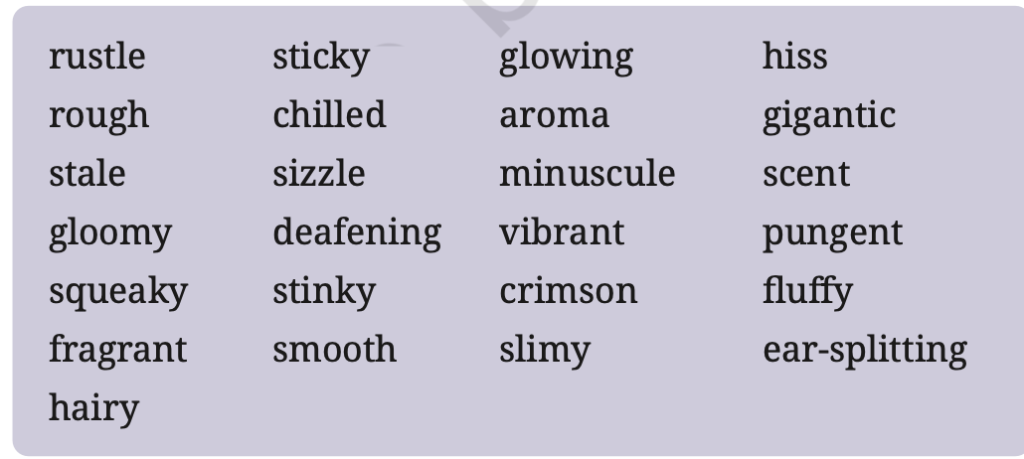
Q1. Work in pairs to classify the sensory words given in the box below. One example has been done for you.
Answer
| Visual | Auditory | Olfactory | Tactile |
| glowing | hiss | aroma | sticky |
| gigantic | sizzle | scent | rough |
| minuscule | deafening | pungent | chilled |
| vibrant | squeaky | fragrant | smooth |
| crimson | ear-splitting | stinky | slimy |
| gloomy | rustle | stale | fluffy |
| hairy |
Vocabulary in Context
II. Fill in the blanks with sensory words in the box for the following passage written by Sarojini Naidu. There are two extra words.
Answer:
- scarlet
- perfumes
- sweetness
- shrill
- scents
- essence
- flaming
Completed Passage
Come and share my exquisite March morning with me:
this sumptuous blaze of gold and sapphire sky; these
1. _____________ lilies that adorn the sunshine; the
voluptuous 2. _____________ of neem and champak
and serisha that beat upon the languid air with their
implacable 3. _____________; the thousand little gold
and blue and silver breasted birds bursting with the 4.
_____________ ecstasy of life in nesting time. And, do you
know that the scarlet lilies are woven petal by petal from
my heart’s blood, these little quivering birds are my soul
made incarnate music, these heavy 5. _____________ are
my emotions dissolved into aerial 6. _____________, this
7. _____________ blue and gold sky is the ‘very me’
Answers
Come and share my exquisite March morning with me: this sumptuous blaze of gold and sapphire sky; these
1. scarlet lilies that adorn the sunshine; the voluptuous
2. scents of neem and champak and serisha that beat upon the languid air with their implacable
3. sweetness; the thousand little gold and blue and silver-breasted birds bursting with the
4. shrill ecstasy of life in nesting time. And, do you know that the scarlet lilies are woven petal by petal from my heart’s blood, these little quivering birds are my soul made incarnate music, these heavy
5. scents are my emotions dissolved into aerial
6. essence, this
7. flaming blue and gold sky is the ‘very me’.
III. Write numbers against each picture with the phrases that describe them with their sensorial associations. One example has been done for you.

| Picture | Number | Phrase |
| 🥁Drums | 1 | Beats of music echo in air (Example) |
| 🌸Flowers | ______ | __________________________________________ |
| 🕯️Incense Sticks | ______ | __________________________________________ |
| 👶Cradle | ______ | __________________________________________ |
| 🌈Colourful Sky | ______ | ___________________________ |
| 🌅Horizon / Sunset | ______ | __________________________________________ |
Answer Table
| Picture | Number | Phrase |
| 🥁Drums | 1 | Beats of music echo in air |
| 🌸Flowers | 3 | Fragrant breeze of blooming buds |
| 🕯️Incense Sticks | 2 | Melody of soothing scent, dancing in the air |
| 👶Cradle | 4 | Gentle lullaby, a soft melody |
| 🌈Colourful Sky | 5 | Colourful sky, painting a lively sight |
| 🌅Horizon / Sunset | 6 | Attractive canvas painting the horizon |
Listen and Respond
I You will listen to four short extracts of people
expressing their childhood memories. As you listen,
match each statement 1–6 to each speaker (i)–(iv). There
are two statements that you do not need.
| Statement | Speaker |
| 1. The precious memories by the seaside are not the same anymore. | ______ |
| 2. My grandfather’s encouragement influences me in moments of difficulty. | ______ |
| 3. The school days are a source of recollection to stay in touch. | ______ |
| 4. Childhood days are about freedom and ordinary pleasures in outdoor activities. | ______ |
| 5. Memories of school days are grandparents and my funny tales. | ______ |
| 6. Parents urge us to be adventurous and discover nature but with limitations. | ______ |
| Statement | Speaker |
| 1. The precious memories by the seaside are not the same anymore. | ( ) |
| 2. My grandfather’s encouragement influences me in moments of difficulty. | ( ) |
| 3. The school days are a source of recollection to stay in touch. | ( ) |
| 4. Childhood days are about freedom and ordinary pleasures in outdoor activities. | ( ) |
| 5. Memories of school days are grandparents and my funny tales. | ( ) |
| 6. Parents urge us to be adventurous and discover nature but with limitations. | ( ) |
fill in the correct speaker numbers (i)–(iv).
Speaking Activity
Q1. Work in pairs. Think of an object, song, or a place that is memorable for you. Take turns to speak about it using the prompts given below.
I. Work in pairs. Think of an object, song, or a place that is memorable for you. Take turns to speak about it using the prompts given below.
✓ Introduce it briefly.
✓ Describe it in detail, including sensory details.
✓ Narrate the specific memory associated with it.
✓ Explain how it has impacted your life.
✓ Summarise why this memory is meaningful to you even now.
You may use the following phrases:
✓ During my childhood…
✓ Growing up, I fondly remember…
✓ Recalling those early years, I can’t forget…
✓ In my younger days, I used to…
✓ I have a clear memory of…
✓ A routine activity in my childhood involved…
✓ A cherished part of my childhood includes…
✓ As a child, I was fond of…
✓ One of my favourite childhood moments is…
✓ Thinking about my early years, I recall…
✓ A common occurrence during my youth was…
Sample Answer
During my childhood, my grandparents’ village was the most memorable place for me. It was surrounded by green fields, tall trees, and a peaceful river. Every morning, I woke up to the sweet songs of birds and enjoyed the fresh fragrance of flowers. In the evenings, I played outdoor games with my cousins and listened to my grandmother’s bedtime stories.
Growing up, I fondly remember spending every summer vacation there. Those happy days taught me the importance of family, nature, and simple joys. Even today, whenever I think about that village, I feel calm and happy because those memories remain one of the most precious parts of my childhood.
(Word count: 99)
Writing Task

Q1. Imagine you had been on a school trip to a scenic place which appealed to all your senses. Write a diary entry describing the place and why it was a memorable experience.
Monday
15 July 20XX
8:30 p.m.
Dear Diary,
Today was one of the most memorable days of my life. My school took us on a trip to a beautiful hill station. As soon as I reached the place, I saw green hills, colourful flowers, and a clear blue sky. The cool breeze touched my face, and the sweet fragrance of pine trees and wild flowers filled the air. I could hear birds singing and the gentle sound of a nearby waterfall, which made the surroundings peaceful and refreshing.
I enjoyed walking with my friends along the nature trail. We clicked photographs, explored the beautiful landscape, and learned about different plants and birds. The fresh air and calm environment made me feel relaxed and happy. Every moment of the trip was exciting and unforgettable.
This visit taught me to appreciate the beauty of nature and the importance of protecting it. I returned home with wonderful memories that I will always treasure.
Riya
(Word count: 140)
Learning Beyond the Text
Q1. You read about the shiuli flowers from the poem. Gather more information on unique flowers of India—where they are found, how they look, what smell they emit, and what the historical significance is, if any. Add more flowers to this list.
Answer
Shiuli (Parijat / Harsingar)
- Known as Parijat, Parijata, and Harsingar
- Found in many parts of India, especially West Bengal, Uttar Pradesh, Assam, and Odisha
- Small white flowers with bright orange stalks
- Releases a sweet fragrance, especially at night
- Revered and used for religious ceremonies
- Associated with many Indian legends and mythology
- Blooms only during the night
Neelakurinji (Kurinji)
- Found in the Nilgiri Hills and Western Ghats (Kerala and Tamil Nadu)
- Beautiful bluish-purple flowers
- Mild, pleasant fragrance
- Famous for blooming once every 12 years
- Symbolises the beauty and uniqueness of nature
- Attracts thousands of visitors during its blooming season
Lotus
- Found in ponds and lakes across India
- Large pink or white flowers with broad green leaves
- Mild, pleasant fragrance
- National Flower of India
- Symbol of purity, peace, and spiritual wisdom
- Closely associated with Goddess Lakshmi and Lord Brahma
Rhododendron (Buransh)
- Found in the Himalayan regions of Uttarakhand, Himachal Pradesh, and Sikkim
- Bright red, pink, or white flowers
- Light, sweet fragrance
- State Flower of Uttarakhand and Nagaland
- Used to prepare traditional juice and herbal medicines
- Blooms during spring and adds beauty to the mountains
Golden Shower Flower (Amaltas)
- Found throughout India during summer
- Bright yellow flowers hanging in long clusters
- Mild fragrance
- State Flower of Kerala
- Used in Ayurvedic medicine
- Symbolises prosperity and good fortune
Flame Lily (Glory Lily)
- Found in the forests of southern and central India
- Red and yellow flame-shaped petals
- Mild fragrance
- State Flower of Tamil Nadu
- Used in traditional medicine
- Known for its striking appearance and unique shape
II. You must have read poems and songs related to the theme of family, friends and their reminiscences, in English and also in your own language. Collect these poems and songs, and share with your classmates and teacher.
Answer
Poems and Songs on Family, Friends, and Memories
| Title | Author / Singer | Theme |
| I Cannot Remember My Mother | Rabindranath Tagore | Mother’s love and childhood memories |
| My Mother at Sixty-Six | Kamala Das | Love and concern for one’s mother |
| A Photograph | Shirley Toulson | Family memories and loss |
| The Banyan Tree | Ruskin Bond | Childhood adventures and family |
| Count on Me | Bruno Mars | True friendship and support |
| You’ve Got a Friend | Carole King | Friendship and trust |
| Nanhi Pari Sone Chali (Hindi) | Traditional | Mother’s love and care |
| Lakdi Ki Kaathi (Hindi) | Gulzar | Childhood fun and happy memories |
| Maa (Film: Taare Zameen Par) | Prasoon Joshi | Mother’s affection and emotional bond |
| Ye Dosti Hum Nahi Todenge (Film: Sholay) | Anand Bakshi | Strong friendship and loyalty |
These poems and songs celebrate the importance of family, friendship, love, and childhood memories. They show how relationships create lasting memories and emotional bonds that remain with us throughout life.
Class 9 English Grammar Worksheet (Based on Poem)
Chapter: I Cannot Remember My Mother
Total Marks: 10
SECTION A: EDITING (4 Marks)
Read the paragraph and choose the correct option for each underlined part.
The poet (a) remember his mother through beautiful memories. He says that a tune (b) hover over his playthings while he is playing. The fragrance of (c) a shiuli flowers reminds him of her. If he (d) see the blue sky, he will feel his mother’s loving presence.
(a) remember
(i) remembers
(ii) remembered
(iii) remembering
(iv) remember
(b) hover
(i) hovered
(ii) hovers
(iii) hovering
(iv) hover
(c) a shiuli flowers
(i) a shiuli flower
(ii) the shiuli flowers
(iii) an shiuli flowers
(iv) some shiuli flower
(d) see
(i) saw
(ii) will see
(iii) sees
(iv) seeing
SECTION B: SENTENCE REARRANGEMENT (3 Marks)
Rearrange the jumbled words to form meaningful sentences.
1. mother / the / cannot / remember / poet / his
2. over / tune / playthings / hovered / the / his
3. blue / mother’s / the / sky / reminds / him / of
SECTION C: SENTENCE TRANSFORMATION (3 Marks)
1. Change the following into Reported Speech.
Mother said, “Look at the beautiful flowers.”
2. Rewrite the sentence using the modal should.
We protect nature because it preserves beautiful memories.
3. Rewrite the sentence using a Type 1 Conditional Clause.
The poet looks at the blue sky. He remembers his mother.
ANSWER KEY
Section A
(a) (i) remembers
(b) (ii) hovers
(c) (ii) the shiuli flowers
(d) (iii) sees
Section B
1. The poet cannot remember his mother.
2. The tune hovered over his playthings.
3. The blue sky reminds him of his mother.
Section C
1. Mother told the poet to look at the beautiful flowers.
2. We should protect nature because it preserves beautiful memories.
3. If the poet looks at the blue sky, he will remember his mother.
Extra Question Answers – I Cannot Remember My Mother
Extra Questions and Answers (CBSE Board Exam)
SHORT ANSWER QUESTIONS
Q1. Why is the poet unable to remember his mother clearly? (2 marks)
The poet cannot remember his mother clearly because she passed away when he was very young. Although her face has faded from his memory, her love remains alive through songs, fragrances, and nature.
(Word count: 33)
Q2. How does the tune remind the poet of his mother? (2 marks)
The familiar tune reminds the poet of the lullaby his mother used to hum while rocking his cradle. It brings back feelings of love, comfort, and care, even though he cannot remember her face.
(Word count: 34)
Q3. Why are the shiuli flowers important in the poem? (3 marks)
The fragrance of the shiuli flowers reminds the poet of his mother’s loving presence. Their sweet smell awakens childhood memories and symbolises her purity, affection, and everlasting love. Nature becomes a bridge between memory and emotion.
(Word count: 38)
Q4. How does the poet use the blue sky to remember his mother? (3 marks)
The poet imagines that his mother’s gentle gaze has spread across the blue sky. The sky symbolises her endless love and peaceful presence, making him feel that she is always watching over him.
(Word count: 35)
Q5. How do the poet’s senses help him remember his mother? (3 marks)
The poet remembers his mother through sound, smell, and sight. The humming tune, the fragrance of shiuli flowers, and the vast blue sky awaken memories that keep her love alive in his heart.
(Word count: 36)
Q6. Why does the poet repeat the line “I cannot remember my mother”? (3 marks)
The repeated line emphasises the poet’s deep sorrow and longing. Although he cannot remember his mother’s face, the refrain highlights that her love continues to live in his memories through simple experiences and nature.
(Word count: 35)
LONG ANSWER QUESTIONS
Q7. How does Rabindranath Tagore express the everlasting presence of a mother’s love in the poem? (5 marks)
Rabindranath Tagore presents a mother’s love as everlasting and beyond physical presence. Although the poet cannot clearly remember his mother’s face, he feels her love through memories and the beauty of nature.
The poet recalls her through a familiar tune, the fragrance of shiuli flowers, and the peaceful blue sky. As the poem states, “I cannot remember my mother,” yet these simple experiences remind him of her care and affection. Each natural image becomes a symbol of her lasting presence.
Thus, the poem shows that true love never disappears. Even when a loved one is absent, memories continue to provide comfort, strength, and emotional connection.
(Word count: 108)
Q8. Discuss the significance of nature in “I Cannot Remember My Mother.” (6 marks)
Nature plays a central role in preserving the poet’s memories of his mother. Instead of remembering her face directly, he connects her with beautiful natural elements such as flowers, fragrance, and the sky.
The shiuli flowers, the scent of the morning service, and the vast blue sky symbolise peace, purity, and maternal affection. The poet’s memories become stronger whenever he experiences these sights and smells. The phrase “my mother’s gaze” transforms the sky into a symbol of her eternal love.
Through these natural images, Tagore shows that nature keeps precious memories alive. It becomes a silent companion that preserves love across time.
(Word count: 111)
Q9. Analyse the poet’s emotions in the poem. (6 marks)
The poet expresses deep emotions of nostalgia, love, and quiet sadness. Although he cannot remember his mother’s appearance, he treasures the memories connected with her.
His emotions are revealed through sensory images such as music, fragrance, and the blue sky. The repeated line “I cannot remember my mother” expresses loss, while the humming tune and shiuli flowers provide emotional comfort. These memories help him feel close to his mother despite her absence.
The poem ends with hope rather than despair. It suggests that love survives in memories and continues to guide the heart throughout life.
(Word count: 104)
Q10. Explain how imagery and symbolism strengthen the poem. (6 marks)
Rabindranath Tagore uses vivid imagery and symbolism to express emotions that cannot be described directly. The poem appeals to the senses of hearing, smell, and sight, making the memories more realistic.
The humming tune symbolises the mother’s lullaby, the shiuli flowers represent her gentle love, and the blue sky symbolises her endless presence. The expression “my mother’s gaze” creates a powerful visual image of protection and affection.
These literary devices deepen the emotional impact of the poem. They help readers understand that memories remain alive through simple experiences, even when a loved one is no longer physically present.
(Word count: 110)
EXTRACT-BASED QUESTIONS
Q11. Read the extract and answer the questions:
“I cannot remember my mother
only sometimes in the midst of my play
a tune seems to hover over my playthings.”
(i) Who is the speaker in the extract? (1 mark)
The speaker is the poet, Rabindranath Tagore.
(ii) What reminds the poet of his mother? (1 mark)
A familiar tune reminds the poet of his mother’s lullaby.
(iii) Which literary device is used in the phrase “a tune seems to hover”? (1 mark)
The phrase uses personification, as the tune is described as if it can hover.
(iv) What does the extract reveal about the poet? (1 mark)
It reveals that the poet deeply misses his mother and remembers her through childhood memories.
Q12. Read the extract and answer the questions:
“The smell of the shiuli flowers
floats in the air,
the scent of the morning service.”
(i) Which sense is mainly appealed to in the extract? (1 mark)
The extract mainly appeals to the sense of smell (olfactory sense).
(ii) What do the shiuli flowers symbolise? (1 mark)
They symbolise the poet’s mother’s loving and gentle presence.
(iii) Name the literary device used in the extract. (1 mark)
The extract uses imagery, especially olfactory imagery.
(iv) Why is this extract important in the poem? (1 mark)
It shows how nature helps the poet remember his mother through fragrance.
Q13. Read the extract and answer the questions:
“I feel that the stillness of
my mother’s gaze on my face
has spread all over the sky.”
(i) What does the sky symbolise in the extract? (1 mark)
The sky symbolises the mother’s everlasting love and presence.
(ii) Which emotion is expressed in the extract? (1 mark)
The extract expresses peace, love, and nostalgia.
(iii) Identify the literary device used in “my mother’s gaze”. (1 mark)
The poet uses symbolism to represent his mother’s eternal care.
(iv) What message does this extract convey? (1 mark)
It conveys that a mother’s love remains alive through memories, even after her absence.
I Remember, I Remember
I remember, I remember
The house where I was born,
The little window where the sun
Came peeping in at morn;
He never came a wink too soon
Nor brought too long a day;
But now, I often wish the night
Had borne my breath away.
I remember, I remember
The roses red and white,
The violets and the lily cups —
Those flowers made of light!
The lilacs where the robin built,
And where my brother set
The laburnum on his birthday, —
The tree is living yet!
Thomas Hood
Have you ever looked back at your childhood and wished you could visit those happy days again? What if the place that once filled you with joy now exists only in your memories? This poem explores the beauty of childhood and the deep emotions that come with remembering the past.
The poet looks back on his childhood home with love and longing. He remembers the happy days, the beautiful garden, and the peaceful surroundings. However, as he grows older, he realises that those precious moments can never return, making his memories both joyful and sad.
The poem begins with Thomas Hood remembering the house where he was born. He recalls the little window through which the morning sun entered every day. The sunlight always arrived at the right time and made each day cheerful. During his childhood, everything seemed simple, peaceful, and full of happiness. The house was not just a building but a place filled with love and comfort. The poet remembers these moments clearly and warmly. However, he also admits that life has changed. The line “I remember, I remember” is repeated to show how deeply these memories remain in his heart. The contrast between his happy childhood and his present life creates a feeling of quiet sadness.
The poet then remembers the beauty of nature around his home. He recalls the bright roses, violets, and lily cups, which looked so beautiful that they seemed to be “made of light.” These flowers filled his childhood with colour and joy. He also remembers the lilac tree where a robin built its nest. Another precious memory is of his brother, who planted a laburnum tree on his birthday. The poet happily recalls that the tree is still alive. While many years have passed, the tree continues to stand as a living reminder of his childhood. Through these natural images, the poet shows how places and objects can preserve memories even when time moves forward.
As the poem ends, the poet reflects on the difference between childhood and adulthood. His memories are beautiful, but they also make him realise that those carefree days can never return. The sights of the little window, the sunshine, the flowers, the birds, and the trees remain fresh in his mind. However, they also remind him of the passing of time. The poem does not describe any dramatic event. Instead, it gently expresses how memories stay alive even when life changes. The repeated words “I remember, I remember” and the image of the tree “living yet” show that while childhood is gone, its memories continue to live forever in the poet’s heart.
Thomas Hood – thoughtful and nostalgic – remembers his happy childhood with love and longing.
Brother – caring and cheerful – plants the laburnum tree on his birthday.
Robin – symbolic and lively – builds its nest in the lilac tree, adding life to the poet’s memories.
Laburnum Tree – lasting and meaningful – represents memories that continue to live through time.
The poem reminds you that childhood memories are precious treasures that remain with you throughout life.Although time changes people and places, the love, joy, and beauty of those early years continue to live in your heart forever.
क्या तुमने कभी अपने बचपन को याद करके सोचा है कि काश वे सुनहरे दिन फिरलौट आते? क्या हो, अगर वह जगह जिसने कभी तुम्हें सबसे ज़्यादा खुशी दी थी, अबकेवल तुम्हारी यादों में ही बची हो? यह कविता बचपन की सुंदर यादों और बीते समयको याद करने से जुड़ी गहरी भावनाओं को व्यक्त करती है।
कवि अपने बचपन के घर को प्रेम और अपनापन के साथ याद करता है। उसे अपनेबचपन के सुखद दिन, सुंदर बगीचा और शांत वातावरण याद आते हैं। लेकिन जैसे-जैसेवह बड़ा होता है, उसे एहसास होता है कि वे अनमोल पल कभी वापस नहीं आ सकते।यही बात उसकी यादों को एक साथ सुखद और दुखभरी बना देती है।
कविता की शुरुआत में थॉमस हुड अपने जन्म के घर को याद करते हैं। उन्हें वह छोटी-सीखिड़की याद आती है, जिससे हर सुबह सूरज की किरणें अंदर आती थीं। सूरज हमेशासही समय पर आता था और हर दिन को खुशियों से भर देता था। बचपन में सब कुछसरल, शांत और आनंद से भरा हुआ लगता था। वह घर केवल ईंट-पत्थरों से बनी इमारतनहीं था, बल्कि प्रेम और अपनापन से भरी एक जगह था। कवि इन यादों को आज भीबहुत स्पष्टता और स्नेह के साथ याद करता है। लेकिन वह यह भी स्वीकार करता है किसमय बदल चुका है। कविता में बार-बार आने वाली पंक्ति “मुझे याद है, मुझे यादहै“ यह दिखाती है कि ये यादें आज भी उसके दिल में कितनी गहराई से बसी हुई हैं।उसके सुखद बचपन और वर्तमान जीवन के बीच का अंतर कविता में हल्की-सी उदासीपैदा करता है।
इसके बाद कवि अपने घर के आसपास की प्रकृति को याद करता है। उसे लाल औरसफेद गुलाब, बनफशे और लिली के फूल याद आते हैं, जो इतने सुंदर लगते थे मानोवे “प्रकाश से बने हों।“ इन फूलों ने उसके बचपन को रंगों और खुशियों से भर दियाथा। उसे लाइलैक का वह पेड़ भी याद है, जिस पर एक रॉबिन चिड़िया ने अपना घोंसलाबनाया था। एक और प्यारी याद उसके भाई से जुड़ी है, जिसने अपने जन्मदिन परएक लैबर्नमका पेड़ लगाया था। कवि खुशी के साथ बताता है कि वह पेड़ आज भीजीवित है। इतने वर्षों के बाद भी वह पेड़ उसके बचपन की यादों का जीवित प्रतीक बनाहुआ है। इन प्राकृतिक दृश्यों के माध्यम से कवि दिखाता है कि समय बीत जाने पर भीकुछ स्थान और वस्तुएँ हमारी यादों को सहेजकर रखती हैं।
कविता के अंत में कवि बचपन और बड़े होने के बीच के अंतर पर विचार करता है। उसकीयादें बहुत सुंदर हैं, लेकिन वे उसे यह भी महसूस कराती हैं कि वे निश्चिंत और आनंदमयदिन कभी लौटकर नहीं आएँगे। छोटी खिड़की, सुबह की धूप, फूल, पक्षी और पेड़—येसभी दृश्य आज भी उसकी स्मृतियों में ताज़ा हैं। लेकिन यही यादें उसे समय के बीतने काएहसास भी कराती हैं। कविता में कोई बड़ा या नाटकीय घटना नहीं होती। इसके बजाययह बहुत सहजता से बताती है कि जीवन बदल जाने पर भी यादें हमेशा जीवित रहती हैं।बार-बार दोहराई गई पंक्ति “मुझे याद है, मुझे याद है“ और पेड़ के “अब भी जीवितहै“ होने का उल्लेख यह दिखाता है कि बचपन भले ही बीत गया हो, लेकिन उसकी यादेंहमेशा कवि के हृदय में जीवित रहेंगी।
थॉमस हुड – संवेदनशील और स्मृतिप्रिय – अपने सुखद बचपन को प्रेम और अपनापन केसाथ याद करते हैं।
भाई – स्नेही और प्रसन्न स्वभाव का – अपने जन्मदिन पर लैबर्नम का पेड़ लगाता है।
रॉबिन – जीवंत और प्रतीकात्मक – लाइलैक के पेड़ पर घोंसला बनाकर कवि की यादोंको और जीवंत बना देती है।
लैबर्नम का पेड़ – स्थायी और अर्थपूर्ण – समय बीतने के बाद भी बचपन की यादों काजीवित प्रतीक बना रहता है।
यह कविता तुम्हें याद दिलाती है कि बचपन की यादें जीवन की सबसे अनमोल धरोहरहोती हैं। समय लोगों और स्थानों को बदल सकता है, लेकिन बचपन का प्रेम, खुशी औरसुंदरता हमेशा तुम्हारे दिल में जीवित रहती है।
Extra Question Answers – I Remember, I Remember
Extra Questions and Answers (CBSE Board Exam)
SHORT ANSWER QUESTIONS
Q1. Why does the poet remember his childhood home with affection? (2 marks)
The poet remembers his childhood home with affection because it was filled with happiness, peace, and beautiful memories. The little window, the morning sunlight, and the cheerful atmosphere remind him of the joy of his early years.
(Word count: 37)
Q2. What does the poet recall about the little window? (2 marks)
The poet remembers the little window through which the morning sun entered every day. The sunlight always arrived at the right time, making his childhood mornings bright, pleasant, and full of hope.
(Word count: 34)
Q3. Why does the poet describe the flowers as “made of light”? (3 marks)
The poet describes the flowers as “made of light” to show their extraordinary beauty and freshness. This vivid image highlights the brightness and innocence of his childhood memories, making nature appear magical and joyful.
(Word count: 37)
Q4. What is the significance of the laburnum tree in the poem? (3 marks)
The laburnum tree symbolises the lasting memories of the poet’s childhood. It was planted by his brother on his birthday and is still alive, reminding the poet that some memories remain unchanged despite the passage of time.
(Word count: 39)
Q5. How does nature help the poet remember his childhood? (3 marks)
Nature preserves the poet’s childhood memories through flowers, birds, trees, and sunlight. These familiar sights bring back happy moments and create a strong emotional connection between his past and present life.
(Word count: 34)
Q6. Why does the poet feel both happy and sad while remembering the past? (3 marks)
The poet feels happy because his childhood was peaceful and joyful. However, he also feels sad because those wonderful days have passed forever and can now exist only in his memories.
(Word count: 33)
LONG ANSWER QUESTIONS
Q7. How does Thomas Hood present childhood as a precious stage of life in the poem? (5 marks)
Thomas Hood presents childhood as a time of happiness, innocence, and peace. The poet lovingly remembers his home, the morning sunshine, colourful flowers, and the beautiful surroundings that made his early life memorable.
The repeated line “I remember, I remember” shows how deeply these memories remain in his heart. The images of the “little window”, blooming flowers, and the living laburnum tree create a vivid picture of a joyful childhood. Although the memories bring happiness, they also remind him that those days can never return.
The poem celebrates childhood as life’s most precious period. It suggests that memories of those early years continue to comfort a person throughout life.
(Word count: 111)
Q8. Discuss the role of nature in the poem “I Remember, I Remember.” (6 marks)
Nature is central to the poet’s memories of childhood. The flowers, birds, trees, and sunshine are not merely part of the scenery; they preserve the happiness and innocence of his early years.
The poet remembers “roses red and white,” violets, lily cups, and the robin’s nest in the lilac tree. He also recalls the laburnum tree planted by his brother, which “is living yet.” These natural images symbolise beauty, growth, and the lasting power of memory.
Through rich imagery and symbolism, Thomas Hood shows that nature keeps childhood alive in the heart, even when time changes everything else.
(Word count: 108)
Q9. Analyse the poet’s emotions in the poem. (6 marks)
The poem expresses a mixture of joy, nostalgia, and quiet sadness. The poet treasures the beautiful memories of his childhood but also realises that they belong to the past.
His memories of the house, the little window, the flowers, and the trees fill him with warmth. However, the line “I often wish the night” reveals the sorrow he feels while comparing childhood with adulthood. The repeated refrain strengthens his emotional longing for those carefree days.
The poem shows that memories can bring both happiness and pain because they remind us of moments that can never return.
(Word count: 105)
Q10. Explain how imagery and symbolism enhance the poem. (6 marks)
Thomas Hood uses vivid imagery and symbolism to make childhood memories meaningful and memorable. Every natural object in the poem represents a happy moment from the poet’s early life.
The little window symbolises hope and new beginnings, while the morning sun represents joy and freshness. The flowers described as “made of light” create bright visual imagery, and the laburnum tree symbolises memories that continue to live through time. These images make the poet’s emotions vivid and realistic.
Through these literary devices, the poem captures the beauty of childhood and the lasting power of memory.
(Word count: 104)
EXTRACT-BASED QUESTIONS
Q11. Read the extract and answer the questions:
“I remember, I remember
The house where I was born,
The little window where the sun
Came peeping in at morn;”
(i) Who is the speaker in the extract? (1 mark)
The speaker is the poet, Thomas Hood.
(ii) What does the poet remember first? (1 mark)
He first remembers the house where he was born and its little window.
(iii) Which literary device is used in “the sun came peeping”? (1 mark)
The phrase uses personification because the sun is given the human action of peeping.
(iv) What is the significance of this extract? (1 mark)
The extract introduces the poet’s nostalgic memories of his happy childhood.
Q12. Read the extract and answer the questions:
“The roses red and white,
The violets and the lily cups—
Those flowers made of light!”
(i) What does the poet describe in this extract? (1 mark)
The poet describes the beautiful flowers from his childhood garden.
(ii) What does the phrase “made of light” suggest? (1 mark)
It suggests that the flowers appeared exceptionally bright, pure, and beautiful.
(iii) Identify one literary device used in the extract. (1 mark)
The extract uses imagery to create a vivid picture of the colourful flowers.
(iv) Why are these flowers important in the poem? (1 mark)
They preserve the poet’s joyful childhood memories and symbolise innocence and beauty.
Q13. Read the extract and answer the questions:
“The lilacs where the robin built,
And where my brother set
The laburnum on his birthday,—
The tree is living yet!”
(i) Who planted the laburnum tree? (1 mark)
The poet’s brother planted the laburnum tree on his birthday.
(ii) What does the robin represent in the poem? (1 mark)
The robin represents the liveliness and beauty of the poet’s childhood surroundings.
(iii) What does the laburnum tree symbolise? (1 mark)
The laburnum tree symbolises lasting memories and the passage of time.
(iv) Why is the last line important? (1 mark)
It shows that although childhood has passed, its memories continue to live, just like the tree.