

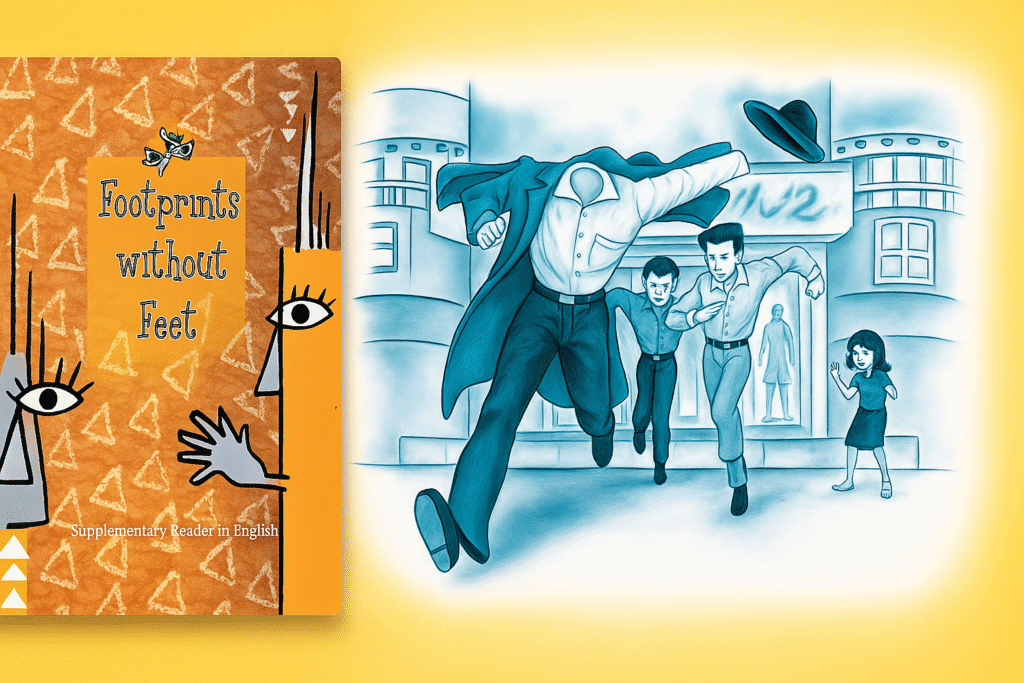
Score high on your Class 10 English exams with this complete Footprints Without Feet resource. Find detailed summaries for chapter, the gripping Griffin invisible man story, along with NCERT-style solutions, character sketches, and theme explanations. This page includes important questions with model answers, grammar exercises, extract-based questions, and extra practice materials. Whether you need quick chapter summaries or deep-dive exam preparation, access everything in one place to master your supplementary reader.
Table of Contents
footprints without feet summary
English summary
Have you ever seen footprints appear out of thin air on a cold London street? Imagine following them, step by step, and realizing there is no man at all. This is how a strange mystery begins—one that pulls you straight into a world of science, danger, and fear.
The chapter tells the story of Griffin, a brilliant but reckless scientist who discovers how to make himself invisible. His discovery gives him power, but it also pushes him into crime, loneliness, and constant trouble, until his secret is finally exposed in a shocking way.
Two boys in London are startled when they see fresh muddy footprints on the steps of a house. There is no person in sight, yet the footprints keep appearing, one after another, moving down the street. Curious and amazed, the boys follow them until the marks slowly fade and vanish. The mystery is soon explained. The footprints belong to Griffin, a scientist who has discovered how to make the human body invisible. After swallowing rare drugs, his body becomes “as transparent as a sheet of glass,” though still solid. However, Griffin is also described as “rather a lawless person.” When his landlord tries to evict him, Griffin burns the house in revenge. To escape unseen, he removes his clothes and becomes completely invisible. Homeless, moneyless, and naked, he wanders the streets until stepping in mud makes him visible through footprints.
Griffin soon escapes the boys but faces a bigger problem—it is mid-winter, and the cold is unbearable without clothes. To survive, he sneaks into a large London store at closing time. Once inside, he eats freely, drinks coffee and wine, and steals warm clothes. Fully dressed, he becomes visible again, wearing shoes, an overcoat, and a wide-brimmed hat. Tired and satisfied, he sleeps on a pile of quilts. But he wakes too late the next morning. When store assistants arrive, Griffin panics and runs. To escape, he throws off his clothes once more, becoming invisible again in the freezing January air.
Desperate for proper disguise, Griffin heads to Drury Lane, the centre of the theatre world. He enters a theatrical shop invisibly and comes out wearing bandages, dark glasses, a false nose, bushy whiskers, and a large hat. To escape, he attacks the shopkeeper from behind and steals his money. Wanting solitude, he travels by train to the village of Iping and stays at the local inn run by Mrs Hall. His strange appearance and secretive behaviour make him seem eccentric. He tells her, “I do not wish to be disturbed in my work.” Though he pays in advance, his stolen money soon runs out, and he pretends a cheque is on the way.
Soon, strange events shake the village. A clergyman hears money being stolen, yet finds no thief. At the inn, furniture seems to come alive—chairs attack, hats fly, and doors lock themselves. Terrified, Mrs Hall believes the room is haunted. Suspicion grows when Griffin suddenly has money again. When confronted, Griffin loses his temper and cries, “I’ll show you.” He removes his disguise, and the people see a headless man. The constable Mr Jaffers tries to arrest him, but Griffin throws off his clothes and becomes invisible. A wild struggle follows, blows come from nowhere, and Griffin finally escapes, unseen and untouchable.
Griffin – brilliant and lawless – scientist who discovers invisibility
Mrs Hall – suspicious but practical – landlady of the inn at Iping
Mr Jaffers – determined – village constable
The two boys – curious – first witnesses to the invisible man
The story teaches you that great power without responsibility leads to trouble. It shows you how misuse of knowledge can turn brilliance into danger, and how secrecy and crime only create fear and chaos.
footprints without feet Hindi summary
क्या तुमने कभी ठंडी लंदन की सड़क पर हवा में अपने-आप उभरते पैरों के निशान देखे हैं? ज़रा सोचो, उन निशानों का पीछा करते-करते यह समझ में आए कि वहाँ कोई आदमी है ही नहीं। इसी तरह एक अजीब रहस्य शुरू होता है—जो तुम्हें सीधे विज्ञान, ख़तरे और डर की दुनिया में खींच ले जाता है।
यह अध्याय ग्रिफ़िन की कहानी बताता है, जो एक प्रतिभाशाली लेकिन लापरवाह वैज्ञानिक है और जो खुद को अदृश्य बनाने का तरीका खोज लेता है। यह खोज उसे ताकत देती है, लेकिन साथ ही उसे अपराध, अकेलेपन और लगातार मुसीबतों की ओर भी धकेल देती है, जब तक कि उसका रहस्य एक चौंकाने वाले ढंग से सबके सामने आ नहीं जाता।
लंदन में दो लड़के तब चौंक जाते हैं जब वे एक घर की सीढ़ियों पर ताज़ा कीचड़ भरे पैरों के निशान देखते हैं। वहाँ कोई इंसान दिखाई नहीं देता, फिर भी निशान एक-एक करके आगे बढ़ते जाते हैं और सड़क की ओर जाते हैं। जिज्ञासु और हैरान लड़के उनका पीछा करते हैं, जब तक कि निशान धीरे-धीरे हल्के पड़कर गायब नहीं हो जाते। जल्द ही इस रहस्य की सच्चाई सामने आ जाती है। ये निशान ग्रिफ़िन के हैं—उस वैज्ञानिक के, जिसने मानव शरीर को अदृश्य बनाने का तरीका खोज लिया था। दुर्लभ दवाएँ निगलने के बाद उसका शरीर “शीशे की चादर जितना पारदर्शी” हो जाता है, हालाँकि वह ठोस ही रहता है। लेकिन ग्रिफ़िन को “कुछ हद तक कानून तोड़ने वाला व्यक्ति” भी बताया गया है। जब उसका मकान-मालिक उसे घर से निकालना चाहता है, तो बदले में ग्रिफ़िन घर में आग लगा देता है। बिना देखे गए भागने के लिए वह अपने कपड़े उतार देता है और पूरी तरह अदृश्य हो जाता है। बिना घर, बिना पैसे और नंगा, वह सड़कों पर भटकता है—जब तक कि कीचड़ में पैर रखने से उसके पैरों के निशान दिखाई देने नहीं लगते।
जल्द ही ग्रिफ़िन लड़कों से बच निकलता है, लेकिन एक और बड़ी समस्या सामने आ जाती है—सर्दियों का बीच का समय है और बिना कपड़ों के ठंड सहन करना नामुमकिन है। बचने के लिए वह बंद होने के समय एक बड़े लंदन के स्टोर में चुपके से घुस जाता है। अंदर जाकर वह पेट भरकर खाता है, कॉफी और शराब पीता है और गर्म कपड़े चुरा लेता है। जूते, ओवरकोट और चौड़ी टोपी पहनकर वह फिर से दिखाई देने लगता है। थका-हारा और संतुष्ट होकर वह रजाइयों के ढेर पर सो जाता है। लेकिन अगली सुबह वह बहुत देर से जागता है। जैसे ही स्टोर के कर्मचारी आते हैं, ग्रिफ़िन घबरा जाता है और भागने लगता है। बचने के लिए वह फिर से अपने कपड़े उतार देता है और जनवरी की जमा देने वाली ठंड में दोबारा अदृश्य हो जाता है।
सही भेस की तलाश में ग्रिफ़िन, थिएटरों के केंद्र ड्रुरी लेन की ओर जाता है। वह एक थिएटर की दुकान में अदृश्य होकर घुसता है और कुछ देर बाद माथे पर पट्टियाँ, काले चश्मे, नकली नाक, घनी मूँछें और बड़ी टोपी पहनकर बाहर आता है। भागने के लिए वह दुकानदार पर पीछे से हमला करता है और उसके पैसे चुरा लेता है। भीड़ से दूर रहना चाहकर वह ट्रेन से इपिंग गाँव पहुँचता है और मिसेज़ हॉल द्वारा चलाए जाने वाले सराय में ठहरता है। उसका अजीब रूप और रहस्यमय व्यवहार उसे सनकी बना देता है। वह उनसे कहता है, “मैं अपने काम में किसी तरह की रुकावट नहीं चाहता।” हालाँकि वह पहले ही पैसे दे देता है, लेकिन चोरी का धन जल्दी खत्म हो जाता है और वह यह बहाना बनाता है कि एक चेक आने वाला है।
जल्द ही गाँव में अजीब घटनाएँ होने लगती हैं। एक पादरी को पैसे चोरी होने की आवाज़ सुनाई देती है, लेकिन कोई चोर नहीं मिलता। सराय में फर्नीचर जैसे ज़िंदा हो उठता है—कुर्सियाँ हमला करती हैं, टोपियाँ उड़ती हैं और दरवाज़े अपने-आप बंद हो जाते हैं। डरी हुई मिसेज़ हॉल मान लेती हैं कि कमरा भूतिया है। जब ग्रिफ़िन के पास अचानक फिर से पैसे दिखाई देते हैं, तो शक और बढ़ जाता है। पूछे जाने पर ग्रिफ़िन गुस्से में चिल्लाता है, “मैं तुम्हें दिखाता हूँ।” वह अपना भेस उतार देता है और लोग एक बिना सिर का आदमी देखते हैं। सिपाही मिस्टर जाफ़र्स उसे गिरफ़्तार करने की कोशिश करता है, लेकिन ग्रिफ़िन कपड़े उतारकर अदृश्य हो जाता है। ज़बरदस्त संघर्ष होता है, कहीं से भी वार पड़ते हैं, और अंत में ग्रिफ़िन अदृश्य और अछूता होकर भाग निकलता है।
ग्रिफ़िन – प्रतिभाशाली और कानून तोड़ने वाला – अदृश्यता खोजने वाला वैज्ञानिक
मिसेज़ हॉल – शंकालु लेकिन व्यावहारिक – इपिंग की सराय की मालकिन
मिस्टर जाफ़र्स – दृढ़ निश्चयी – गाँव का सिपाही
दो लड़के – जिज्ञासु – अदृश्य आदमी को सबसे पहले देखने वाले
यह कहानी तुम्हें सिखाती है कि ज़िम्मेदारी के बिना बड़ी ताकत मुसीबत बन जाती है। यह दिखाती है कि ज्ञान का गलत उपयोग कैसे प्रतिभा को ख़तरे में बदल देता है, और कैसे रहस्य और अपराध सिर्फ डर और अफ़रा-तफ़री ही पैदा करते हैं।
Footprints without Feet Keywords and meanings:
Griffin – brilliant but lawless scientist who becomes invisible
Invisibility – power to be unseen like transparent glass
Footprints – muddy marks that reveal the unseen man
London – city setting for early chase and thefts
Mid-winter – bitter cold season that makes invisibility risky
Store – big London shop where Griffin eats, dresses, sleeps
Drury Lane – theatre area where disguise items are stolen
Bandages – wraps used to hide head’s emptiness
Dark glasses – part of disguise to look normal
False nose – fake feature to cover invisibility
Whiskers – bushy side hair for disguise
Inn – lodging in Iping where strange events occur
Iping – village where suspense and chaos rise
Mrs Hall – innkeeper who suspects and questions Griffin
Clergyman – victim of burglary who shouts surrender
Housekeeping money – stolen cash from the desk
Chair – moving furniture that frightens the Halls
Witchcraft – villagers’ explanation for strange events
Constable Jaffers – duty-first policeman who tries to arrest Griffin
Arrest – attempt to catch the invisible man
Headless – shocking sight when Griffin unveils himself
Chase – pursuit by assistants and villagers
Theft – repeated stealing for survival and escape
Violence – attacks used to flee and rob
Solitude – Griffin’s stated reason for coming to Iping
Eccentric – unusual habits that worry Mrs Hall
Transparency – body as clear as glass yet solid
Landlord – owner who tries to eject Griffin
Fire – revenge burning of the house
Morality – missing ethics that turn power dangerous
Footprints without Feet Important Phrases :
“fresh muddy imprints of a pair of bare feet”
“A fresh footmark appeared from nowhere!”
“make the human body transparent”
“as transparent as a sheet of glass”
“as solid as glass”
“rather a lawless person”
“set fire to the house”
“a homeless wanderer”
“the air was bitterly cold”
“a big London store”
“with shoes, an overcoat and a wide-brimmed hat”
“sleep on a pile of quilts”
“the chill January air”
“the centre of the theatre world”
“bandages round his forehead, dark glasses, false nose, big bushy side-whiskers, and a large hat”
“callously attacked the shopkeeper from behind”
“a desire for solitude”
“an accident has affected my face.”
“the chink of money”
“Surrender!”
“Extraordinary affair!”
“the bedroom chair became alive”
“pushed them both out of the room”
“the room was haunted by spirits”
“You don’t understand who or what I am!”
“staring at a headless man!”
“with or without his head.”
“a man who was becoming more and more invisible”
“blows that seemed to come from nowhere”
“no one knew where to lay hands on him.”
footprints without feet question and answer
Text based questions and answers
Q1. How did the invisible man first become visible?
Answer:The invisible man first became visible when the effects of the scientist’s experiment began to wear off. His body that was once transparent slowly started appearing again. This happened because the invisibility was not permanent, and the human body naturally returned to its normal state. This shows that scientific experiments have limits and nature tries to restore balance.
Q2. Why was he wandering the streets?
Answer:He was wandering the streets because he was confused and unable to control his invisibility. Being invisible made him feel isolated and lost, so he moved around in search of help and a way to reverse his condition. This wandering reflects his fear and the consequences of misusing science.
Q3. Why does Mrs Hall find the scientist eccentric?
Answer:Mrs Hall finds the scientist eccentric because of his strange behavior and unusual experiments. He keeps to himself, acts secretively, and shows little concern for social norms. His odd habits make others suspicious and afraid, portraying how society often misunderstands those who are different or deeply focused on their work.
Q4. What curious episode occurs in the study?
Answer:In the study, strange and unexplained events happen, such as objects moving on their own or disappearing. This mystifies the people around, showing the invisible man’s powers in action. It emphasizes the theme of invisibility creating mystery and fear simultaneously.
Q5. What other extraordinary things happen at the inn?
Answer:At the inn, more strange incidents take place like sounds without a visible source and sudden movements. These events scare the guests and increase the suspense of the story. It highlights how the invisible man’s presence disrupts normal life and causes panic among people.
Text based questions and answers
Q1. “Griffin was rather a lawless person.” Comment.
Answer:Griffin showed lawless behavior by ignoring rules and using his invisibility for selfish and harmful purposes. He
stole, scared people, and acted violently, not caring about the damage he caused. This shows how power without responsibility leads to chaos. It reminds us that science must be guided by ethics and discipline.
Q2. How would you assess Griffin as a scientist?
Answer:Griffin was a brilliant but reckless scientist. His discovery of invisibility was amazing, but he lacked control and moral judgment. Instead of helping others, he used his power for bad deeds, causing fear and destruction. This shows that great intelligence must be paired with strong values for science to benefit humanity.
Q3. Would you like to become invisible? What advantages and disadvantages do you foresee, if you did?
Answer:Becoming invisible could give exciting advantages, like avoiding danger and exploring unseen places. However, it could also cause loneliness, fear, and temptation to misuse power. The story warns us that such abilities bring great responsibility and can harm both ourselves and others if not handled wisely.
Q4. Are there forces around us that are invisible, for example, magnetism? Are there aspects of matter that are ‘invisible’ or not visible to the naked eye? What would the world be like if you could see such forces or such aspects of matter?
Answer:Yes, forces like magnetism and many tiny particles are invisible to us. Scientists use tools to detect them. If we could see them, the world would look very different, showing hidden energy and matter everywhere. This could help us understand nature better but might also be overwhelming to our senses.
Q5. What makes glass or water transparent (what is the scientific explanation for this)? Do you think it would be scientifically possible for a man to become invisible, or transparent? (Keep in mind that writers of science fiction have often turned out to be prophetic in their imagination!)
Answer:Glass and water are transparent because their molecules allow light to pass through without much scattering. Making a human invisible would need bending light around the body, which is very difficult scientifically. However, science fiction inspires real discoveries, showing how imagination can lead to future inventions.
footprints without feet Grammar
Do as directed:
Fill in the blanks with the correct form of the verb in brackets (Tenses)
- Griffin ______ (discover) the secret of invisibility after many experiments.
- Do as directed: Change the sentence into passive voice (Voice Change)
- The invisible man frightened the villagers.
- Do as directed: Change into indirect speech (Reported Speech)
- Mrs Hall said, “I want to know who you really are.”
- Do as directed: Fill in the blanks with suitable articles (Articles)
- He wore ______ long coat and ______ broad hat when he entered the room.
- Do as directed: Fill in the blanks with suitable prepositions (Prepositions)
- Griffin escaped ______ the house through the back door.
- Do as directed: Fill in the blanks with suitable modals (Modals)
- He ______ (must/should) have taken care not to leave footprints behind.
- Do as directed: Combine the sentences using ‘because’ (Sentence Transformation)
- He was invisible. People were afraid of him.
- Do as directed: Change into a question (Question Formation)
- The invisible man entered the inn silently.
- Do as directed: Spot the error and rewrite the sentence (Editing)
- The man’s invisibility made him unstoppable and unseeable.
- Do as directed: Omit the unnecessary word and rewrite the sentence (Omission)
- He started to ran quickly to avoid being caught.
- Do as directed: Fill in the blanks with comparative or superlative forms (Sentence Transformation)
- The night was ______ (cold) than he had expected.
- Do as directed: Fill in the blanks with suitable verbs and modals in the passage (Gap Filling / Cloze Test)
- Griffin ______ (become) invisible by using a special formula. He ______ (can/must) hide anywhere without being seen.
- Do as directed: Change from affirmative to negative sentence (Sentence Transformation)
- Griffin frightened the people with his invisibility.
- Do as directed: Change the following into active voice (Voice Change)
- The footprints were followed by the boys carefully.
- Do as directed: Rewrite the sentences using ‘either…or’ (Sentence Transformation)
- Griffin could escape by flight. Griffin could escape by hiding.
Here is the answer key for the grammar exercises
- discovered
- The villagers were frightened by the invisible man.
- Mrs Hall said that she wanted to know who he really was.
- a, a
- from
- must / should
- He was invisible because people were afraid of him.
- Did the invisible man enter the inn silently?
- The man’s invisibility made him unstoppable and invisible. (Correct word: invisible instead of unseeable)
- He started to run quickly to avoid being caught. (Omit ‘to’)
- colder
- became, must / can
- Griffin did not frighten the people with his invisibility.
- The boys carefully followed the footprints.
- Griffin could either escape by flight or hide.
footprints without feet Short questions and answers
Q1. Why did Griffin become a homeless wanderer without clothes or money?
Answer:Griffin had to remove his clothes to escape without being seen.
He became invisible but had no money or shelter.
Without clothes, he was forced to wander naked in cold weather.
This shows the practical difficulties invisibility caused him.
Q2. Why did Griffin choose the village of Iping to stay?
Answer:Griffin wanted solitude to work without disturbance.
He preferred a quiet place away from busy London crowds.
He also wanted to hide his strange appearance and temper.
Iping seemed suitable for privacy and concealment.
Q3. What caused the strange happenings in Mrs Hall’s inn?
Answer:Griffin moved invisibly inside the rooms at night.
He made noises and caused furniture to appear alive.
The hat on the bedpost hit Mrs Hall’s face.
The bedroom chair jumped and charged at her, terrifying her.
Mrs Hall thought the room was haunted by spirits.
Q4. How did Griffin explain his strange appearance to Mrs Hall?
Answer:Griffin said he wanted solitude to work.
He claimed an accident had affected his face.
This was a lie to hide his invisibility and real nature.
Mrs Hall believed his excuse because he paid in advance.
footprints without feet Short Long questions and answers.
Q1. Describe the event when Griffin revealed himself to the inn’s guests.
Answer:Griffin, angry at accusations, threw off his disguise.
Bandages, whiskers, spectacles, and false nose were removed.
The guests saw a headless man, which terrified them.
This dramatic reveal showed Griffin’s invisibility clearly.
Q2. How did the policeman react to Griffin’s invisibility during arrest?
Answer:The policeman tried to arrest Griffin despite his invisibility.
Griffin became more invisible as he removed clothes.
The policemen struggled to catch someone they could not see.
Eventually, Griffin escaped by shaking himself free.
This showed the difficulty of enforcing law on an invisible man.
footprints without feet extract based question answer
Extract 1:
“THE two boys started in surprise at the fresh muddy imprints of a pair of bare feet. What was a barefooted man doing on the steps of a house, in the middle of London? And where was the man?”
Q1. Why were the two boys surprised when they saw the footprints?
Answer:The footprints showed a barefooted man walking on the steps of a London house
The footmarks appeared from nowhere, which was very unusual and mysterious
They could see fresh footprints, but the person making them was invisible
This strange sight confused them because they could follow the footprints but not find the man
Extract 2:
“Griffin, the scientist, had carried out experiment after experiment to prove that the human body could become invisible. Finally he swallowed certain rare drugs and his body became as transparent as a sheet of glass – though it also remained as solid as glass.”
Q1. How did Griffin become invisible? What does the comparison with glass tell us?
Answer:Griffin conducted many experiments to discover the secret of invisibility
He swallowed special rare drugs that made his body transparent
The comparison to glass means his body became see-through like glass panes
However, it also remained solid, so he could still move and act normally
This shows that invisibility doesn’t mean losing physical strength or form
Extract 3:
“Brilliant scientist though he was, Griffin was rather a lawless person. His landlord disliked him and tried to eject him. In revenge Griffin set fire to the house.”
Q2. What does this extract reveal about Griffin’s character?
Answer:Despite being intelligent and brilliant, Griffin was dishonest and lawless
He had a violent temper and took revenge on his landlord
When the landlord tried to throw him out, Griffin burned down the entire house
This shows that his scientific talent was not matched with moral values
His actions caused harm to others, making him dangerous and irresponsible
Intelligence without morality leads to destruction and chaos
Extract 4:
“He had chosen a bad time of the year to wander about London without clothes. It was mid-winter. The air was bitterly cold and he could not do without clothes.”
Q1. What problem did Griffin face after becoming invisible? How did he solve it initially?
Answer:Griffin became invisible but had to remove his clothes to escape detection
Walking naked through London in January was extremely difficult due to bitter cold
He decided to slip into a big London store for warmth and shelter
Inside the store, he broke open boxes and dressed himself with warm clothes
He also ate food and drank wine to satisfy his hunger and keep warm
This shows that invisibility created practical problems he hadn’t considered
Extract 5:
“If only Griffin had managed to wake up in good time all might have been well. As it was, he did not wake up until the assistants were already arriving next morning. When he saw a couple of them approaching, he panicked and began to run.”
Q1. What mistake did Griffin make at the London store? What was the consequence?
Answer:Griffin overslept and didn’t wake up before the store assistants arrived
When he saw them approaching, he panicked instead of thinking calmly
He had to run away quickly to escape being caught
To get away, he had to remove all his clothes and become invisible again
He ended up back in the cold January streets, naked and invisible
His poor decision-making (panicking) cost him the warm clothes and food he needed
Extract 6:
“He soon found a suitable shop. He made his way, invisible, upstairs and came out a little later wearing bandages round his forehead, dark glasses, false nose, big bushy side-whiskers, and a large hat.”
Q1. Why did Griffin buy theatrical costumes? What did they help him do?
Answer:Griffin needed to hide the fact that he had no body visible above his shoulders
The theatrical shop had exactly what he needed—disguises to cover his “empty space”
He wore bandages, dark glasses, a false nose, fake whiskers, and a large hat
These items made him look like a normal person with a covered face
This disguise allowed him to move around in public without raising suspicion
However, he attacked the shopkeeper violently to steal the money to pay for these items
Extract 7:
“My reason for coming to Iping is a desire for solitude. I do not wish to be disturbed in my work. Besides, an accident has affected my face.”
Q1. What excuse did Griffin give Mrs Hall for his strange behavior? What does this show about him?
Answer:Griffin told Mrs Hall that he wanted solitude to focus on his work undisturbed
He also lied by saying an accident had damaged his face, which is why he looked strange
Mrs Hall believed him and accepted his excuses because he paid in advance
This shows that Griffin was a skilled liar and manipulator
He used false stories to hide his true identity and criminal activities
His ability to deceive shows how invisibility gave him power to lie without consequences
Extract 8:
“Very early in the morning a clergyman and his wife were awakened by noises in the study. Creeping downstairs, they heard the chink of money being taken from the clergyman’s desk.”
Q1. What crime did Griffin commit at the clergyman’s house? How was it remarkable?
Answer:Griffin stole housekeeping money from the clergyman’s desk
The remarkable part was that when the clergyman opened the door with a poker, the room appeared completely empty
The desk was opened and money was missing, but no person was visible
The clergyman was shocked because he could not find anyone, yet the theft was real
This demonstrates the perfect crime that invisibility allows—stealing without being seen
It created mystery and fear, making people doubt what they had witnessed
Extract 9:
“All of a sudden Mrs Hall heard a sniff close to her ear. A moment later the hat on the bedpost leapt up and dashed itself into her face. Then the bedroom chair became alive. Springing into the air it charged straight at her, legs foremost.”
Q9. Describe the extraordinary events that happened in Griffin’s bedroom. What did Mrs Hall think was the cause?
Answer:Mrs Hall heard a sniff near her ear, which startled her
The hat on the bedpost suddenly flew up and hit her face
The bedroom chair suddenly jumped up and charged at her like it was alive
The chair pushed her and her husband out of the room and locked the door
Mrs Hall screamed in hysterics, thinking the room was haunted by ghosts
She believed the scientist had somehow brought spirits into her furniture
In reality, it was invisible Griffin inside the room, moving these objects
This scene combines horror with the mystery of invisibility
Extract 10:
“You don’t understand who or what I am! Very well I’ll show you.” Suddenly he threw off bandages, whiskers, spectacles, and even nose. The horrified people in the bar found themselves staring at a headless man!”
Q10. What did Griffin do to reveal his true identity? How did people react?
Answer:Griffin became furious at Mrs Hall’s accusations about the furniture and room
He decided to prove his extraordinary nature by removing his disguise
He threw off his bandages, whiskers, spectacles, and fake nose
The horrified crowd saw what appeared to be a headless man in front of them
People in the bar were shocked and terrified by this impossible sight
This dramatic moment revealed Griffin’s invisibility to everyone at the inn
It shows that Griffin’s pride and anger made him expose his secret
The crowd’s fear proved how dangerous and shocking invisibility truly
FAQs
Who is Griffin and how does invisibility cause his downfall?
A: Griffin is a brilliant but lawless scientist who makes himself invisible. His invisibility helps him steal and terrorise, but practical problems (cold, lack of clothes), moral failure and panic lead to violence and isolation — showing power without ethics becomes a curse.
How do the “footprints” in the story symbolise Griffin’s actions?
A: The muddy footprints are physical proof that someone exists even when invisible — they symbolise that actions leave traces; moral “footprints” (choices) reveal character and consequences, despite attempts to hide.
