

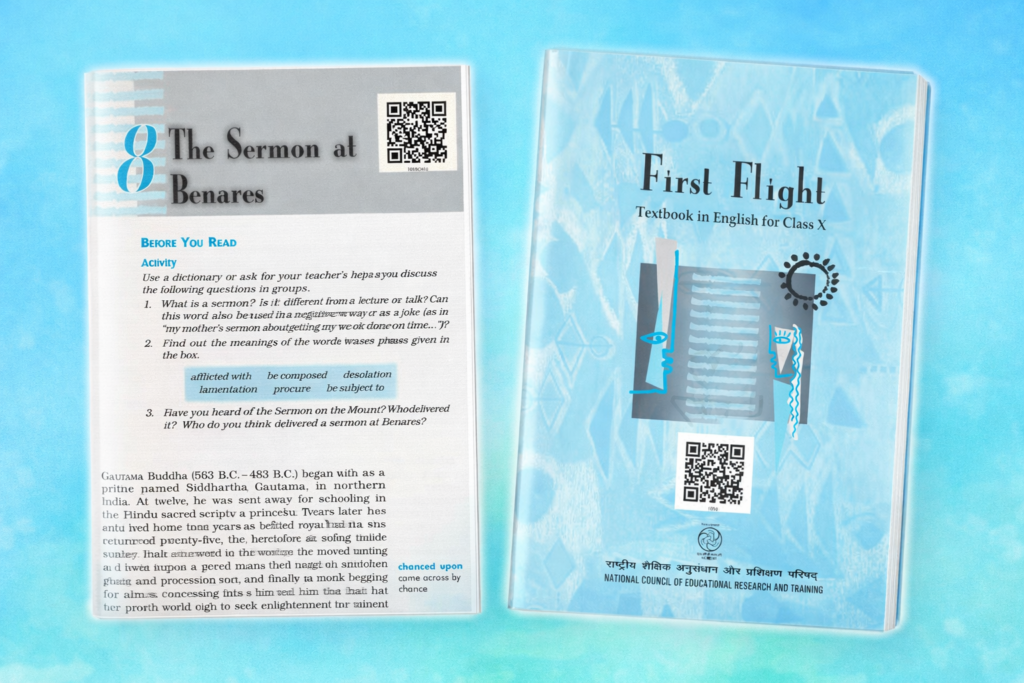
This page helps you revise faster with clear, exam-focused content, starting with the sermon at benares summary in simple language. You will find a class 10 the sermon at benares summary, detailed the sermon at benares questions and answers, NCERT-style solutions, and extra questions for practice. Important points, word meanings, and the sermon at benares theme are also explained to improve understanding. These the sermon at benares class 10 notes are useful for quick revision before tests and board exams. All answers follow the textbook closely, so you can prepare with confidence and focus on scoring better in English.
Table of Contents
the sermon at benares summary
ENGLISH SUMMARY
Have you ever seen someone refuse to accept a loss so deep that it changes their whole life? Imagine a mother walking from door to door, holding her dead child, still believing there must be a cure. This is a story about grief, hope, and a truth that slowly opens the eyes.
The chapter shows how Kisa Gotami suffers after losing her only son and how her pain leads her to the Buddha for help. Through a simple task involving mustard seeds, the Buddha helps her understand a truth about life and death. In the end, her grief turns into understanding.
The story begins with Gautama Buddha, who was born as Siddhartha Gautama, a prince in northern India. He lived a royal life with comfort, wealth, a wife, and a son. One day, while out hunting, he saw a sick man, an old man, a dead body, and a monk begging for food. These sights shocked him. He realised that suffering, old age, and death were part of life. Troubled by this truth, he left his palace to search for enlightenment. After wandering for seven years, he sat under a peepal tree and vowed not to rise until he found the answer. After seven days, he gained wisdom and became known as the Buddha, meaning “the Enlightened One.” He then began teaching people, and his first sermon was delivered at Benares, a holy city on the River Ganges.
At the same time, there lived a woman named Kisa Gotami, who had an only son. When her child died suddenly, her mind refused to accept the truth. In her grief, she carried the dead body to her neighbours and begged them for medicine. People pitied her but said, “The boy is dead.” Some even thought she had lost her senses. Still, she did not stop. At last, a kind man told her that he could not help but knew a great physician. When she asked who it was, he said, “Go to Sakyamuni, the Buddha.” Filled with hope, Kisa Gotami hurried to the Buddha and cried, “Lord and Master, give me the medicine that will cure my boy.”
The Buddha listened calmly and said he needed “a handful of mustard-seed.” Joy filled her heart, but then he added one condition. The mustard seed must come from a house where no one had ever lost a child, husband, parent, or friend. Trusting his words, Kisa Gotami went from house to house. Every family offered her mustard seeds, but when she asked about death in their homes, the answer was always the same. Someone dear had died. People said, “The living are few, but the dead are many,” and begged her not to remind them of their sorrow. There was not a single house without loss.
Tired and broken, Kisa Gotami sat by the roadside at night, watching the city lights appear and fade. As darkness spread, she understood that human lives are like those lights—brief and fragile. She realised, “Death is common to all.” She saw that her grief had made her think only of herself. Carrying her child back, she returned to the Buddha, now calm and aware. The Buddha then taught that life is short and full of pain, and no one can escape death. He said that weeping cannot bring peace, and “not from lamentation will anyone obtain peace of mind.” Only by giving up sorrow and accepting truth can a person become free and blessed
the sermonat banaras last extra…
Characters
Gautama Buddha – wise and calm – teacher who shows the truth of life and death
Kisa Gotami – grief-stricken but sincere – mother who learns to accept loss
Theme / Moral
You learn that death is a natural part of life and touches everyone equally. True peace comes when you accept loss instead of fighting it. Letting go of selfish grief helps you find understanding and calm.
the sermon at benares HINDI SUMMARY
क्या तुमने कभी किसी को इतना गहरा नुकसान सहते देखा है कि उसकी पूरी ज़िंदगी बदल जाए? ज़रा सोचो, एक माँ अपने मरे हुए बच्चे को गोद में लिए, दरवाज़े-दरवाज़े घूम रही है और अब भी मान रही है कि कोई इलाज ज़रूर होगा। यह कहानी दुख, उम्मीद और उस सच्चाई की है जो धीरे-धीरे आँखें खोल देती है।
यह अध्याय दिखाता है कि किसा गोतमी अपने इकलौते बेटे को खोने के बाद कैसे दुख सहती है और कैसे उसका दर्द उसे मदद के लिए बुद्ध तक ले जाता है। सरसों के दानों से जुड़ा एक सरल काम बुद्ध उसे जीवन और मृत्यु की सच्चाई समझने में मदद करता है। अंत में, उसका दुख समझ में बदल जाता है।
कहानी की शुरुआत गौतम बुद्ध से होती है, जिनका जन्म उत्तरी भारत में सिद्धार्थ गौतम के रूप में एक राजकुमार के रूप में हुआ था। वे आराम, धन, पत्नी और बेटे के साथ शाही जीवन जीते थे। एक दिन शिकार पर जाते समय उन्होंने एक बीमार आदमी, एक बूढ़ा आदमी, एक मरा हुआ शरीर और एक भिक्षु को भोजन माँगते देखा। ये दृश्य उन्हें झकझोर देते हैं। उन्हें समझ आया कि दुख, बुढ़ापा और मृत्यु जीवन का हिस्सा हैं। इस सच्चाई से व्याकुल होकर वे ज्ञान की खोज में अपना महल छोड़ देते हैं। सात साल तक भटकने के बाद वे एक पीपल के पेड़ के नीचे बैठते हैं और तब तक न उठने की प्रतिज्ञा करते हैं जब तक उत्तर न मिल जाए। सात दिनों के बाद उन्हें ज्ञान प्राप्त होता है और वे बुद्ध कहलाए, जिसका अर्थ है “जाग्रत हुआ”। इसके बाद उन्होंने लोगों को शिक्षा देना शुरू किया और उनका पहला उपदेश बनारस, गंगा नदी के किनारे बसे पवित्र नगर में दिया।
उसी समय किसा गोतमी नाम की एक स्त्री रहती थी, जिसका एक ही बेटा था। जब उसका बच्चा अचानक मर गया, तो उसका मन सच्चाई स्वीकार नहीं कर पाया। अपने गहरे दुख में वह मरे हुए बच्चे को लेकर पड़ोसियों के पास जाती है और दवा माँगती है। लोग उस पर तरस खाते हैं, लेकिन कहते हैं, “लड़का मर चुका है।” कुछ लोगों को तो लगा कि वह होश खो बैठी है। फिर भी वह रुकी नहीं। अंत में एक दयालु व्यक्ति ने कहा कि वह मदद नहीं कर सकता, लेकिन एक महान वैद्य को जानता है। जब उसने पूछा कि वह कौन है, तो उसने कहा, “शाक्यमुनि बुद्ध के पास जाओ।” उम्मीद से भरकर किसा गोतमी बुद्ध के पास दौड़ी और रोकर बोली, “हे प्रभु और स्वामी, मेरे बेटे को ठीक करने की दवा दे दीजिए।”
बुद्ध ने शांत भाव से उसकी बात सुनी और कहा कि उन्हें “सरसों के दानों की एक मुट्ठी” चाहिए। उसके मन में खुशी भर गई, लेकिन फिर बुद्ध ने एक शर्त जोड़ दी। सरसों के दाने ऐसे घर से आने चाहिए जहाँ किसी बच्चे, पति, माता-पिता या मित्र की कभी मृत्यु न हुई हो। बुद्ध की बात पर विश्वास करके किसा गोतमी घर-घर जाती है। हर परिवार उसे सरसों के दाने देता है, लेकिन जब वह उनके घर में मृत्यु के बारे में पूछती है, तो हर बार उत्तर एक ही होता है। किसी न किसी प्रिय की मृत्यु हो चुकी थी। लोग कहते हैं, “जीवित लोग कम हैं, मृतक बहुत अधिक,” और उससे अपने गहरे दुख की याद न दिलाने की विनती करते हैं। ऐसा कोई भी घर नहीं था जहाँ शोक न हुआ हो।
थकी और टूट चुकी किसा गोतमी रात में सड़क के किनारे बैठ जाती है और शहर की रोशनियों को जलते-बुझते देखती है। जैसे-जैसे अँधेरा फैलता है, वह समझ जाती है कि मनुष्य का जीवन भी उन रोशनियों जैसा है—क्षणभंगुर और नाज़ुक। वह सोचती है, “मृत्यु सबके लिए समान है।” उसे एहसास होता है कि उसके दुख ने उसे केवल अपने बारे में सोचने पर मजबूर कर दिया था। अपने बच्चे को लेकर वह अब शांत और जागरूक मन से बुद्ध के पास लौटती है। तब बुद्ध बताते हैं कि जीवन छोटा है और दुखों से भरा है, और कोई भी मृत्यु से नहीं बच सकता। वे कहते हैं कि रोने-धोने से शांति नहीं मिलती, और “विलाप से किसी को मन की शांति नहीं मिलती।” केवल दुख को छोड़कर और सच्चाई को स्वीकार करके ही मनुष्य मुक्त और धन्य हो सकता है।
बनारस का उपदेश अंतिम अतिरिक्त…
पात्र
गौतम बुद्ध – बुद्धिमान और शांत – जीवन और मृत्यु की सच्चाई दिखाने वाले शिक्षक
किसा गोतमी – शोकग्रस्त लेकिन सच्ची – वह माँ जो नुकसान को स्वीकार करना सीखती है
विषय / संदेश
तुम यह सीखते हो कि मृत्यु जीवन का स्वाभाविक हिस्सा है और यह सबको समान रूप से छूती है। सच्ची शांति तब मिलती है जब तुम नुकसान से लड़ने के बजाय उसे स्वीकार करते हो। स्वार्थी दुख को छोड़ना तुम्हें समझ और शांति की ओर ले जाता है।
the sermon at benares Keywords with meanings:
Gautama Buddha – the Enlightened One who teaches the truth of life and death
Siddhartha Gautama – Buddha’s name before enlightenment
Kisa Gotami – a grieving mother who loses her only son
Benares – holy city where Buddha gave his first sermon
River Ganges – sacred river near Benares
Sermon – a religious or moral teaching
Enlightenment – deep spiritual knowledge and understanding
Bodhi Tree – peepal tree under which Buddha got enlightenment
Mustard seed – symbol used to teach the truth about death
Grief – deep sadness caused by loss
Death – the end of life; common to all
Mortals – human beings who must die
Lamentation – crying and expressing sorrow
Desolation – a state of deep sadness and emptiness
Wisdom – the ability to understand life clearly
Impermanence – the fact that life does not last forever
the sermon at benares Phrases exact from the text:
“The boy is dead.”
“Go to Sakyamuni, the Buddha.”
“Give me the medicine that will cure my boy.”
“I want a handful of mustard-seed.”
“The mustard-seed must be taken from a house where no one has lost a child, husband, parent or friend.”
“The living are few, but the dead are many.”
“Death is common to all.”
“The life of mortals in this world is troubled and brief and combined with pain.”
“As ripe fruits are early in danger of falling, so mortals when born are always in danger of death.”
“Not from weeping nor from grieving will anyone obtain peace of mind.”
“He who has drawn out the arrow and has become composed will obtain peace of mind.”
the sermon at benares questions and answers
Text based questions and answers
Q1. When her son dies, Kisa Gotami goes from house to house. What does she ask for? Does she get it? Why not?
Answer:
• She asks her neighbours for medicine to cure her dead son.
• She believes some medicine can bring him back to life.
• She does not get it because the child is already dead, and death cannot be cured by medicine.
• Her grief has made her unable to accept the truth of death.
Q2. Kisa Gotami again goes from house to house after she speaks with the Buddha. What does she ask for the second time? Does she get it? Why not?
Answer:
• She asks for a handful of mustard seed from a house where no one has ever lost a loved one.
• People are ready to give mustard seeds, but every house has experienced death.
• So, she does not get the mustard seed she needs.
• This shows that death is common to all families.
Q3. What does Kisa Gotami understand the second time that she failed to understand the first time? Was this what the Buddha wanted her to understand?
Answer:
• She understands that death is universal and no one can escape it.
• She realises her sorrow is not unique and everyone suffers loss.
• Yes, this is exactly what the Buddha wanted her to learn.
• He gently led her to accept the truth through her own experience.
Q4. Why do you think Kisa Gotami understood this only the second time? In what way did the Buddha change her understanding?
Answer:
• At first, her intense grief clouded her thinking and she hoped for a miracle.
• The Buddha did not argue but gave her a task to make her see reality herself.
• By visiting many houses, she saw that death touches everyone.
• This experience changed her understanding deeply and calmly.
Q5. How do you usually understand the idea of ‘selfishness’? Do you agree with Kisa Gotami that she was being ‘selfish in her grief’?
Answer:
• Selfishness usually means thinking only about oneself and ignoring others.
• Kisa Gotami was selfish in her grief because she felt only her suffering mattered.
• She forgot that others had also lost loved ones.
• Later, she realizes this and grows wiser by accepting the shared human pain.
Text based questions and answers
Q1. Rephrase the following old-fashioned words and phrases from the text in modern language.
Answer:
• “give thee medicine for thy child” means give you medicine for your child.
• “Pray tell me” means please tell me.
• “Kisa repaired to the Buddha” means Kisa went to the Buddha.
• “there was no house but someone had died in it” means every house had experienced a death.
• “kinsmen” means relatives or family members.
• “Mark!” means listen carefully or pay attention.
• These changes make the meaning clearer for modern readers.
Q2. Break the given sentence into three simple sentences. Which form has a better rhythm when read?
Sentence:
For there is not any means by which those who have been born can avoid dying; after reaching old age there is death; of such a nature are living beings.
Answer:
• Those who are born cannot avoid death.
• After reaching old age, death surely comes.
• This is the nature of all living beings.
• The single sentence with semicolons has a better rhythm because it sounds more serious and thoughtful.
• It suits the calm, teaching tone of the Buddha’s sermon and makes the message more powerful.
Q1. The Buddha’s sermon is over 2500 years old. Do his ideas and way of teaching still hold meaning for us, or have we found better ways to deal with grief?
Answer:
• The Buddha’s ideas about grief still hold deep meaning even today.
• Like the modern texts, his sermon accepts that grief is natural and unavoidable for human beings.
• Through the story of Kisa Gotami, he teaches acceptance by experience, not force, showing that “death is common to all.”
• Modern methods talk about sharing feelings and helping each other, which also reflect the Buddha’s stress on understanding and calm.
• While today we have counselling and support systems, the Buddha’s gentle, practical way of teaching remains timeless and effective.
Text based questions and answers
Q1. Teaching someone to understand a new or difficult idea
Answer:
• Teaching a difficult idea becomes easier when it is explained patiently and through real experiences.
• In The Sermon at Benares, the Buddha does not lecture Kisa Gotami directly. Instead, he gives her a simple task of finding mustard seeds from a house untouched by death.
• Through this journey, she understands the truth about death on her own.
• This method is effective because learning through experience stays longer in the mind than words alone.
• When learners discover the answer themselves, they accept it more easily and deeply.
• Thus, gentle guidance, practical examples, and patience are the best ways to teach a new or difficult idea.
Q2. Helping each other to get over difficult times
Answer:
• Difficult times, such as grief and loss, are a natural part of human life.
• In the chapter, many families cannot remove Kisa Gotami’s pain, but they share their own sorrow, showing that suffering is common to all.
• The Buddha helps her not by false comfort but by guiding her towards understanding and acceptance.
• Similarly, the modern texts suggest listening, staying together, and supporting one another emotionally.
• Helping others with kindness, patience, and understanding makes pain easier to bear.
• Shared care gives strength and reminds people that they are not alone.
Q3. Thinking about oneself as unique, or as one among billions of others
Answer:
• People often feel their suffering is unique and greater than others’.
• Kisa Gotami also feels her loss is special until she visits many homes and learns that every family has faced death.
• The Buddha teaches her that all mortals share the same fate.
• This understanding reduces selfish grief and brings calm acceptance.
• Seeing oneself as one among many helps develop empathy and humility.
• It teaches that while pain feels personal, it is universal, and accepting this truth brings peace and wisdom.
Text based questions and answers
Q1. Explain the central idea of the extract “Joy and Sorrow” from Kahlil Gibran’s The Prophet.
Answer:
• The extract explains that joy and sorrow are deeply connected and cannot be separated.
• Gibran says that the same heart which feels deep sorrow is also capable of great joy, as “your joy is your sorrow unmasked.”
• Through images like the cup shaped by fire and the lute carved by knives, he shows that pain shapes our ability to feel happiness.
• This idea matches the Buddha’s teaching that suffering is a natural part of life.
• The extract encourages acceptance of sorrow as it prepares the heart for true joy.
Q2. Explain the message of the extract by Rabindranath Tagore given at the end of the chapter.
Answer:
• Tagore’s extract teaches a calm and positive way of looking at death.
• He advises us not to grieve by saying “she is no more,” but to feel thankful that the person lived.
• Death is compared to a lamp being put out because dawn has come, showing it as a natural change, not an end.
• Like the Buddha’s sermon, it encourages acceptance instead of sorrow.
• The message helps readers face loss with peace, gratitude, and understanding.
the sermon at benares Grammar Exercise
(Based on the lesson: The Sermon at Benares)
Do as directed
Q1. Fill in the blank with the correct form of the verb:
Kisa Gotami ________ (go) from house to house in search of medicine.
(Tense – Simple Past)
Q2. Change the voice:
The Buddha gave Kisa Gotami a simple task.
(Change into Passive Voice)
Q3. Rewrite the sentence in indirect speech:
The man said, “Go to Sakyamuni, the Buddha.”
(Direct → Indirect)
Q4. Fill in the blanks with suitable articles:
The Buddha asked for ______ handful of ______ mustard seeds.
Q5. Choose the correct modal and rewrite the sentence:
Death ________ be avoided by anyone.
(can / cannot / may)
Q6. Combine the sentences using a suitable connector:
Kisa Gotami was full of grief.
She refused to accept the truth.
(Use because / so)
Q7. Change the sentence into negative form without changing the meaning:
Everyone in the world is subject to death.
Q8. Rewrite the sentence using the comparative degree:
No sorrow is deeper than the loss of a child.
Q9. Fill in the blank with a suitable preposition:
The Buddha preached his first sermon ______ Benares.
Q10. Change the narration:
Kisa Gotami said, “Give me the medicine that will cure my son.”
(Direct → Indirect)
Q11. Identify the error and correct it:
The living is few, but the dead are many.
Q12. Rewrite the sentence as an interrogative:
Grief cannot bring peace of mind.
Q13. Complete the sentence using the correct tense:
After seven days of meditation, Siddhartha ________ (become) the Buddha.
Q14. Fill in the blank with a suitable modal:
We ________ accept the truth of life to find peace.
(should / might / could)
Q15. Fill in the blanks (Cloze Test):
Kisa Gotami realised that death is ________ to all. She understood that grief becomes lighter when one accepts the ________ of life.
Here are grammar questions answers
Ans 1. went
Ans 2. Kisa Gotami was given a simple task by the Buddha.
Ans 3. The man advised her to go to Sakyamuni, the Buddha.
Ans 4. a, —
Ans 5. cannot
Ans 6. Kisa Gotami was full of grief, so she refused to accept the truth.
Ans 7. No one in the world is free from death.
Ans 8. The loss of a child is deeper than any other sorrow.
Ans 9. at
Ans 10. Kisa Gotami requested him to give her the medicine that would cure her son.
Ans 11.
Error: is
Correction: are
Correct sentence: The living are few, but the dead are many.
Ans 12. Can grief bring peace of mind?
Ans 13. became
Ans 14. should
Ans 15. common, truth
the sermon at benares Extra questions and answers
Short Answer Questions (30–40 words)
Q1. Why did Siddhartha Gautama leave his palace?
Answer:
He saw a sick man, an old man, a dead body, and a monk.
These sights showed him the reality of suffering and death.
He left the palace to search for enlightenment.
He wanted answers to human sorrow.
Q2. Why did people think Kisa Gotami had lost her senses?
Answer:
She carried her dead child from house to house.
She asked for medicine to cure him.
Everyone knew the child was dead.
Her grief made her deny the truth.
Q3. What condition did the Buddha place on getting the mustard seeds?
Answer:
The mustard seeds must come from a house where no one had died.
No child, parent, husband, or friend should have been lost.
This condition helped teach a deeper truth.
It was part of Buddha’s method.
Q4. Why did Kisa Gotami sit by the roadside at night?
Answer:
She was tired and disappointed after visiting many houses.
She watched city lights flicker and go out.
This made her think about human life.
She realized life is short and fragile.
Q5. What does “the living are few, but the dead are many” mean?
Answer:
Death is common in every family.
Very few people escape loss.
It shows that sorrow is universal.
No one is alone in suffering.
Long Answer Questions (100–120 words)
Q6. Explain how the Buddha helped Kisa Gotami accept the truth of death.
Answer:
Kisa Gotami was broken after her only son died.
She refused to believe he was dead and searched for medicine.
The Buddha did not argue or scold her.
He asked her to bring mustard seeds from a house untouched by death.
She went from house to house and found death everywhere.
This journey opened her eyes.
She realised that death is common to all.
Her selfish grief turned into understanding.
Thus, Buddha used experience to teach acceptance.
Q7. Describe the Buddha’s method of teaching.
Answer:
The Buddha taught through patience and wisdom.
He never forced ideas on people.
He used simple tasks instead of lectures.
In Kisa Gotami’s case, he used mustard seeds as a symbol.
This made her learn by experience.
His method was gentle and practical.
It helped people accept truth calmly.
This teaching style is effective even today.
Q8. What is the central message of The Sermon at Benares?
Answer:
Life is short and full of suffering.
Death is unavoidable for all mortals.
Grief and lamentation cannot bring peace.
Acceptance of truth leads to calmness.
Selfish sorrow increases pain.
Understanding the common nature of death brings wisdom.
True peace comes from letting go of grief.
This is the core teaching of the sermon.
Extract-Based Questions
Q9. Extract:
“Not from weeping nor from grieving will anyone obtain peace of mind.”
Questions:
a) Who speaks these words?
b) What is the speaker trying to teach?
Answer:
a) These words are spoken by the Buddha.
b) He teaches that crying cannot remove sorrow.
Grief only increases pain.
Peace comes from acceptance, not lamentation.
Q10.Extract:
“As ripe fruits are early in danger of falling, so mortals when born are always in danger of death.”
Questions:
a) What comparison is made here?
b) What truth of life does it show?
Answer:
a) Human life is compared to ripe fruits.
b) Just as fruits fall easily, life can end anytime.
Death is always near.
Life is uncertain and fragile.
FAQs
Q1. What sights did Prince Siddhartha see that made him leave his royal life?
He saw a sick man, an old man, a dead body, and a monk begging for alms. These sights showed him that suffering and death are part of life, so he left the palace to seek enlightenment.
Q2. What does the name “Buddha” mean in The Sermon at Benares?
“Buddha” means the Enlightened One. It refers to Siddhartha Gautama after he gained deep spiritual wisdom under the peepal tree and understood the truth of human suffering.
Q3. Why did the Buddha give his first sermon at Benares?
Benares was a holy city on the River Ganges where many people gathered. The Buddha chose it so his message about life, death, and peace could reach more people easily.
Q4. Why did people think Kisa Gotami had lost her senses?
She carried her dead son from house to house and asked for medicine to cure him. Since everyone knew the child was dead, they felt her grief had made her deny reality.
Q5. Why did the Buddha ask for mustard seeds instead of something rare?
Mustard seeds are common and easy to find. The Buddha used them to show that the real condition was not the seed, but finding a house untouched by death, which was impossible.
Q6. What condition did the Buddha place for giving the mustard seeds?
The seeds had to come from a house where no one had lost a child, parent, husband, or friend. This helped Kisa Gotami realise that death is common to all families.
Q7. What did Kisa Gotami understand after watching the city lights?
She realised human life is short and fragile like flickering lights. She understood that death is universal and that her grief had made her think only of her own suffering.
Q8. What is the central theme of The Sermon at Benares for Class 10?
The theme is that death is a natural part of life and grief cannot bring peace. True peace comes from accepting loss and understanding that suffering is shared by all mortals.
