

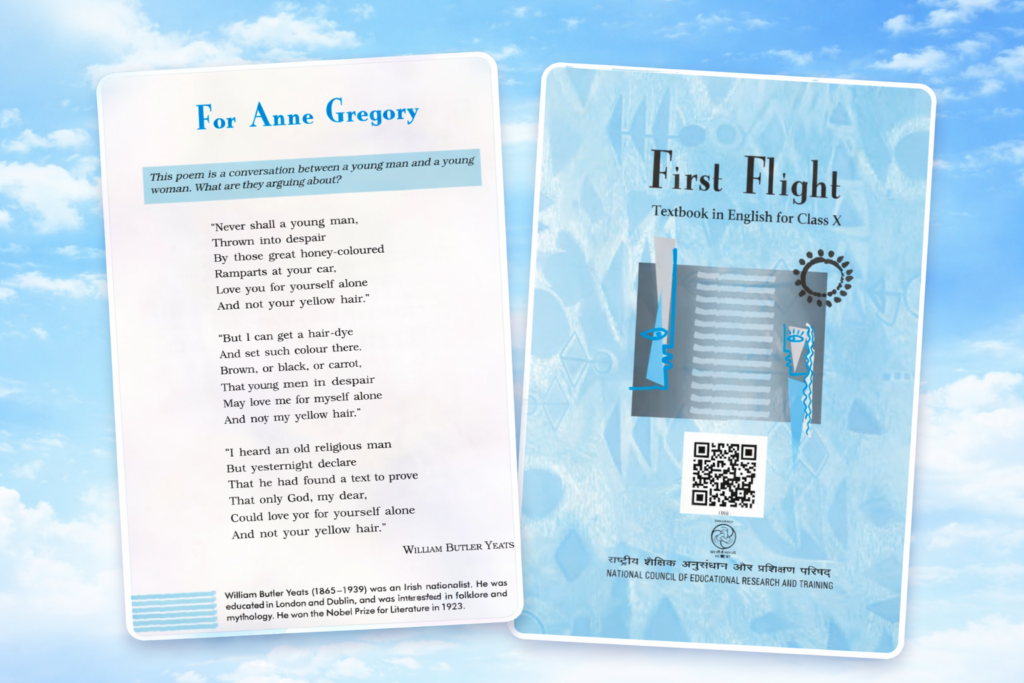
This page helps you prepare faster with For Anne Gregory summary Class 10 explained in simple words. You will find a clear poem summary, NCERT-based question answers, extra questions for practice, and short notes for quick revision. It also includes For Anne Gregory explanation with line by line explanation, word meaning, theme, and poetic devices to improve understanding. All answers follow exam patterns and cover important extract-based and short questions. This complete set of For Anne Gregory class 10 notes is useful for school tests, homework, and board exam preparation.
Table of Contents
for anne gregory summary
English Summary
Have you ever wondered if people admire you or just the way you look? What if love begins with beauty but never moves beyond it? This poem drops you straight into that uncomfortable question, spoken out loud in a quiet but sharp conversation.
The chapter shows a short talk between a young man and a young woman about love and appearance. The young man believes physical beauty always comes first and cannot be ignored. The young woman argues back, but the poem ends with a firm answer that only divine love can truly see beyond looks.
The poem opens with a young man speaking directly to a young woman. He sounds calm but certain. He says that no young man, no matter how emotional or desperate, will ever love her only for who she is inside. He claims that men are first captured by what they see. He points to her yellow hair, describing it vividly as “great honey-coloured ramparts at your ear.” His words paint her hair like strong golden walls that attract attention before anything else. He clearly says that her beauty, especially her hair, will always come before her true self in the eyes of men. In his view, love based only on inner qualities simply does not happen in the real world.
The young woman listens, but she does not accept this idea quietly. She answers with confidence and a practical solution. She says that she can easily change the color of her hair. She mentions using hair-dye and lists different colors—“brown, or black, or carrot.” Her reply shows hope and belief in choice. She feels that if her hair color changes, then young men might finally look beyond appearance. She believes that once the bright attraction is gone, people may be forced to notice her real personality. Her response suggests that love based on the self is possible, and beauty can be controlled or removed if needed.
But the conversation does not end there. The young man responds again, this time with a deeper and more serious tone. He shares something he heard from an old religious man just the night before. This man, according to him, had found a text that proved a powerful truth. The young man explains that this religious figure believed only God can love a person completely for who they truly are. According to this belief, human love is always mixed with desire, attraction, and appearance. The young man gently but firmly tells the woman that even if she changes her hair, human love will never be pure in the way she hopes. The poem ends quietly but strongly, with the idea that divine love alone can see the soul without being distracted by the outer form.
The conversation never turns angry, but it stays serious and thoughtful. Each speaker holds their ground. The poem closes without argument or solution, leaving the final statement as a truth that feels heavy and final. The repeated mention of “yourself alone” and “yellow hair” keeps reminding the reader of the main conflict between inner worth and outer beauty.
Young Man – realistic and firm – questions whether humans can love beyond appearance
Young Woman – hopeful and confident – believes inner self can be loved if beauty is removed
Old Religious Man – wise and symbolic – represents spiritual truth about pure love
for anne gregory Hindi Summary
The central message is clear and direct: you may hope that people love you for who you truly are, but human love is often drawn to outer beauty first. Only pure, divine love can see beyond appearance and love the soul completely.
क्या तुमने कभी सोचा है कि लोग तुम्हें सच में पसंद करते हैं या सिर्फ तुम्हारी शक्ल को? अगर प्यार सुंदरता से शुरू हो और वहीं रुक जाए तो? यह कविता तुम्हें सीधे इसी असहज सवाल के बीच ला खड़ा करती है, जो एक शांत लेकिन तीखी बातचीत में ज़ोर से कहा जाता है।
यह अध्याय प्यार और दिखावट पर एक युवक और एक युवती के बीच हुई छोटी-सी बातचीत दिखाता है। युवक मानता है कि शारीरिक सुंदरता हमेशा पहले आती है और उसे नज़रअंदाज़ नहीं किया जा सकता। युवती इसका विरोध करती है, लेकिन कविता का अंत एक पक्के उत्तर के साथ होता है कि सिर्फ ईश्वरीय प्रेम ही सच में रूप-रंग से आगे देख सकता है।
कविता की शुरुआत में एक युवक सीधे एक युवती से बात करता है। उसकी आवाज़ शांत है, लेकिन भरोसे से भरी हुई। वह कहता है कि कोई भी युवक, चाहे वह कितना ही भावुक या परेशान क्यों न हो, उसे सिर्फ उसके अंदर के व्यक्ति के लिए कभी प्यार नहीं करेगा। उसका कहना है कि पुरुष सबसे पहले वही देखते हैं जो आँखों से दिखता है। वह उसके पीले बालों की ओर इशारा करता है और उन्हें “कान के पास शहद जैसे रंग की ऊँची दीवारें” बताता है। उसके शब्द बालों को मजबूत सुनहरी दीवारों की तरह दिखाते हैं, जो सबसे पहले ध्यान खींचती हैं। वह साफ़ कहता है कि पुरुषों की नज़र में उसकी सुंदरता, खासकर उसके बाल, हमेशा उसके असली व्यक्तित्व से पहले आएगी। उसके अनुसार, सिर्फ अंदरूनी गुणों पर टिका प्यार असली दुनिया में होता ही नहीं।
युवती ध्यान से सुनती है, लेकिन वह इस बात को चुपचाप नहीं मानती। वह पूरे भरोसे के साथ और एक व्यावहारिक हल देकर जवाब देती है। वह कहती है कि वह अपने बालों का रंग आसानी से बदल सकती है। वह हेयर-डाई का ज़िक्र करती है और अलग-अलग रंग गिनाती है—“भूरा, या काला, या गाजर जैसा।” उसके जवाब में उम्मीद और अपने फैसले पर विश्वास झलकता है। उसे लगता है कि अगर उसके बालों का रंग बदल जाएगा, तो शायद युवक दिखावट से आगे देख पाएँगे। उसका मानना है कि जब चमकदार आकर्षण हट जाएगा, तब लोग उसके असली स्वभाव को देखने के लिए मजबूर होंगे। उसका उत्तर यह संकेत देता है कि आत्मा पर आधारित प्यार संभव है, और सुंदरता को ज़रूरत पड़ने पर बदला या हटाया जा सकता है।
लेकिन बातचीत यहीं खत्म नहीं होती। युवक फिर से जवाब देता है, इस बार और गहरे और गंभीर अंदाज़ में। वह कुछ बताता है जो उसने पिछली ही रात एक बूढ़े धार्मिक व्यक्ति से सुना था। उसके अनुसार, उस व्यक्ति को एक धार्मिक ग्रंथ का वाक्य मिला था, जो एक गहरी सच्चाई साबित करता था। युवक समझाता है कि उस धार्मिक व्यक्ति का विश्वास था कि सिर्फ भगवान ही किसी इंसान को पूरी तरह उसके असली रूप के लिए प्यार कर सकता है। इस विश्वास के अनुसार, इंसानी प्यार हमेशा चाहत, आकर्षण और दिखावट से जुड़ा रहता है। युवक नरमी से लेकिन दृढ़ता के साथ युवती से कहता है कि वह बालों का रंग बदल भी ले, तो भी इंसानी प्यार कभी वैसा शुद्ध नहीं होगा जैसा वह उम्मीद करती है। कविता शांत लेकिन मज़बूत ढंग से खत्म होती है, इस विचार के साथ कि सिर्फ ईश्वरीय प्रेम ही बाहरी रूप से भटके बिना आत्मा को देख सकता है।
बातचीत कभी गुस्से में नहीं बदलती, लेकिन वह गंभीर और सोचने वाली बनी रहती है। दोनों अपने-अपने विचारों पर अड़े रहते हैं। कविता बिना किसी बहस या हल के समाप्त हो जाती है, और आख़िरी बात एक भारी और अंतिम सच्चाई की तरह महसूस होती है। “सिर्फ अपने आप से” और “पीले बाल” का बार-बार ज़िक्र पाठक को अंदरूनी मूल्य और बाहरी सुंदरता के बीच के मुख्य टकराव की याद दिलाता रहता है।
युवक – यथार्थवादी और दृढ़ – यह सवाल उठाता है कि क्या इंसान दिखावट से आगे जाकर प्यार कर सकता है
युवती – आशावादी और आत्मविश्वासी – मानती है कि सुंदरता हटने पर आत्मा से प्यार किया जा सकता है
बूढ़ा धार्मिक व्यक्ति – बुद्धिमान और प्रतीकात्मक – शुद्ध प्रेम की आध्यात्मिक सच्चाई का प्रतिनिधि
केंद्रीय संदेश साफ़ और सीधा है: तुम यह उम्मीद कर सकते हो कि लोग तुम्हें तुम्हारे असली रूप के लिए प्यार करें, लेकिन इंसानी प्यार अक्सर पहले बाहरी सुंदरता की ओर खिंच जाता है। सिर्फ शुद्ध, ईश्वरीय प्रेम ही दिखावट से आगे देखकर आत्मा को पूरी तरह प्यार कर सकता है।
for anne Gregory Keywords with meanings:
young man – the speaker who doubts true love
Anne Gregory – the girl with yellow hair
yellow hair – her beautiful golden locks that attract guys
ramparts – huge fortress walls (symbol for her hair)
despair – deep sadness or hopelessness
hair-dye – color to change hair
religious man – wise old holy person
text – holy writing or scripture
God – the only one who loves truly
for anne Gregory Important Phrases:
great honey-coloured Ramparts at your ear
Thrown into despair
Love you for yourself alone And not your yellow hair
But I can get a hair-dye
Brown, or black, or carrot
I heard an old religious man But yesternight declare
only God, my dear, Could love you for yourself alone And not your yellow hair
In-text Question: What are they arguing about?
Answer:
The young man and Anne Gregory argue about whether a young man can love her for herself alone or only for her beautiful yellow hair. The young man says no young man can ignore her hair’s charm, while Anne believes she can dye it to prove true love. This shows love often mixes inner self with outer beauty, helping us think deeper about real affection.
for anne gregory question answer
Text based questions answers
Question 1
What does the young man mean by great honey-coloured Ramparts at your ear? Why does he say that young men are thrown into despair by them?
Answer:The young man means Anne’s beautiful yellow hair by “great honey-coloured Ramparts at your ear,” comparing it to strong, golden walls that guard a fort. Young men fall into despair because this hair is so attractive that they love her for it, not her true self. This image reminds us how outer beauty can overshadow inner qualities in love.
Question 2. What colour is the young woman’s hair? What does she say she can change it to? Why would she want to do so?
Answer:The young woman’s hair is yellow, described as honey-coloured. She says she can dye it brown, black, or carrot to change its colour. She wants to do this so young men love her for herself alone, not her hair, proving love goes beyond looks. This clever reply shows her confidence in true inner worth.
Question 3. Objects have qualities which make them desirable to others. Can you think of some objects a car, a phone, a dress… and say what qualities make one object more desirable than another? Imagine you were trying to sell an object what qualities would you emphasise?
Answer: Objects like a car become desirable for speed and shiny design, a phone for fast camera and long battery, or a dress for soft fabric and bright colours over plainer ones. While selling a phone, emphasise its clear display, quick charging, and durability to attract buyers. This teaches us qualities draw attention, just like in people, building smart choices.
Question 4 What about people? Do we love others because we like their qualities, whether physical or mental? Or is it possible to love someone for themselves alone? Are some people more lovable than others? Discuss this question in pairs or in groups, considering points like the following. i a parent or caregivers love for a newborn baby, for a mentally or physically challenged child, for a clever child or a prodigy ii the public’s love for a film star, a sportsperson, a politician, or a social worker iii your love for a friend, or brother or sister iv your love for a pet, and the pet’s love for you.
Answer:We often love people for qualities like a film star’s charm or a friend’s kindness, but true love sees the person alone, as parents love all children—newborns, challenged kids, or prodigies—without conditions. Public loves stars for skills, yet siblings or pets bond deeply beyond looks or talents. Some seem more lovable due to visible traits, but real bonds value the heart, strengthening our relationships.
Question 5 You have perhaps concluded that people are not objects to be valued for their qualities or riches rather than for themselves. But elsewhere Yeats asks the question How can we separate the dancer from the dance? Is it possible to separate the person himself or herself from how the person looks, sounds, walks, and so on? Think of how you or a friend or member of your family has changed over the years. Has your relationship also changed? In what way?
Answer: Yeats questions if we can separate a person from traits like looks or walk, using “How can we separate the dancer from the dance?”—meaning our qualities shape who we are. As a friend grows from shy to confident, their style changes, yet the bond deepens with shared memories. Relationships evolve with these shifts, proving love adapts to the whole person for lasting connection.
Grammar: For Anne Gregory
1.Never shall a young man love you for yourself alone. (Change into future tense)
Do as directed.
2.The young man was thrown into despair by those great honey-coloured ramparts. (Change into active voice)
Do as directed.
3.Anne Gregory said, “I can get a hair-dye and set such colour there.” (Change into indirect speech)
Do as directed.
4.The old religious man declared that only God could love you for yourself alone. (Change into direct speech)
Do as directed.
5.A young man ___ thrown into despair by ramparts at your ear. (Use article ‘was’)
Do as directed.
6.Young men may love me for myself alone and not my yellow hair. (Change into negative)
Do as directed.
7.She ___ dye her hair brown, black or carrot. (Use modal ‘can’)
Do as directed.
8.The ramparts are great honey-coloured walls. (Change into passive voice)
Do as directed.
9.He had found a text to prove that God loves you. (Change into present perfect tense)
Do as directed.
10.The young woman argued ___ the young man about true love. (Fill with preposition ‘with’)
Do as directed.
11.No young man can love her for herself alone. (Change into affirmative)
Do as directed.
12.Those ramparts are more attractive than any other feature. (Change into superlative degree)
Do as directed.
13.Combine: The old man heard it yesternight. He declared a text.
Do as directed.
14.The young men despair. They love her yellow hair. (Join into a complex sentence using ‘because’)
Do as directed.
15.Is it possible to separate the person from their qualities? (Change into passive voice)
Do as directed.
Editing Exercise
The following passage has ten errors related to grammar from the poem. Identify and correct them.
A young man throw into despair by those great honey-coloured rampart at your ear. He say never shall young men love you for yourself alone and not your yellow hairs. But she can gets a hair-dye and set such colour there, brown or black or carrot. That young men in despair may loves me for myself alone.
Gap Filling (Cloze Test)
Fill in the blanks with correct forms of verbs/modals/articles/prepositions from the poem context:
Never shall a young man, ___ (throw) into despair by those great honey-coloured ramparts ___ your ear, love you ___ yourself alone and not ___ yellow hair. But I ___ (can) get a hair-dye ___ set such colour there.
Here are grammar questions answers
1. Change into future tense
Answer:
A young man will never love you for yourself alone.
2. Change into active voice
Answer:
Those great honey-coloured ramparts threw the young man into despair.
3. Change into indirect speech
Answer:
Anne Gregory said that she could get a hair-dye and set such colour there.
4. Change into direct speech
Answer:
The old religious man declared, “Only God can love you for yourself alone.”
5. Use article ‘was’
Answer:
A young man was thrown into despair by ramparts at your ear.
6. Change into negative
Answer:
Young men may not love me for myself alone and not my yellow hair.
7. Use modal ‘can’
Answer:
She can dye her hair brown, black or carrot.
8. Change into passive voice
Answer:
Great honey-coloured walls are called ramparts.
9. Change into present perfect tense
Answer:
He has found a text to prove that God loves you.
10. Fill in the preposition ‘with’
Answer:
The young woman argued with the young man about true love.
11. Change into affirmative
Answer:
A young man can love her for herself alone.
12. Change into superlative degree
Answer:Those ramparts are the most attractive feature.
13. Combine the sentences
Answer:
The old man, who heard it yesternight, declared a text.
14. Join using ‘because’
Answer:
The young men despair because they love her yellow hair.
15. Change into passive voice
Answer:
Can the person be separated from their qualities?
Editing Exercise (Corrections)
Incorrect Correct
throw was thrown
rampart ramparts
say said
young men a young man
hairs hair
gets get
That Then
Men man
loves love
me her
Corrected Passage:
A young man was thrown into despair by those great honey-coloured ramparts at your ear. He said never shall a young man love you for yourself alone and not your yellow hair. But she can get a hair-dye and set such colour there, brown or black or carrot. Then that young man in despair may love her for herself alone.
Gap Filling (Cloze Test)
Answer:
Never shall a young man, thrown into despair by those great honey-coloured ramparts at your ear, love you for yourself alone and not your yellow hair. But I can get a hair-dye and set such colour there.
Extra questions and answers
Short Answer Questions
Q1.Who is the poet of ‘For Anne Gregory’?
Answer:William Butler Yeats wrote the poem ‘For Anne Gregory’.
He was an Irish nationalist who won the Nobel Prize for Literature in 1923.
This fact connects to his interest in folklore and mythology.
Q2.What does the glossary say about ‘ramparts’?
Answer:Ramparts mean high, wide walls around a castle or fort.
The example given is the ramparts of the Red Fort.
In the poem, it describes Anne’s yellow hair poetically.
Q3. Why does the young man mention an old religious man?
Answer:The old man declared a text the previous night.
He said only God could love Anne for herself alone.
This supports the young man’s view on true love.
Long Answer Questions
Q1. Explain the central theme of the poem with examples.
Answer:The poem explores if love can be for a person’s inner self or only outer beauty.
The young man says no young man can ignore Anne’s yellow hair, calling it honey-coloured ramparts.
Anne replies she can dye it brown, black, or carrot to test true love.
The old man’s words confirm only God loves without qualities.
Overall, it questions separating true self from appearance.
Q2.Describe the conversation structure in the poem.
Answer:It is a dialogue between a young man and Anne Gregory.
The man speaks first, saying young men despair over her hair and cannot love her alone.
Anne counters she can change her hair colour for real love.
The man then shares the old religious man’s view about God.
These back-and-forth highlights debate on love’s nature.
Extract Based Questions
Extract: “Never shall a young man, / Thrown into despair / By those great honey-coloured / Ramparts at your ear, / Love you for yourself alone / And not your yellow hair.”
Q1.Who is the speaker here? What does he mean by ‘ramparts’?
Answer:The young man speaks these lines to Anne Gregory.
’Ramparts’ mean her beautiful yellow hair like strong golden walls.
He means her hair causes despair as men love it, not her self.
Q2.What emotion do young men feel according to this extract? Why?
Answer:Young men feel thrown into despair.
This happens because of her attractive honey-coloured hair.
It prevents loving her for herself alone.
Extract: “But I can get a hair-dye / And set such colour there, / Brown, or black, or carrot,”
Q1.Who says this? What is her plan?
Answer:Anne Gregory replies confidently.
Her plan is to dye her hair brown, black, or carrot.
She wants men to love her self, not yellow hair.
FAQs
Q1. Between whom does the conversation in the poem For Anne Gregory take place?
The conversation is between a young man and Anne Gregory. They discuss whether people can love someone for inner self or only for physical beauty.
Q2. What does the word ramparts mean in the poem, literally and symbolically?
Literally, ramparts mean strong walls of a fort. Symbolically, it refers to Anne’s beautiful yellow hair that attracts attention and hides her true self.
Q3. Why are young men said to be thrown into despair in the poem?
Young men feel despair because they are attracted to Anne’s yellow hair and cannot love her for herself alone. Her beauty distracts them from her inner qualities.
Q4. Why does Anne Gregory talk about changing her hair color?
Anne believes that by dyeing her hair brown, black, or carrot, men may look beyond her appearance. She wants to test if true love for her self is possible.
Q5. What is the text mentioned by the old religious man?
The text refers to a holy or religious scripture. It proves that only God can love a person for who they truly are, without judging outer beauty.
Q6. How does the poem differentiate between human love and divine love?
Human love is influenced by appearance and attraction, while divine love is pure and sees only the soul. Only God can love without being distracted by beauty.
Q7. What is the central theme of For Anne Gregory poem?
The poem explores inner worth versus outer beauty. It shows that people often love based on looks, while true, selfless love is rare and divine.
Q8. Which poetic device is used in the phrase honey-coloured ramparts?
This phrase uses metaphor and imagery. Hair is compared to strong golden walls to show how powerful and attention-grabbing Anne’s beauty is.
