

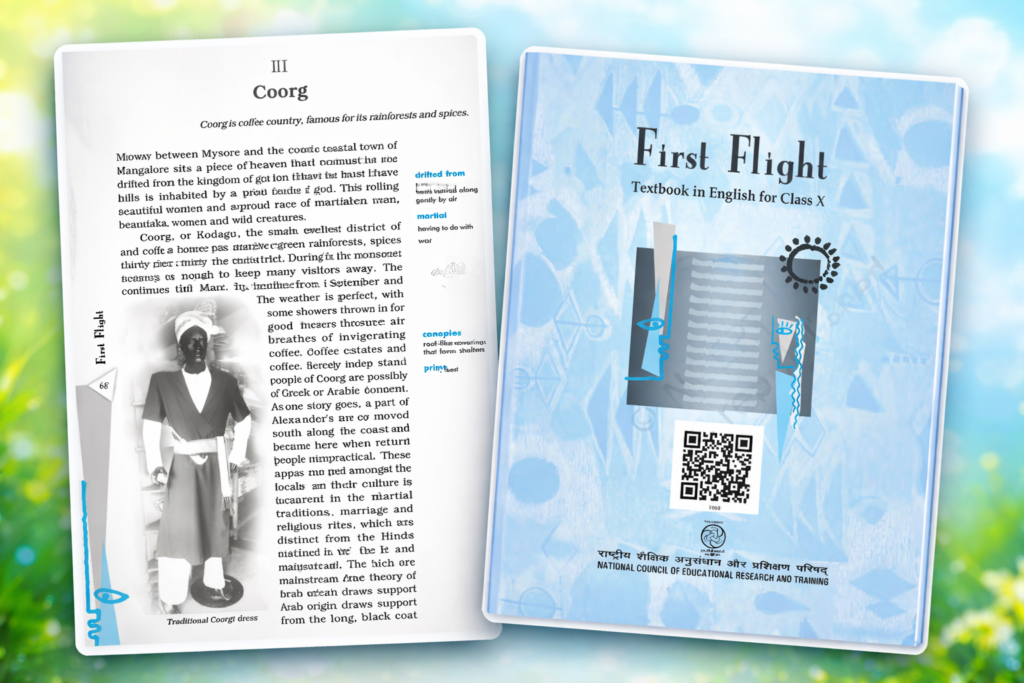
This page helps you revise Coorg Class 10 in a clear and exam-focused way, so you can understand the chapter and score better in tests. You will find a simple summary, NCERT solutions, short and long question answers, extra questions, grammar practice, and helpful notes in one place. For quick revision, we also include Coorg MCQ and extract-based questions to improve concept clarity. All answers are written in simple language and follow the CBSE exam pattern, making this page useful for homework, school exams, and last-minute board preparation.
Table of Contents
Coorg Summary
English Summary
Have you ever imagined a place so green and peaceful that it feels like it “drifted from the kingdom of God”? You are about to step into a land of misty hills, strong traditions, and quiet adventure. This chapter takes you straight into the heart of Coorg, where nature and people live in powerful harmony.
This chapter presents Coorg as a land of natural beauty and brave people, located between Mysore and Mangalore. It shows how the region’s forests, coffee plantations, wildlife, and traditions shape its identity. The chapter ends by revealing Coorg as a place where the “heart and soul of India” can still be felt.
Coorg, also called Kodagu, is the smallest district of Karnataka. It lies midway between Mysore and the coastal town of Mangalore. The writer describes it as a “piece of heaven” that seems to have “drifted from the kingdom of God.” Rolling hills, evergreen rainforests, and wild creatures fill this land. Almost thirty percent of Coorg is covered with evergreen forests. During the monsoon season, it rains so heavily that many visitors stay away. But from September to March, the season of joy begins. The weather turns pleasant, with light showers. The air smells of fresh, invigorating coffee. Coffee estates and old colonial bungalows stand quietly under thick tree canopies in the best corners of the land.
The people of Coorg, called Kodavus, are known for their fierce independence and pride. There is a popular story about their origin. It is believed that a part of Alexander’s army once moved south along the coast and settled in Coorg when returning home became impossible. These soldiers married local women, and over time, a unique culture was formed. Another theory suggests an Arab origin, supported by the traditional dress of the Kodavus. They wear a long black coat with an embroidered waist-belt, called kuppia, which looks like the kuffia worn by Arabs and Kurds. Coorgi homes are famous for their warm hospitality. The people happily share “numerous tales of valour” about their fathers and sons.
The bravery of the Kodavus is clearly seen in their military history. The Coorg Regiment is one of the most decorated regiments in the Indian Army. The first Chief of the Indian Army, General Cariappa, was also a Coorgi. Even today, Kodavus are the only people in India who are allowed to carry firearms without a licence. Nature also plays a major role in Coorg’s life. The Kaveri river begins its journey in the hills and forests of this region. The river is full of Mahaseer, a large freshwater fish. Kingfishers dive into the water to catch fish, while squirrels and langurs drop half-eaten fruits just to enjoy the splash. Elephants love being bathed and scrubbed by their mahouts in the river.
Coorg also offers excitement and adventure. Even the most laidback people are drawn into high-energy sports like river rafting, canoeing, rappelling, rock climbing, and mountain biking. There are many walking trails that trekkers love. Birds, bees, and butterflies keep visitors company, while animals like macaques, Malabar squirrels, langurs, and the slender loris watch quietly from the tree canopy. The climb to the Brahmagiri hills rewards travelers with a wide, panoramic view of the misty land. A walk across a rope bridge leads to the sixty-four-acre island of Nisargadhama. Nearby, in Bylakuppe, visitors may unexpectedly meet Buddhist monks from India’s largest Tibetan settlement, dressed in red, ochre, and yellow robes. These moments make Coorg a place full of surprises.
People of Coorg – brave and independent – shape the culture and traditions
General Cariappa – courageous leader – first Chief of the Indian Army
Kodavus – martial community – known for valour and hospitality
The central message of this chapter is that Coorg is a land where nature, courage, and tradition exist together. You learn that true beauty lies in harmony between people and their environment. You also see how pride in culture and respect for nature give a place its soul.
Coorg Hindi Summary
क्या तुमने कभी ऐसी जगह की कल्पना की है जो इतनी हरी-भरी और शांत हो कि लगे वह “भगवान के राज्य से बहकर आ गई हो”? अब तुम एक ऐसी धरती में कदम रखने वाले हो जहाँ धुंध से ढकी पहाड़ियाँ हैं, मजबूत परंपराएँ हैं और शांत रोमांच है। यह अध्याय तुम्हें सीधे कूर्ग के दिल तक ले जाता है, जहाँ प्रकृति और इंसान गहरी एकता में रहते हैं।
यह अध्याय कूर्ग को प्राकृतिक सुंदरता और बहादुर लोगों की भूमि के रूप में प्रस्तुत करता है, जो मैसूर और मैंगलोर के बीच स्थित है। यह दिखाता है कि इस क्षेत्र के जंगल, कॉफी के बागान, वन्यजीवन और परंपराएँ उसकी पहचान कैसे बनाती हैं। अध्याय का अंत कूर्ग को ऐसी जगह बताकर होता है जहाँ आज भी “भारत का दिल और आत्मा” महसूस की जा सकती है।
कूर्ग, जिसे कोडागू भी कहा जाता है, कर्नाटक का सबसे छोटा जिला है। यह मैसूर और समुद्री शहर मैंगलोर के बीच स्थित है। लेखक इसे “स्वर्ग का एक टुकड़ा” बताता है, जो मानो “भगवान के राज्य से बहकर आ गया हो।” लहराते पहाड़, सदाबहार वर्षावन और जंगली जानवर इस धरती को भर देते हैं। कूर्ग का लगभग तीस प्रतिशत हिस्सा सदाबहार जंगलों से ढका है। मानसून के समय यहाँ इतनी तेज बारिश होती है कि कई पर्यटक आने से रुक जाते हैं। लेकिन सितंबर से मार्च तक खुशी का मौसम शुरू हो जाता है। मौसम सुहावना हो जाता है, बीच-बीच में हल्की बारिश होती है। हवा में ताज़ी, स्फूर्तिदायक कॉफी की खुशबू फैल जाती है। कॉफी के बागान और पुराने औपनिवेशिक बंगले घने पेड़ों की छाया में, इलाके के सबसे अच्छे कोनों में चुपचाप खड़े रहते हैं।
कूर्ग के लोग, जिन्हें कोडावु कहा जाता है, अपनी तेज़ स्वतंत्रता और गर्व के लिए जाने जाते हैं। उनके मूल के बारे में एक प्रसिद्ध कहानी है। माना जाता है कि सिकंदर की सेना का एक हिस्सा कभी समुद्र तट के साथ दक्षिण की ओर बढ़ा और जब वापस लौटना संभव नहीं रहा, तो कूर्ग में बस गया। इन सैनिकों ने स्थानीय महिलाओं से विवाह किया और समय के साथ एक अलग संस्कृति बनी। एक और मान्यता अरबी मूल की ओर इशारा करती है, जिसे कोडावुओं की पारंपरिक पोशाक से बल मिलता है। वे कढ़ाईदार कमरपट्टे वाली लंबी काली कोट पहनते हैं, जिसे कुप्पिया कहा जाता है, जो अरबों और कुर्दों द्वारा पहनी जाने वाली कुफ़्फ़िया जैसी दिखती है। कूर्गी घर अपनी गर्मजोशी भरी मेहमाननवाज़ी के लिए प्रसिद्ध हैं। लोग खुशी-खुशी अपने पिता और बेटों की “वीरता की अनेक कहानियाँ” सुनाते हैं।
कोडावुओं की बहादुरी उनके सैन्य इतिहास में साफ दिखाई देती है। कूर्ग रेजिमेंट भारतीय सेना की सबसे अधिक सम्मानित रेजिमेंटों में से एक है। भारतीय सेना के पहले प्रमुख, जनरल करियप्पा, भी एक कूर्गी थे। आज भी कोडावु भारत के एकमात्र लोग हैं जिन्हें बिना लाइसेंस हथियार रखने की अनुमति है। प्रकृति भी कूर्ग के जीवन में अहम भूमिका निभाती है। कावेरी नदी की शुरुआत इसी क्षेत्र की पहाड़ियों और जंगलों से होती है। इस नदी में महासीर, एक बड़ी मीठे पानी की मछली, भरपूर मात्रा में पाई जाती है। किंगफिशर मछलियाँ पकड़ने के लिए पानी में गोता लगाते हैं, जबकि गिलहरियाँ और लंगूर आधा खाया फल गिराकर पानी की छींटों का मज़ा लेते हैं। हाथी अपने महावतों द्वारा नदी में नहलाए और रगड़े जाना पसंद करते हैं।
कूर्ग रोमांच और उत्साह भी देता है। सबसे आलसी लोग भी नदी राफ्टिंग, कैनोइंग, रैपलिंग, रॉक क्लाइंबिंग और माउंटेन बाइकिंग जैसे तेज़ रोमांचक खेलों की ओर खिंचे चले आते हैं। यहाँ कई पैदल चलने वाले ट्रेल्स हैं, जिन्हें ट्रेकर्स बहुत पसंद करते हैं। पक्षी, मधुमक्खियाँ और तितलियाँ यात्रियों का साथ देती हैं, जबकि मकाक, मालाबार गिलहरियाँ, लंगूर और स्लेंडर लोरिस पेड़ों की छतरी से चुपचाप देखते रहते हैं। ब्रह्मगिरि पहाड़ियों पर चढ़ाई करने पर धुंध से भरे पूरे इलाके का एक विशाल, पैनोरमिक दृश्य दिखाई देता है। एक रस्सी के पुल से होकर चलने पर चौंसठ एकड़ के द्वीप निसर्गधामा तक पहुँचा जा सकता है। पास ही बायलाकुप्पे में, यात्रियों को अचानक भारत की सबसे बड़ी तिब्बती बस्ती के बौद्ध भिक्षु मिल सकते हैं, जो लाल, गेरुए और पीले वस्त्र पहने होते हैं। ऐसे पल कूर्ग को आश्चर्यों से भरी जगह बना देते हैं।
कूर्ग के लोग – बहादुर और स्वतंत्र – संस्कृति और परंपराओं को आकार देते हैं
जनरल करियप्पा – साहसी नेता – भारतीय सेना के पहले प्रमुख
कोडावु – युद्धप्रिय समुदाय – वीरता और मेहमाननवाज़ी के लिए प्रसिद्ध
इस अध्याय का मुख्य संदेश यह है कि कूर्ग वह भूमि है जहाँ प्रकृति, साहस और परंपरा एक साथ रहते हैं। तुम सीखते हो कि असली सुंदरता लोगों और उनके वातावरण के बीच सामंजस्य में छिपी होती है। तुम यह भी देखते हो कि संस्कृति पर गर्व और प्रकृति के प्रति सम्मान किसी जगह को उसकी आत्मा देता है।
Coorg Keywords with meanings:
Coorg / Kodagu – A small district in Karnataka, famous for coffee, rainforests and hills.
Coffee country – A region where coffee is the main and most famous crop.
Evergreen rainforests – Thick forests that stay green all year and get heavy rain.
Monsoons – The rainy season when it pours very heavily.
Season of joy – The pleasant tourist season from September to March.
Coffee plantations – Large farms where coffee plants are grown.
Colonial bungalows – Old style houses built in the British period.
Tree canopies – The roof-like cover formed by the tops of trees.
Kodavus – The people of Coorg, known for bravery and independence.
Martial traditions – War-like customs related to soldiers and fighting.
Hindu mainstream – The common Hindu culture followed by most people.
Kuppia – Long black coat with an embroidered waist-belt worn by Kodavus.
Coorg Regiment – Famous regiment of the Indian Army with many bravery awards.
General Cariappa – First Chief of the Indian Army, from Coorg.
Tales of valour – Stories about great courage and bravery.
Kaveri – Important river that gets its water from Coorg’s hills and forests.
Mahaseer – Large freshwater fish found in the Kaveri river.
Mahouts – Keepers who look after and bathe elephants.
Adventure sports – Exciting outdoor activities like rafting and rock climbing.
River rafting – Travelling in a fast river on an inflatable raft.
Canoeing – Travelling on water in a narrow boat called a canoe.
Rappelling – Sliding down a cliff using a rope.
Rock climbing – Sport of climbing up steep rocks or cliffs.
Mountain biking – Cycling on rough, hilly paths.
Walking trails – Narrow paths made for walking or trekking.
Macaques – A kind of monkey found in Coorg’s forests.
Malabar squirrels – Large colourful squirrels seen in Coorg.
Slender loris – Small, thin, slow-moving animal watching from trees.
Brahmagiri hills – Hills in Coorg that give a wide, misty view.
Panoramic view – Wide, sweeping view of a large area.
Rope bridge – Narrow bridge made of ropes to cross a river or valley.
Nisargadhama – A sixty-four-acre island near Coorg, a tourist spot.
Bylakuppe – Place with India’s largest Tibetan settlement near Coorg.
Buddhist monks – Holy men in red, ochre and yellow robes living in monasteries.
Heart and soul of India – Deep spirit and true feel of India’s culture.
Coorg Important Phrases:
“Coorg is coffee country, famous for its rainforests and spices.”
“MIDWAY between Mysore and the coastal town of Mangalore sits a piece of heaven that must have drifted from the kingdom of god.”
“This land of rolling hills is inhabited by a proud race of martial men, beautiful women and wild creatures.”
“Coorg, or Kodagu, the smallest district of Karnataka, is home to evergreen rainforests, spices and coffee plantations.”
“Evergreen rainforests cover thirty per cent of this district.”
“During the monsoons, it pours enough to keep many visitors away.”
“The season of joy commences from September and continues till March.”
“The air breathes of invigorating coffee.”
“Coffee estates and colonial bungalows stand tucked under tree canopies in prime corners.”
“The fiercely independent people of Coorg are possibly of Greek or Arabic descent.”
“As one story goes, a part of Alexander’s army moved south along the coast and settled here when return became impractical.”
“Their culture is apparent in the martial traditions, marriage and religious rites, which are distinct from the Hindu mainstream.”
“The theory of Arab origin draws support from the long, black coat with an embroidered waist-belt worn by the Kodavus.”
“Known as kuppia, it resembles the kuffia worn by the Arabs and the Kurds.”
“Coorgi homes have a tradition of hospitality, and they are more than willing to recount numerous tales of valour related to their sons and fathers.”
“The Coorg Regiment is one of the most decorated in the Indian Army.”
“The first Chief of the Indian Army, General Cariappa, was a Coorgi.”
“Kodavus are the only people in India permitted to carry firearms without a licence.”
“The river, Kaveri, obtains its water from the hills and forests of Coorg.”
“Mahaseer a large freshwater fish abound in these waters.”
“Squirrels and langurs drop partially eaten fruit for the mischief of enjoying the splash and the ripple effect in the clear water.”
“Elephants enjoy being bathed and scrubbed in the river by their mahouts.”
“The most laidback individuals become converts to the life of high-energy adventure with river rafting, canoeing, rappelling, rock climbing and mountain biking.”
“Numerous walking trails in this region are a favourite with trekkers.”
“Birds, bees and butterflies are there to give you company.”
“Macaques, Malabar squirrels, langurs and slender loris keep a watchful eye from the tree canopy.”
“I do, however, prefer to step aside for wild elephants.”
“The climb to the Brahmagiri hills brings you into a panoramic view of the entire misty landscape of Coorg.”
“A walk across the rope bridge leads to the sixty-four-acre island of Nisargadhama.”
“Running into Buddhist monks from India’s largest Tibetan settlement, at nearby Bylakuppe, is a bonus.”
“The monks, in red, ochre and yellow robes, are amongst the many surprises that wait to be discovered by visitors searching for the heart and soul of India, right here in Coorg.”
Coorg question and answer
Text based questions and answers
Q1. Where is Coorg?
Answer:Coorg is a small district in Karnataka, located midway between Mysore and the coastal town of Mangalore. It lies among rolling hills, rainforests and coffee plantations, which makes it a very scenic place. Remembering its position between Mysore and Mangalore helps you easily recall the location in exams.
Q2. What is the story about the Kodavu people’s descent?
Answer:There are two main theories about the Kodavu people’s descent. One story says that part of Alexander’s army moved south along the coast and settled in Coorg, marrying local people. Another theory says they are of Arab origin, supported by their long, black coat with an embroidered waist-belt called kuppia, which resembles the kuffia worn by Arabs and Kurds. These stories show that Coorg’s people have a unique and interesting background.
Q3. What are some of the things you now know about
(i) the people of Coorg?
Answer:The people of Coorg, called Kodavus, are fiercely independent, brave and hospitable. They have strong martial traditions and love to tell tales of valour about their sons and fathers. The Coorg Regiment is one of the most decorated in the Indian Army, and the first Chief of the Indian Army, General Cariappa, was a Coorgi. Their courage and warmth make them stand out in Indian culture.
Q3 (ii). the main crop of Coorg?
Answer:The main crop of Coorg is coffee. Coorg is described as “coffee country, famous for its rainforests and spices”, and there are many coffee plantations and coffee estates spread over the hills. The air itself “breathes of invigorating coffee,” showing how deeply coffee is linked with Coorg’s life and economy.
Q3 (iii). the sports it offers to tourists?
Answer:Coorg offers many adventure sports to tourists. Visitors can enjoy river rafting, canoeing, rappelling, rock climbing and mountain biking. There are also numerous walking trails that are a favourite with trekkers. Even the most laidback people become converts to the life of high-energy adventure in Coorg, which makes it exciting for young travellers.
Q3 (iv). the animals you are likely to see in Coorg?
Answer:In Coorg, you can see a variety of animals and birds. In and around the river Kaveri, there are mahaseer, a large freshwater fish, and elephants enjoying their bath, scrubbed by their mahouts. In the forests, you may see kingfishers, squirrels, langurs, macaques, Malabar squirrels and the slender loris, often watching from the tree canopy. Sometimes, there are also wild elephants, for whom even the narrator prefers to step aside.
Q3 (v). its distance from Bangalore, and how to get there?
Answer: Coorg is about 250–260 km from Bangalore. You can reach it by road through two main routes, the more common one via Mysore. The nearest airports are at Mangalore (135 km) and Bangalore (260 km), and the nearest railheads are at Mysore, Mangalore and Hassan. From these places, tourists can travel by road to reach Coorg, making it fairly easy to access.
Q4. Here are six sentences with some words in italics. Find phrases from the text that have the same meaning.
Q4 (i). During monsoons it rains so heavily that tourists do not visit Coorg. (para 2)
Answer:The matching phrase from the text is:
“During the monsoons, it pours enough to keep many visitors away.”
This line shows very heavy rain that stops tourists from coming.
Q4 (ii). Some people say that Alexander’s army moved south along the coast and settled there. (para 3)
Answer:The matching phrase from the text is:
“As one story goes, a part of Alexander’s army moved south along the coast and settled here when return became impractical.”
This connects directly to the legend of the Kodavus’ Greek descent.
Q4 (iii). The Coorg people are always ready to tell stories of their sons’ and fathers’ valour. (para 4)
Answer:The matching phrase from the text is:
“Coorgi homes have a tradition of hospitality, and they are more than willing to recount numerous tales of valour related to their sons and fathers.”
It highlights both their warmth and pride in bravery.
Q4 (iv). Even people who normally lead an easy and slow life get smitten by the high-energy adventure sports of Coorg. (para 6)
Answer:The matching phrase from the text is:
“The most laidback individuals become converts to the life of high-energy adventure with river rafting, canoeing, rappelling, rock climbing and mountain biking.”
This shows how Coorg’s adventures can change even very relaxed people.
Q4 (v). The theory of the Arab origin is supported by the long coat with embroidered waist-belt they wear. (para 3)
Answer:The matching phrase from the text is:
“The theory of Arab origin draws support from the long, black coat with an embroidered waist-belt worn by the Kodavus. Known as kuppia, it resembles the kuffia worn by the Arabs and the Kurds.”
Their dress becomes proof for the Arab origin theory.
Q4 (vi). Macaques, Malabar squirrels observe you carefully from the tree canopy. (para 7)
Answer:The matching phrase from the text is:
“Macaques, Malabar squirrels, langurs and slender loris keep a watchful eye from the tree canopy.”
This creates a clear image of animals watching from above.
Coorg Grammar
Coorg ______________ (be) coffee country, famous for its rainforests and spices. (Do as directed: Fill in the blank with the correct form of the verb.)
During the monsoons, it ______________ (pour) enough to keep many visitors away. (Do as directed: Rewrite the sentence using the correct tense of the verb.)
The season of joy ______________ (commence) from September and ______________ (continue) till March. (Do as directed: Use the simple present tense of the verbs.)
Coffee estates and colonial bungalows stand tucked under tree canopies in prime corners. (Do as directed: Change the voice of the sentence.)
The Coorg Regiment is one of the most decorated in the Indian Army. (Do as directed: Change this into the active voice.)
“Coorg is coffee country,” the writer said. (Do as directed: Change into indirect speech.)
The guide said, “You will get a panoramic view from the Brahmagiri hills.” (Do as directed: Change into reported speech.)
Madikeri is _______ only gateway _______ Coorg. (Do as directed: Fill in the blanks with suitable prepositions.)
The monks in red, ochre and yellow robes _______ be seen at Bylakuppe, India’s largest Tibetan settlement. (Do as directed: Fill in the blank with a suitable modal to show possibility.)
Tourists _______ try river rafting and mountain biking when they visit Coorg. (Do as directed: Use a suitable modal to show advice.)
Even the most laidback individuals become converts to the life of high-energy adventure. (Do as directed: Rewrite the sentence in the negative without changing its meaning.)
Coorg is the smallest district of Karnataka. (Do as directed: Change this sentence into the comparative degree.)
Macaques, Malabar squirrels, langurs and slender loris keep a watchful eye from the tree canopy. (Do as directed: Frame a question so that the answer is “Macaques, Malabar squirrels, langurs and slender loris.”)
Coorgi homes have a tradition of hospitality, they are more than willing to recount numerous tales of valour. (Do as directed: Rewrite the sentence correctly by using a suitable conjunction.)
Editing: The following passage has an error in each line. Identify the incorrect word and write the correct word. (Do as directed.)
The air breathes of invigorating coffee.
Coffee estates and colonial bungalow stand tucked
under tree canopies in a prime corners.
Omission: One word is missing in each line. Write the missing word along with the word that comes before and after it. (Do as directed.)
The river, Kaveri, obtains its from the hills
and forests Coorg. Mahaseer, a large
freshwater fish, abound these waters.
Gap Filling: Complete the passage using suitable words. (Do as directed.)
Coorg, or Kodagu, is home _______ evergreen rainforests, spices and coffee plantations. Evergreen rainforests cover thirty per cent _______ this district. During the monsoons, it pours enough _______ keep many visitors away.
Here are grammar-based questions answers:
is
pours
commences, continues
The tree canopies in prime corners have coffee estates and colonial bungalows tucked under them.
The Indian Army has highly decorated the Coorg Regiment.
The writer said that Coorg is coffee country.
The guide said that we would get a panoramic view from the Brahmagiri hills.
the, to
may / can
should
Even the most laidback individuals do not remain untouched by the life of high-energy adventure.
Coorg is smaller than any other district of Karnataka.
Who keep a watchful eye from the tree canopy?
Coorgi homes have a tradition of hospitality, and they are more than willing to recount numerous tales of valour.
breathes of → breathes with; bungalow → bungalows; a prime corners → prime corners
its from the → its water from the; forests Coorg → forests of Coorg; abound these waters → abound in these waters
to, of, to
Short Answer Questions (30–40 words)
Q1. Why is Coorg called “a piece of heaven that must have drifted from the kingdom of God”?
Answer:It lies midway between Mysore and Mangalore among rolling hills.
It has misty, evergreen rainforests, coffee plantations and spices.
The land is filled with wild creatures and proud, martial people.
Q2. Why do many tourists avoid visiting Coorg during the monsoons?
Answer:Evergreen rainforests cover thirty per cent of Coorg.
During the monsoons, it pours very heavily.
The rain is so strong that it keeps many visitors away.
Q3. How does the chapter show that the people of Coorg are brave and martial?
Answer:They have strong martial traditions, marriage and religious rites.
Coorgi homes recount numerous tales of valour of sons and fathers.
The Coorg Regiment is one of the most decorated in the Indian Army.
General Cariappa, the first Chief of the Indian Army, was a Coorgi.
Q4. What proofs are given to support the Arab origin theory of the Kodavus?
Answer:The theory of Arab origin draws support from their traditional dress.
They wear a long, black coat with an embroidered waist-belt, called kuppia.
It resembles the kuffia worn by the Arabs and the Kurds.
Q5. How does the writer describe the river Kaveri and life around it?
Answer:The river Kaveri gets its water from the hills and forests of Coorg.
Mahaseer, a large freshwater fish, abound in these waters.
Kingfishers dive for their catch; squirrels and langurs drop fruit for the splash.
Elephants enjoy being bathed and scrubbed by their mahouts.
Q6. Why is Coorg a good place for adventure lovers?
Answer:The most laidback individuals become converts to high-energy adventure here.
Coorg offers river rafting, canoeing, rappelling and rock climbing.
Mountain biking and numerous walking trails attract trekkers.
Q7. What kind of wildlife can be seen in the forests of Coorg?
Answer:Birds, bees and butterflies give company along the trails.
Macaques, Malabar squirrels, langurs and slender loris keep a watchful eye.
Wild elephants may also appear, and the writer prefers to step aside for them.
Q8. What special sights does one get from the Brahmagiri hills and Nisargadhama?
Answer:The climb to the Brahmagiri hills gives a panoramic view of the misty landscape.
A walk across the rope bridge leads to the sixty-four-acre island of Nisargadhama.
Both spots are major attractions for nature lovers and tourists.
Q9. How is Bylakuppe described as a “bonus” for visitors to Coorg?
Answer:Bylakuppe has India’s largest Tibetan settlement near Coorg.
Visitors may run into Buddhist monks in red, ochre and yellow robes.
These monks are among the many surprises that wait to be discovered.
Q10. What does the fact file tell you about how to reach Coorg?
Answer:Madikeri, the district headquarters, is the only gateway to Coorg.
Nearest airports are at Mangalore and Bangalore.
Nearest railheads are at Mysore, Mangalore and Hassan.
By road, Coorg can be reached from Bangalore via Mysore or via Neelamangal–Kunigal–Channarayapatna.
Long Answer Questions (100–120 words)
Q1. Give a brief description of Coorg as a tourist destination.
Answer:Coorg, or Kodagu, is the smallest district of Karnataka.
It is described as “coffee country, famous for its rainforests and spices”.
Evergreen rainforests cover thirty per cent of the district and stay misty and green.
The season of joy from September to March offers perfect weather with some showers.
The air breathes of invigorating coffee; coffee estates and colonial bungalows stand tucked under tree canopies.
Tourists can enjoy adventure sports like river rafting, canoeing, rappelling, rock climbing and mountain biking.
Walking trails, the Brahmagiri hills, Nisargadhama island and Bylakuppe add variety.
Together, nature, adventure and culture make Coorg a magical destination.
Q2. Write a short character sketch of the people of Coorg.
Answer:The people of Coorg, known as Kodavus, are fiercely independent and proud.
They possibly have Greek or Arabic descent, as suggested by their legends and dress.
Their culture is apparent in their martial traditions, marriage and religious rites.
Coorgi homes have a strong tradition of hospitality; they welcome guests warmly.
They are more than willing to recount numerous tales of valour of their sons and fathers.
The Coorg Regiment is one of the most decorated in the Indian Army.
General Cariappa, the first Chief of the Indian Army, was a Coorgi.
Even today, Kodavus are the only people in India permitted to carry firearms without a licence, showing deep-rooted bravery.
Q3. How does the chapter “Coorg” bring out the blend of nature, culture and adventure?
Answer:The chapter opens with Coorg as a piece of heaven between Mysore and Mangalore.
Evergreen rainforests, rolling hills and coffee plantations create rich natural beauty.
Cultural depth appears in the legends of Greek and Arab descent and the kuppia dress.
Martial traditions, tales of valour and the decorated Coorg Regiment show a proud community.
The river Kaveri, mahaseer, kingfishers and playful squirrels and langurs add life to the scene.
Adventure sports like rafting, canoeing, rappelling, rock climbing and mountain biking attract thrill-seekers.
Buddhist monks at Bylakuppe bring a peaceful spiritual touch.
Thus, Coorg becomes a living picture where nature, culture and adventure meet.
Extract Based Questions
Extract 1
“Coorg, or Kodagu, the smallest district of Karnataka, is home to evergreen rainforests, spices and coffee plantations. Evergreen rainforests cover thirty per cent of this district. During the monsoons, it pours enough to keep many visitors away.”
Q.1 What is Coorg the home to, according to this extract?
Answer:Evergreen rainforests.
Spices.
Coffee plantations.
Q.2 Why do many visitors stay away during the monsoons?
Answer:Because it pours very heavily in Coorg.
The continuous heavy rain makes travel difficult.
Tourists do not find it comfortable to visit in such weather.
Q.3 What does “evergreen rainforests” tell you about the climate of Coorg?
Answer:The forests remain green throughout the year.
They receive plenty of rainfall.
The climate is moist and supports thick vegetation.
Q.4 How does this extract set the mood for the description of Coorg?
Answer:It introduces Coorg as small but rich in natural beauty.
It highlights rainforests, spices and coffee plantations.
It prepares the reader for a vivid picture of a lush, rainy land.
Extract 2
“Coorgi homes have a tradition of hospitality, and they are more than willing to recount numerous tales of valour related to their sons and fathers. The Coorg Regiment is one of the most decorated in the Indian Army, and the first Chief of the Indian Army, General Cariappa, was a Coorgi.”
Q.1 What tradition is mentioned about Coorgi homes?
Answer:They have a strong tradition of hospitality.
They warmly welcome guests.
They like to share stories with visitors.
Q.2 What do Coorgi people love to talk about?
Answer:Numerous tales of valour.
Stories related to the bravery of their sons and fathers.
Their martial achievements and courage.
Q.3 How does the Coorg Regiment add to the pride of Coorg?
Answer:It is one of the most decorated regiments in the Indian Army.
It has received many awards for bravery.
It shows that Coorgis are brave and patriotic soldiers.
Q.4 Who was General Cariappa and why is he important here?
Answer:He was the first Chief of the Indian Army.
He was a Coorgi by origin.
His position reflects the high standing and courage of Coorg’s people.
Extract 3
“Birds, bees and butterflies are there to give you company. Macaques, Malabar squirrels, langurs and slender loris keep a watchful eye from the tree canopy. I do, however, prefer to step aside for wild elephants.”
Q.1 Which creatures are mentioned as giving “company” to visitors?
Answer:
Birds.
Bees.
Butterflies.
Q.2 From where do the macaques and other animals watch the visitors?
Answer:From the tree canopy.
They stay high up in the trees.
They keep a watchful eye from above.
Q.3 What does the line “I do, however, prefer to step aside for Answer:wild elephants” show about the narrator’s attitude?
The narrator enjoys wildlife but stays cautious.
He respects the power and danger of wild elephants.
He is sensible enough to keep a safe distance.
Q4 How does this extract add to the atmosphere of Coorg?
Answer: It shows Coorg as full of wildlife and natural life.
There is beauty in small creatures and thrill in bigger animals.
It creates a sense of both charm and adventure in the forests.
FAQs
What makes the landscape of Coorg appear like rolling hills?
Coorg has gently rising and falling hills covered with evergreen rainforests and coffee plantations. This natural slope of the land gives it a smooth, wave-like look, which the writer describes as rolling hills.
Why is September to March called the season of joy in Coorg?
After the monsoon, the weather becomes pleasant with light showers and fresh air. This period is ideal for travel and sightseeing, so most tourists visit Coorg from September to March.
How does the smell of coffee add to Coorg’s natural beauty?
The air in Coorg is filled with the fresh aroma of coffee from nearby plantations. This invigorating smell creates a refreshing atmosphere and highlights that Coorg is a famous coffee-growing region.
How are the Kodavus different from mainstream Hindu communities?
Kodavus follow distinct martial traditions, marriage customs, and religious practices. These are different from the usual Hindu mainstream, which shows their unique cultural identity in Coorg.
What supports the idea that Kodavus may have Arabic origins?
Kodavus wear a traditional long black coat with an embroidered belt called kuppia. It resembles the kuffia worn by Arabs and Kurds, which supports the theory of Arab descent.
Why is the Coorg Regiment important in Indian military history?
The Coorg Regiment is one of the most decorated units in the Indian Army. Also, General Cariappa, the first Chief of the Indian Army, was a Coorgi, showing their strong martial tradition.
How does the river Kaveri show the rich wildlife of Coorg?
The Kaveri starts from Coorg’s hills and forests and has fish like mahaseer. Animals like squirrels, langurs, and elephants are often seen near the river, showing active natural life.
What adventure activities can tourists enjoy in Coorg?
Tourists can try river rafting, canoeing, rappelling, rock climbing, and mountain biking. These adventure sports attract even relaxed visitors and make Coorg popular among thrill-seekers.
