

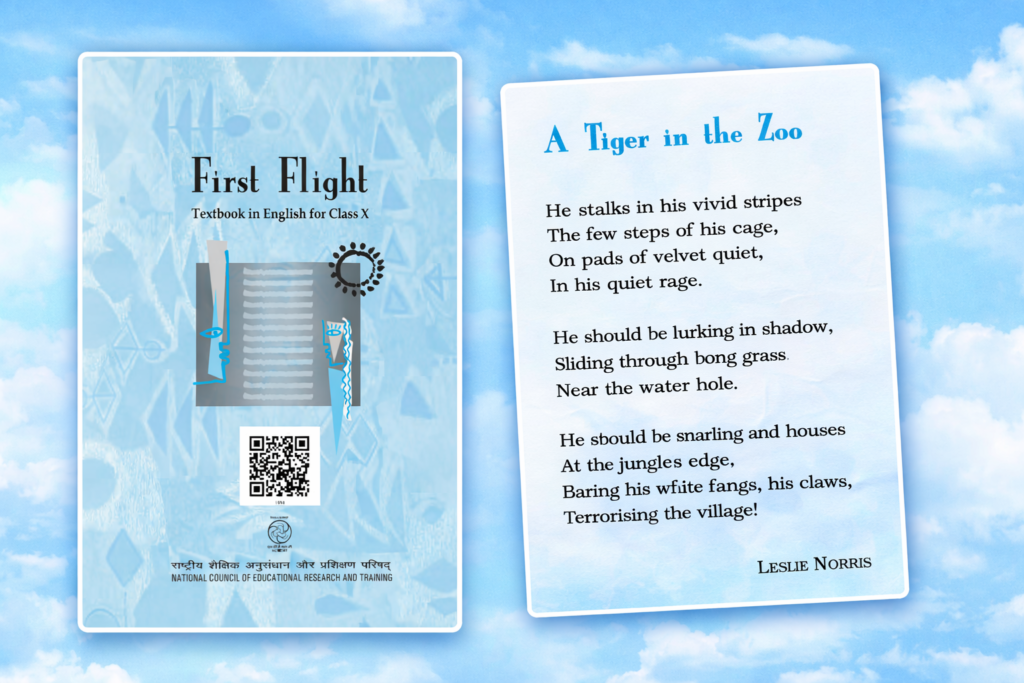
This page helps Class 10 students understand A Tiger in the Zoo summary clearly and prepare confidently for CBSE exams. It includes a simple explanation of the poem, A Tiger in the Zoo summary Class 10 question answers, extra questions, and exam-focused notes. You will also find a clear breakdown of the a tiger in the zoo central idea and theme, along with stanza-wise explanation to support better understanding. Important points like poetic devices, writer details, and key meanings are covered in student-friendly language, making this page useful for revision, practice, and last-minute exam preparation.
Table of Contents
A Tiger in the Zoo Summary
English summary
Have you ever seen a powerful wild animal trapped behind bars and felt something was wrong? Imagine a tiger meant to rule forests, now walking the same few steps again and again. This poem pulls you into that moment and makes you feel the tiger’s silent anger and lost freedom.
The poem shows a sharp contrast between a tiger in a zoo and a tiger in the wild. It begins with the tiger trapped in a cage, moves into what his life should have been like in the jungle, and then returns to the zoo again. By the end, the conflict between freedom and captivity is clear, with no escape for the tiger.
The poem opens inside a zoo, where the tiger moves slowly in his cage. He walks back and forth, taking only “the few steps of his cage,” his body covered in vivid stripes. His feet fall softly on “pads of velvet quiet,” but inside him there is anger. The poet describes this as “his quiet rage.” The tiger looks calm from the outside, but his repeated movement shows frustration. He is powerful, yet his power has no use here. The narrow space controls every step he takes, turning a fierce hunter into a restless prisoner.
The poem then shifts to what the tiger’s life should have been like in the jungle. Instead of pacing behind bars, he should be “lurking in shadow,” moving silently through “long grass” near a water hole. This is where deer come to drink, and where the tiger would naturally hunt. He should also be roaming near villages at the edge of the jungle, snarling and showing his sharp teeth and claws. The poet imagines him “terrorising the village,” not as a villain, but as a true wild animal living his natural role. These lines show strength, danger, and freedom. The tiger belongs to open land, darkness, and movement, not walls and bars.
But this freedom is only imagined. The poem returns to the harsh reality of the zoo with a sudden turn: “But he’s locked in a concrete cell.” The tiger’s strength is now “behind bars.” Once again, he walks the length of his cage, repeating the same path. Visitors come to look at him, but he ignores them. Their presence means nothing to him. They can watch, but they cannot understand his loss. The concrete walls and iron bars cut him off completely from the world he belongs to.
In the final moments, night falls over the zoo. The tiger hears “the last voice at night” and the sound of “patrolling cars.” These noises remind him that humans control even the night. He lifts his eyes and looks at the sky, staring “with his brilliant eyes / At the brilliant stars.” The stars are free and far away, shining in the open sky, while the tiger remains trapped below. The poem ends quietly, but the feeling is strong. The tiger is awake, aware, and imprisoned, with freedom visible but unreachable.
Tiger – powerful and silent – the main figure whose captivity highlights the loss of freedom.
Zoo guards and visitors – controlling presence – represent human authority and confinement.
The poem teaches you that freedom is a natural right, especially for wild creatures. It shows how captivity can crush strength and spirit without making a sound. By the end, you are reminded that beauty and power lose meaning when they are locked behind bars.
A Tiger in the Zoo Summary in Hindi
क्या तुमने कभी किसी ताकतवर जंगली जानवर को सलाखों के पीछे बंद देखा है और महसूस किया है कि कुछ बहुत गलत है? ज़रा सोचो, जंगलों पर राज करने वाला बाघ, जो अब बार-बार उसी छोटी सी जगह में कुछ ही कदम चल रहा है। यह कविता तुम्हें उसी पल में खींच ले जाती है और बाघ के भीतर छिपे गुस्से और खोई हुई आज़ादी को महसूस कराती है।
यह कविता चिड़ियाघर में बंद बाघ और जंगल में रहने वाले बाघ के बीच तेज़ विरोध दिखाती है। कविता की शुरुआत पिंजरे में कैद बाघ से होती है, फिर यह बताती है कि जंगल में उसका जीवन कैसा होना चाहिए था, और अंत में फिर से चिड़ियाघर में लौट आती है। अंत तक आते-आते आज़ादी और कैद के बीच का टकराव साफ हो जाता है, जहाँ बाघ के पास कोई रास्ता नहीं बचता।
कविता की शुरुआत चिड़ियाघर के भीतर होती है, जहाँ बाघ अपने पिंजरे में धीरे-धीरे चलता है। वह आगे-पीछे टहलता रहता है, बस “अपने पिंजरे के कुछ ही कदम” चलता हुआ। उसका शरीर चमकीली धारियों से भरा है। उसके पंजे “मखमली खामोशी वाले पैड्स” पर धीरे से पड़ते हैं, लेकिन उसके भीतर गुस्सा भरा है। कवि इसे “उसका शांत गुस्सा” कहता है। बाहर से बाघ शांत लगता है, लेकिन उसकी बार-बार की चाल उसकी बेचैनी दिखाती है। वह ताकतवर है, फिर भी यहाँ उसकी ताकत किसी काम की नहीं। तंग जगह उसके हर कदम को बाँध देती है और एक खूँखार शिकारी को बेचैन कैदी बना देती है।
इसके बाद कविता उस जीवन की ओर मुड़ती है जो बाघ को जंगल में जीना चाहिए था। सलाखों के पीछे घूमने की जगह, उसे “छाया में छिपकर” रहना चाहिए था और लंबी घास के बीच से चुपचाप फिसलते हुए पानी के गड्ढे के पास जाना चाहिए था। वहीं हिरण पानी पीने आते हैं और वहीं बाघ स्वाभाविक रूप से शिकार करता। उसे जंगल के किनारे बसे गाँवों के पास घूमना चाहिए था, दहाड़ते हुए, अपने नुकीले दाँत और पंजे दिखाते हुए। कवि कल्पना करता है कि वह “गाँव में आतंक फैलाता,” किसी खलनायक की तरह नहीं, बल्कि अपने प्राकृतिक रूप में जीते हुए एक जंगली जानवर की तरह। ये पंक्तियाँ ताकत, खतरे और आज़ादी को दिखाती हैं। बाघ खुली ज़मीन, अँधेरे और आज़ाद गति के लिए बना है, न कि दीवारों और सलाखों के लिए।
लेकिन यह आज़ादी सिर्फ कल्पना है। कविता अचानक मोड़ लेकर चिड़ियाघर की कठोर सच्चाई पर लौट आती है: “लेकिन वह कंक्रीट की कोठरी में बंद है।” अब बाघ की सारी ताकत “सलाखों के पीछे” कैद है। वह फिर से अपने पिंजरे की लंबाई में चलता है, वही रास्ता दोहराता हुआ। लोग उसे देखने आते हैं, लेकिन वह उन्हें नज़रअंदाज़ करता है। उनकी मौजूदगी उसके लिए कुछ भी नहीं है। वे उसे देख सकते हैं, लेकिन उसका दर्द नहीं समझ सकते। कंक्रीट की दीवारें और लोहे की सलाखें उसे पूरी तरह उस दुनिया से काट देती हैं, जहाँ वह होना चाहिए था।
आख़िरी पलों में चिड़ियाघर पर रात उतर आती है। बाघ “रात की आख़िरी आवाज़” और “गश्त करती गाड़ियों” की आवाज़ सुनता है। ये आवाज़ें उसे याद दिलाती हैं कि इंसान रात पर भी काबू रखते हैं। वह अपनी आँखें उठाकर आसमान की ओर देखता है और “अपनी चमकदार आँखों से / चमकते तारों को” निहारता है। तारे आज़ाद हैं, बहुत दूर हैं, खुले आसमान में चमक रहे हैं, जबकि बाघ नीचे कैद ही रहता है। कविता शांति से खत्म होती है, लेकिन असर गहरा है। बाघ जाग रहा है, सब समझता है, और कैद में है—आज़ादी सामने दिखती है, पर पहुँच से बाहर।
बाघ – ताकतवर और शांत – मुख्य पात्र, जिसकी कैद आज़ादी के नुकसान को दिखाती है।
चिड़ियाघर के पहरेदार और दर्शक – नियंत्रण रखने वाली मौजूदगी – इंसानी सत्ता और कैद का प्रतीक।
यह कविता तुम्हें सिखाती है कि आज़ादी एक प्राकृतिक अधिकार है, खासकर जंगली जीवों के लिए। यह दिखाती है कि कैद बिना शोर किए ताकत और आत्मा को तोड़ सकती है। अंत में, तुम्हें याद दिलाया जाता है कि जब सुंदरता और शक्ति को सलाखों के पीछे बंद कर दिया जाता है, तो उनका अर्थ ही खो जाता है।
Keywords with Meanings
Tiger – The wild animal shown both in the zoo and in the jungle.
Zoo – The place with cages where the tiger is kept.
Jungle – The tiger’s natural home with grass, water, and animals.
Cage – The small, closed space in the zoo where the tiger walks.
Concrete cell – The hard, man-made room that locks the tiger in.
Bars – The iron rods that stop the tiger from going out.
Stripes – The tiger’s vivid lines on his body that make him stand out.
Stalks – The way the tiger walks slowly and carefully, like a hunter.
Velvet pads – The tiger’s soft paws that make no sound.
Quiet rage – The tiger’s silent anger that he keeps inside.
Lurking – Hiding and waiting in shadows to attack.
Shadow – The dark, hidden place where the tiger should be.
Long grass – The tall jungle grass that hides the tiger.
Water hole – The small water place where animals come to drink.
Plump deer – The fat, healthy deer the tiger wants to hunt.
Snarling – Making an angry, warning sound with teeth showing.
White fangs – The tiger’s sharp white teeth used for hunting.
Claws – The tiger’s sharp nails used to catch prey.
Village – The group of houses near the jungle that he can scare.
Terrorising – Spreading fear among the villagers.
Strength – The tiger’s power and energy held inside his body.
Visitors – The people who come to see the tiger in the zoo.
Patrolling cars – The vehicles moving around to guard the area.
Brilliant eyes – The tiger’s bright, shining eyes full of life.
Brilliant stars – The bright stars in the night sky he looks at.
Important Phrases in the Poem
“He stalks in his vivid stripes”
“The few steps of his cage”
“On pads of velvet quiet”
“In his quiet rage”
“He should be lurking in shadow”
“Sliding through long grass”
“Near the water hole”
“Where plump deer pass”
“He should be snarling around houses”
“At the jungle’s edge”
“Baring his white fangs, his claws”
“Terrorising the village!”
“But he’s locked in a concrete cell”
“His strength behind bars”
“Stalking the length of his cage”
“Ignoring visitors.”
“He hears the last voice at night”
“The patrolling cars,”
“And stares with his brilliant eyes”
“At the brilliant stars.”
A Tiger in the Zoo Summary Class 10 Question Answers
Text based questions and answers
Q1. Read the poem silently once, and say which stanzas speak about the tiger in the zoo, and which ones speak about the tiger in the jungle.
Answer: Stanzas 1, 4, and 5 describe the tiger in the zoo: stalking in his cage, locked in a concrete cell, ignoring visitors, and staring at stars.
Stanzas 2 and 3 show the tiger in the jungle: lurking in shadow, sliding through grass, and snarling near villages.
This clear split helps us see the poet’s contrast between captivity and freedom right away.
Q2. Read the poem again, and work in pairs or groups to do the following tasks.
Answer: (This is an instruction for activity; students should read and discuss in groups as directed.)
(i) Find the words that describe the movements and actions of the tiger in the cage and in the wild. Arrange them in two columns.
Answer:
In the cage In the wild
stalks lurking
stalking the length sliding
ignoring visitors snarling
stares baring his fangs/claws
hears terrorising
These words show the tiger’s limited, quiet moves in the cage versus his free, fierce actions in the wild.
(ii) Find the words that describe the two places, and arrange them in two columns.
Answer:
Zoo/Cage Jungle/Wild
cage shadow
concrete cell long grass
bars water hole
length of his cage jungle’s edge
patrolling cars village
The zoo words feel hard and trapped, while jungle words paint a lively, open world.
Q3. Now try to share ideas about how the poet uses words and images to contrast the two situations.
Answer: The poet uses quiet, restricted words like “few steps of his cage” and “concrete cell” for the zoo to show confinement.
For the jungle, vivid images like “sliding through long grass” and “terrorising the village” create freedom and power.
This word choice makes us feel the tiger’s sadness in captivity and his natural strength in the wild.
Q4. Notice the use of a word repeated in lines such as these: (i) On pads of velvet quiet, In his quiet rage. (ii) And stares with his brilliant eyes At the brilliant stars. What do you think is the effect of this repetition?
Answer: The poet repeats “quiet” in the cage to show the tiger’s silent anger and soft steps, building a tense, trapped feeling.
“Brilliant” repeats for eyes and stars to link the tiger’s sharp gaze with distant freedom, creating hope amid sadness.
Repetition makes these images stick in our minds and deepens the poem’s emotional contrast.
Q5. Read the following two poems — one about a tiger and the other about a panther. Then discuss: Are zoos necessary for the protection or conservation of some species of animals? Are they useful for educating the public? Are there alternatives to zoos?
Answer: Zoos can protect endangered animals from poachers and provide breeding programs, but they often cause stress like in “A Tiger in the Zoo.”
They educate the public by showing wildlife up close, sparking interest in conservation, as seen in the other poems’ caged animals.
Better alternatives include wildlife sanctuaries, national parks, and virtual reality tours that let animals roam freely while teaching us.
This balance saves animals without breaking their spirit.
Q6. Take a point of view for or against zoos, or even consider both points of view and write a couple of paragraphs or speak about this topic for a couple of minutes in class.
Answer: Zoos have good sides: they save rare animals from hunters and let city kids see tigers up close, teaching them to care for nature—like how “A Tiger in the Zoo” shows the tiger’s power even behind bars.
But the bad side hurts more; caged animals like the tiger pace in “quiet rage,” losing their wild spirit in concrete cells, just as the panther in the other poem feels trapped with no world beyond bars.
On balance, zoos are not the best—we should shift to large sanctuaries where animals hunt and roam naturally, plus online videos and parks for education.
This way, we protect species without the sadness of “his strength behind bars,” giving tigers back their jungle freedom.
Grammar based on poem “A Tiger in the Zoo”
1. Fill in the blanks with the correct tense form of the verb given in brackets. Do as directed.
(i) The tiger ______ (stalk) in his vivid stripes every day in the cage.
(ii) He ______ (should be/lurk) in shadow near the water hole in the jungle.
(iii) Yesterday, visitors ______ (come) to see the tiger, but he ignored them.
(iv) At night, the tiger ______ (stare) at the brilliant stars last evening.
(v) If he ______ (be) free, he would terrorise the village.
2. Change the following sentences from Active to Passive Voice. Do as directed.
(i) The tiger stalks the few steps of his cage.
(ii) Visitors watch the tiger in the zoo.
(iii) The poet describes the tiger’s quiet rage.
(iv) Patrolling cars guard the zoo at night.
(v) The tiger ignores the visitors.
3. Change the following into Reported Speech. Do as directed.
(i) The poet says, “He should be lurking in shadow.”
(ii) A visitor said, “The tiger looks angry.”
(iii) The tiger seems to think, “I hear the patrolling cars.”
(iv) Someone asked, “Where do plump deer pass?”
(v) The guard said, “The tiger stares at the stars.”
4. Fill in the blanks with appropriate Articles (a/an/the). Do as directed.
(i) ______ tiger stalks in ______ vivid stripes.
(ii) He should be near ______ water hole.
(iii) ______ concrete cell locks him behind ______ bars.
(iv) ______ long grass hides ______ tiger in jungle.
(v) He stares at ______ brilliant stars with ______ brilliant eyes.
5. Fill in the blanks with correct Prepositions. Do as directed.
(i) The tiger slides ______ long grass near ______ water hole.
(ii) He snarls ______ houses at ______ jungle’s edge.
(iii) His strength is behind ______ bars in ______ concrete cell.
(iv) He hears ______ last voice ______ night.
(v) The tiger lurks ______ shadow ______ plump deer pass.
6. Fill in the blanks with correct Modals (can, should, must, may, might). Do as directed.
(i) The tiger ______ be free in the jungle to hunt deer.
(ii) He ______ lurk in shadow to catch his prey.
(iii) Visitors ______ not disturb the caged animal.
(iv) The tiger ______ terrorise the village if released.
(v) His pads ______ make no sound because they are velvet quiet.
7. Transform the sentences as directed. Do as directed.
(i) The cage is very small. (Use ‘too…to’)
(ii) No tiger is stronger than this one. (Comparative)
(iii) The tiger stalks quietly. (Add a question tag)
(iv) The jungle is his natural home. (Negative)
(v) He ignores visitors. He stares at stars. (Combine using ‘and’)
8. Editing Task: There is an error in each line. Identify and write the correct word. Do as directed.
(i) He stalk in his vivid stripes.
(ii) The tiger should be lurk in shadow.
(iii) He slide through a long grass.
(iv) His strength are behind bars.
(v) He hear a last voice at night.
9. Omission Task: A word is missing in each line. Identify and write the missing word. Do as directed.
(i) Tiger ______ (a/an) vivid stripes.
(ii) He ______ (should be) lurking shadow.
(iii) Plump deer ______ near water hole.
(iv) He locked ______ concrete cell.
(v) Stares ______ brilliant stars.
10. Gap Filling/Cloze Test: Fill in the blanks choosing the correct word from the options given. Do as directed.
The tiger (i) ______ (stalks/stalked) in his cage with (ii) ______ (quiet/quietly) rage. He (iii) ______ (should/must) be sliding through (iv) ______ (long/short) grass where (v) ______ (deer/plump) pass. But he is locked (vi) ______ (behind/in) a concrete cell, ignoring (vii) ______ (visitors/stars). At night, he stares at (viii) ______ (brilliant/patrolling) stars.
11. Voice Change (Passive to Active). Do as directed.
(i) The length of his cage is stalked by the tiger.
(ii) Visitors are ignored by him.
(iii) The village is terrorised by the tiger.
(iv) Stars are stared at by his brilliant eyes.
(v) Plump deer are passed near the water hole.
12. Reported Speech (Statements). Do as directed.
(i) Poet: “He bares his white fangs.”
(ii) Guard: “Patrolling cars are here at night.”
(iii) Visitor: “The tiger has velvet pads.”
(iv) Child: “The jungle has long grass.”
(v) Teacher: “The tiger should be in the wild.”
13. Sentence Reordering: Rearrange the words to form meaningful sentences. Do as directed.
(i) vivid / stalks / stripes / in / his / He
(ii) shadow / lurking / be / should / in / He
(iii) cell / locked / concrete / a / he’s / in
(iv) stars / brilliant / stares / eyes / brilliant / at / He
(v) village / terrorising / the / should / be / He
14. Transform into Negative Sentences. Do as directed.
(i) The tiger stalks in his cage.
(ii) He should be in the jungle.
(iii) Visitors come to the zoo.
(iv) His pads make quiet sounds.
(v) He terrorises the village.
15. Question Formation: Frame questions using the words given. Do as directed.
(i) Where / tiger / should / lurk?
(ii) What / tiger / hear / night?
(iii) Who / ignores / visitors?
(iv) How / tiger / move / grass?
(v) Why / tiger / behind / bars?
Grammar Questions Answers
1.(i) stalks (ii) should be lurking (iii) came (iv) stared (v) were
2.(i) The few steps of his cage are stalked by the tiger. (ii) The tiger is watched by visitors… (iii) The tiger’s quiet rage is described by the poet. (iv) The zoo is guarded by patrolling cars at night. (v) Visitors are ignored by the tiger.
3.(i) The poet says that he should be lurking in shadow. (ii) A visitor said that the tiger looked angry… (iii) The tiger seems to think that he hears the patrolling cars. (iv) Someone asked where plump deer passed. (v) The guard said that the tiger stared at the stars.
4.(i) The / his (ii) the (iii) a / the (iv) the / the (v) the / his
5.(i) through / the (ii) around / the (iii) bars / a (iv) the / at (v) in / where
6.(i) should (ii) should (iii) must (iv) might (v) can
7.(i) The cage is too small to walk freely. (ii) This tiger is the strongest. (iii) The tiger stalks quietly, doesn’t he? (iv) The jungle is not his natural home. (v) He ignores visitors and stares at stars.
8(i) stalk → stalks (ii) lurk → lurking (iii) a → through (iv) are → is (v) hear → hears
9.(i) in (ii) in (iii) pass (iv) in (v) with/at
10.(i) stalks (ii) quiet (iii) should (iv) long (v) deer (vi) in (vii) visitors (viii) brilliant
11.(i) The tiger stalks the length of his cage. (ii) He ignores visitors. (iii) The tiger terrorises the village. (iv) His brilliant eyes stare at stars. (v) Plump deer pass near the water hole.
12.(i) The poet says that he bares his white fangs. (ii) The guard said that patrolling cars were there at night. (iii) The visitor said that the tiger had velvet pads. (iv) The child said that the jungle had long grass. (v) The teacher said that the tiger should be in the wild.
13.(i) He stalks in his vivid stripes. (ii) He should be lurking in shadow. (iii) He’s locked in a concrete cell. (iv) He stares at brilliant stars with brilliant eyes. (v) He should be terrorising the village.
14.(i) The tiger does not stalk in his cage. (ii) He should not be in the zoo. (iii) No visitors come to the zoo. (iv) His pads do not make loud sounds. (v) He does not terrorise the village.
15.(i) Where should the tiger lurk? (ii) What does the tiger hear at night? (iii) Who ignores the visitors? (iv) How does the tiger move in grass? (v) Why is the tiger behind bars?
Extra Questions and Answers
Short Answer Questions
Q1. What does the tiger do in his cage?
Answer: The tiger stalks in his vivid stripes for the few steps of his cage.
He moves on pads of velvet quiet, showing his quiet rage.
Later, he stalks the length of his cage, ignoring visitors.
Q2. Where should the tiger be according to the poet?
Answer: He should be lurking in shadow, sliding through long grass near the water hole.
He should be where plump deer pass, ready to hunt.
This shows his natural wild life, not the cage.
Q3. How does the tiger behave at night?
Answer: He hears the last voice at night and the patrolling cars.
Then he stares with his brilliant eyes at the brilliant stars.
This image shows his longing for freedom beyond the bars.
Q4. What contrast does the poet make between the zoo and jungle?
Answer: Zoo: concrete cell, bars, few steps, ignoring visitors.
Jungle: long grass, water hole, snarling near houses, terrorising village.
The poem moves from cage to wild and back to show trapped life vs free life.
Long Answer Questions
Q1. Describe the tiger’s life in the zoo with examples from the poem.
Answer: In the zoo, the tiger stalks only the few steps of his cage on pads of velvet quiet, hiding his quiet rage inside.
He is locked in a concrete cell with his strength behind bars, stalking the length of his cage and ignoring visitors who come to see him.
At night, he hears the last voice and patrolling cars, then stares at brilliant stars with his brilliant eyes, dreaming of freedom.
These details paint a picture of a powerful animal reduced to pacing in a small space, feeling trapped and silent.
Q2. Explain the symbolic meaning of the tiger staring at the stars.
Answer: The tiger stares with his brilliant eyes at the brilliant stars, linking his sharp gaze to the distant, free sky above the cage.
This repetition of “brilliant” shows his inner fire and hope, contrasting his caged body on earth.
It symbolises his spirit reaching for wild freedom, even as bars hold him, making us feel his quiet longing.
The image ends the poem on a sad yet powerful note of unbroken wildness.
Extract Based Questions
Extract: He stalks in his vivid stripes / The few steps of his cage, / On pads of velvet quiet, / In his quiet rage.
Q1. What do “vivid stripes” and “pads of velvet quiet” describe?
Answer: “Vivid stripes” describe the tiger’s bright, colourful body markings.
“Pads of velvet quiet” describe his soft paws that make no sound.
Both show his beauty and stealth even in the cage.
Q2. What is “quiet rage” in this stanza?
Answer: “Quiet rage” is the tiger’s hidden anger at being caged.
It matches his silent steps, building inner tension.
This phrase captures his trapped power without loud roars.
Extract: He should be snarling around houses / At the jungle’s edge, / Baring his white fangs, his claws, / Terrorising the village!
Q3. What actions show the tiger’s wild nature here?
Answer: Snarling around houses at jungle’s edge shows his fierce presence.
Baring white fangs and claws makes him scary and powerful.
Terrorising the village highlights his role as a feared hunter.
Q4. Why does the poet use “should be” in this extract?
Answer: “Should be” contrasts what the tiger’s real life ought to be in the wild.
It builds regret over his zoo captivity.
The excitement with “!” makes us feel his lost freedom strongly.
FAQs
Q1. What is the central idea of the poem A Tiger in the Zoo?
The central idea of A Tiger in the Zoo highlights the contrast between freedom and captivity.
It shows how a powerful tiger loses dignity and spirit when confined in a zoo.
Q2. How is the tiger described in the first stanza of the poem?
In the first stanza, the tiger is shown pacing inside his cage in vivid stripes.
His soft steps and quiet rage reflect suppressed anger and frustration.
Q3. What does the phrase pads of velvet quiet mean in the poem?
Pads of velvet quiet describes the tiger’s soft paws that make no sound.
It uses metaphor to show his natural grace even while he is imprisoned.
Q4. Why does the poet say the tiger has quiet rage?
The tiger’s rage is quiet because he cannot roar or fight back in captivity.
His anger remains hidden, showing helplessness rather than weakness.
Q5. How is the tiger’s life in the zoo different from his life in the jungle?
In the zoo, the tiger is locked in a concrete cell with no freedom.
In the jungle, he would roam freely, hunt deer, and live as a true wild animal.
Q6. What does the concrete cell symbolize in A Tiger in the Zoo?
The concrete cell symbolizes human control and loss of natural freedom.
It represents how civilization restricts wild life unnaturally.
Q7. Why does the tiger ignore the visitors in the zoo?
The tiger ignores visitors because he feels disconnected and hopeless.
Their presence reminds him of captivity, not comfort.
Q8. What is the significance of the line His strength behind bars?
This line shows that the tiger’s power is useless inside the cage.
It emphasizes wasted strength due to confinement.
Q9. What do the brilliant stars symbolize at the end of the poem?
The brilliant stars symbolize freedom and the vast open world.
They reflect the tiger’s silent longing for a life beyond the bars.
Q10. What message does A Tiger in the Zoo convey about animal captivity?
The poem questions the ethics of keeping wild animals in zoos.
It suggests that captivity destroys natural instincts and inner freedom.
